Forgotten Mother: Class and Race in The Last Prince of Florence
WRITTEN BY ALANA WHITE
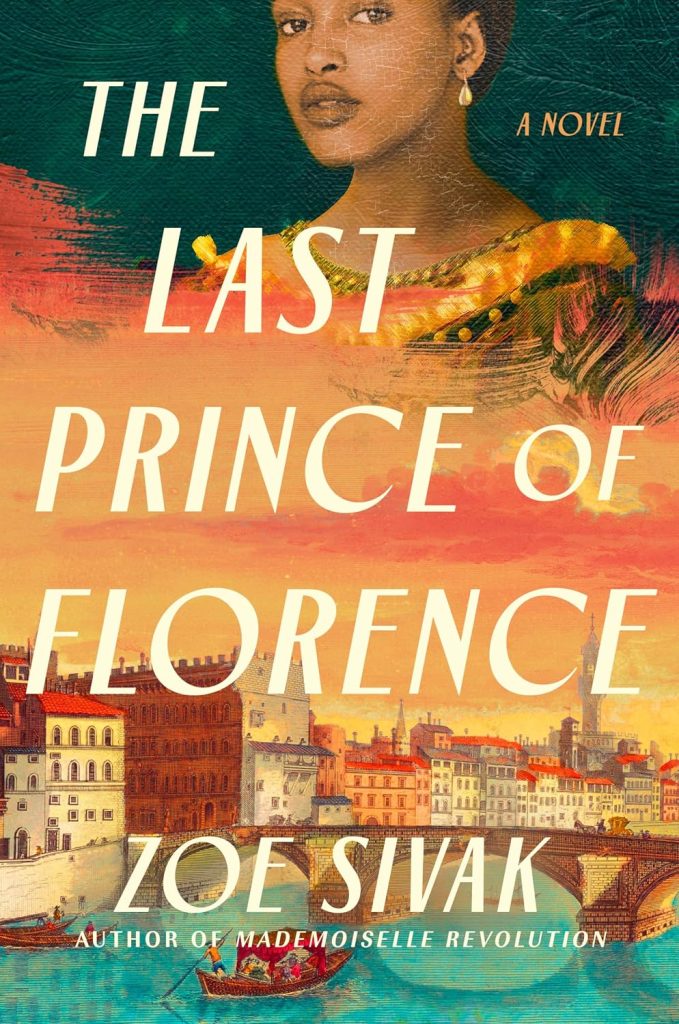
 In 1532, twenty-one-year-old Alessandro de’ Medici rose from uncertain beginnings to become the first Duke of Florence, signaling the fall of Republican Florence. His mother is generally identified as Simonetta da Collevecchio, a woman associated with the Medici household and traditionally believed to have been of African ancestry. While Alessandro would become one of the most controversial figures of the Italian Renaissance, Simonetta left scarcely a trace in the historical record. This silence has given author Zoe Sivak ample room to imagine the Black woman behind the future duke in her new novel, The Last Prince of Florence (Berkley, 2026).
Zoe has previously said she writes about women who could have existed, even though history left them behind. The protagonist of her first book, Mademoiselle Revolution, is a fictional woman. While Simonetta da Collevecchio is different because there is a historical kernel behind her, the woman we encounter in The Last Prince of Florence is largely imagined. Looking back on the origins of the novel, she recalled, “Funnily enough, the first drafts focused on her son and granddaughter: Alessandro and Giulia de’ Medici. But I kept wanting to focus more on Simonetta—especially once I read her letters to her son. A Black servant who could read and write in the first half of 16th Italy? I had so many questions!”
Simonetta is a dark-skinned foundling with no family or legitimate place in society. Rather than accepting marginalization, she becomes fiercely ambitious. By saving the life of Lorenzo de’ Medici (grandson of Lorenzo the Magnificent) she fights her way into the Medici family, plots to become Lorenzo’s mistress, and gives birth to Alessandro in the summer of 1510. The official Medici version presented the child as Lorenzo’s illegitimate son, but many contemporaries and present-day historians suspect Alessandro’s biological father was Lorenzo’s uncle, Giulio de’ Medici, later Pope Clement VII. Zoe addresses the thorny issue of Alessandro’s paternity head-on: Simonetta takes both men as her lovers, so either could be the baby’s father. Simonetta likes, and sometimes loves, them both.
The narrative feels both clear and effortless. As for how she kept history from overwhelming Simonetta’s story—and this is definitely her story, not that of the Medici family—Zoe responded, “Thank you for saying that! One of my favorite sources are digital library archives and academic papers (I love a good thesis). Those resources guide me to ledgers and demographic information, which provide more boots-on-the-ground insight into city living. Based on slaver records, we know that 90% of Florentine enslaved people were women. History is her story too, we just have to look for the right voices (or numbers) instead of military coups and the experience of 0.001% of the population.”
Did Alessandro’s immediate family’s acceptance of him as their heir surprise Zoe, given he was illegitimate and Black? “It didn’t,” she said, “if only because when he came to power, the creation of race hadn’t yet reached its full scale and complexity. What did surprise me was how many indicators of racism I did find. American audiences are more familiar with chattel slavery—a race-based system of human property on an industrial scale. What Europe, and more specifically, Italy, had was different. The lines between slave and servant were much blurrier for many, and enslavement was rarely permanent. Until the mid-fifteenth century, religion rather than race defined who could and couldn’t be sold. Turkic, Slavic, and Caucasus regions were the primary source of enslaved people until the fifteenth century, when Spanish and Portuguese traders began enslaving West Africans.”
Given to the Hospital of the Holy Spirit in Rome as an infant, Simonetta grows up without knowing her mother or why she was abandoned. The maternal relationship Zoe creates with Iye, the scarred African nurse and mentor who takes Simonetta under her wing, is particularly significant to the story. Along with a bronze dagger, Simonetta’s mother gifts her with a handful of cowrie shells. Zoe elaborates, “Cowrie shells have profound meaning to African societies, from actual monetary value to good fortune. Enslaved people smuggled them across oceans and then through generations, woven in hair, clothing, altars, and graves. I wanted Simonetta, someone who cherishes her connection to Edo, to keep them close in the same way someone would a rosary. Eventually, she would sew them into her son, Alessandro’s, sleeves and collars in the same way Iye had done for her. Anyone who has read my previous work, Mademoiselle Revolution, will see them as a motif there as well.”
Simonetta begins life with very little control over her own future. She is determined to gain the security, status and power denied her from birth, and she is willing to lie, cheat, and kill to get it. Ultimately, she wants her son to rule Florence. Not only to survive—Simonetta wants to win. Does Zoe see this as a tale of caution? “I completely agree with this interpretation: Simonetta sees success as reparations of a sort. If she can thrive, or her son, it would make the sacrifices and suffering of her people worth it.”
In Simonetta, Zoe has given a little-known woman a story of her own. When asked about next steps, she replied, “While I can’t share any future work (yet), I encourage readers to explore my previous work, Mademoiselle Revolution, and others who highlight diverse voices,” then added, “it’s hard to distill backstory and circumstances in places and spaces that are well known. But sometimes that is where we can surprise readers the most.”
About the contributor: Alana White is the author of the Guid’Antonio Vespucci historical mystery series set in Renaissance Florence. She lives in Nashville and is the HNS Midsouth Chapter Lead.
Published in Historical Novels Review | Issue 118 (November 2026)