Whitman Days, Opium Nights
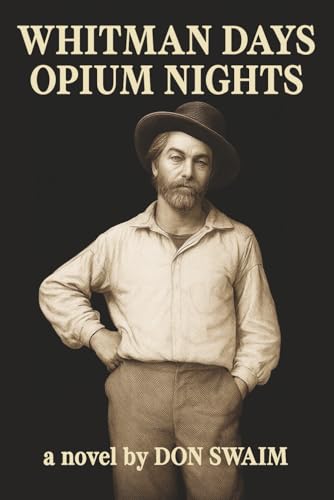
New York City in 1857 comes to life in this novel, with its political corruption, racism, greed, wretchedness—and Walt Whitman, the self-celebrating poet who seems to move in a different realm from the sordid social and political realities of the time and is at risk for that very reason. He’s just published Leaves of Grass, for sale at Fowler and Wells Emporium rather than a regular bookshop. Aaron Renfrew, heir to a once-thriving department store that’s falling on hard times and an aspiring poet himself, becomes inexplicably attached to Whitman, which sends his life on a new track. From the first chapter we know Renfrew, a Union soldier, dies at Antietam in 1862, older than the Irish immigrants he’s fighting beside. What brought him to that final moment?
The seamy side of NYC is fully explored from Renfrew’s point of view. The only child of Phinneas Renfrew, he’s uninterested in the family business other than dressing “manikins” for the windows. On her deathbed his mother made Phinneas promise to continue Aaron’s allowance. He lives on a somewhat limited income, though more than that of his friends, so he covers their bar bills. We see Tammany politicians in action (and learn the curious story of their brotherhood), the corruption of the police, and rivalry between the two forces, municipal police and Metropolitan police, violence in the street and elsewhere with bodies washing up in the river, wanton disregard of human life, moralizing and blatant hypocrisy, and the dangerous, secret lives of Walt Whitman’s “boys.” This novel, skillfully structured and written, depicts the underbelly of the city in vivid detail, at times too noir for the faint of heart. Swaim may be fair to Whitman: his mention in the title is what drew me to this book, but he isn’t the protagonist.