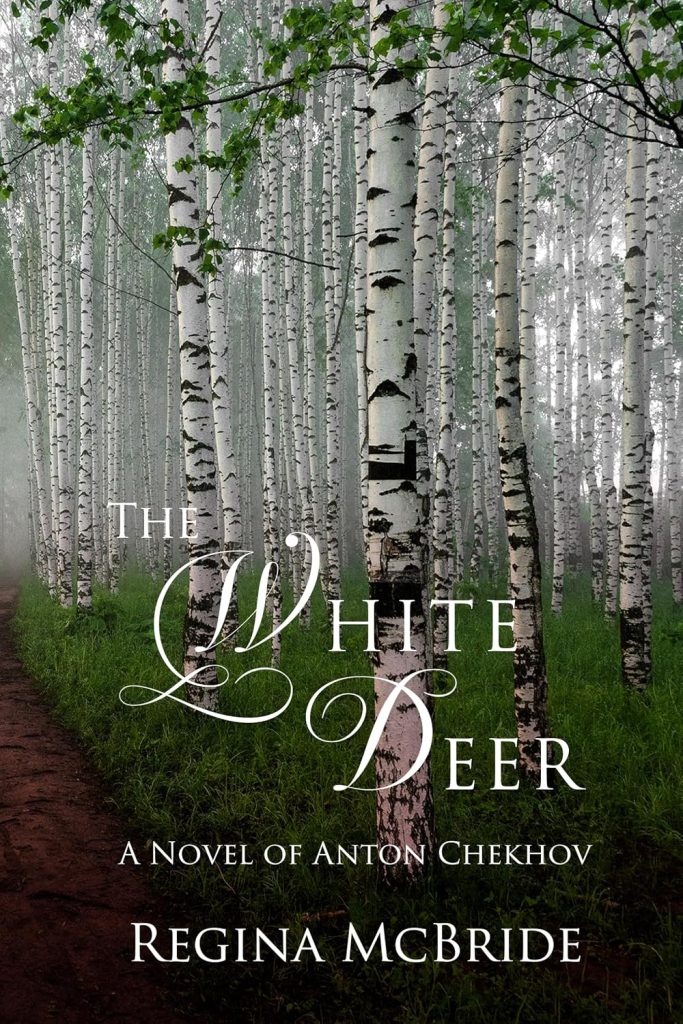
The White Deer
Vera Sergeyevna Denisova grows up on her family’s Ukrainian estate called Volkhov, with extensive unkempt peach orchards. When young, she learns that it’s not true that servants are inferior beings. Her playmate Petya, son of servants, has a remarkable artistic gift even as a small child and understands himself far better than she does herself. This lesson and her love for him frame her future, though she and Petya are separated when they’re fourteen, reconnecting briefly in the summer of 1879 at age nineteen. Petya departs for an art apprenticeship she helped arrange for him, and soon after Vera meets Anton Chekhov. Nineteen as well, Anton is staying at a doctor’s home near Volkhov waiting for medical school to begin in Moscow in the autumn. While her family is hosting their annual summer house party which they can ill afford, Vera and Anton form a friendship that in a sense grows out of Vera’s earlier love for Petya. Set against the oysters and champagne, the backstabbers and the ill-mannered and the aspiring among the guests, Anton and Vera are movingly authentic.
The White Deer delivers an insightful depiction of Chekhov in a beautifully evocative story, with sensory details that create a sense of nostalgia for a way of life that’s outliving itself. This saga of a grand estate deteriorating through poor management, careless spending, and impractical ideas reads like a Russian novel, and the cast of characters belong there—or in a Chekhov play. Like Petya, Anton Chekhov forges a new path, and encourages Vera to do the same. Vera’s mother’s connection to Siberian magic adds a mysterious element to the story. This rich, fulfilling book will appeal to literature-lovers and any reader who wants to be enchanted back to a long-lost era.