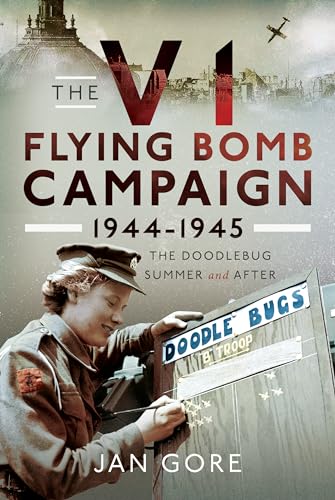
The V1 Flying Bomb Campaign 1944-1945: The Doodlebug Summer and After
‘The Blitz’ has become part of the British national myth. Between September 1940 and May 1941, fleets of conventional aircraft bombarded London and other British cities in mass raids. Hundreds of books have been written about it, usually celebrating the fortitude of the civilian population, particularly in London’s East End.
In contrast, the missile bombardment of London by flying bombs (V1s) and rockets (V2s) from July 1944 to the end of the war, nine months later, has never been romanticised in the same way, although, as Gore explains in great detail, it was enormously destructive in lives and property. It lacked the drama of the mass raids and demanded a more individualistic response from the population. The missiles came without warning day and night, scattered at random across London and its environs.
Gore is strong on the facts, but despite the numerous short first-hand accounts, we get little feel for life under this novel form of attack. Also, she tries to describe the V1 raids separately from the V2s, whereas both missiles were used simultaneously and carried similar payloads. Indeed she often finds it difficult to ascribe an ‘incident’ to one weapon rather than another. They were very much a single V-bomb campaign.
There was a single raid on northern England on Christmas Eve 1944 which scattered bombs from Durham to Shropshire, to which Gore devotes an interesting chapter. She also includes an account of the bombardment of Antwerp and surrounding areas by both V1s and V2s in late 1944.
In all, this is a useful account of an overlooked episode which presaged a new form of aerial warfare which was now becoming the norm.