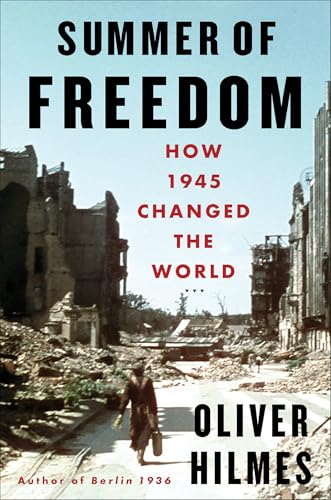
Summer of Freedom: How 1945 Changed the World
Much has been written about WWII, but Hilmes’s slim book focuses specifically on the summer months of 1945, after Germany surrendered to the Allied forces. It was a time of great relief and joy, though tempered with the realization that the road to recovery and normalcy would be a long one. Cities across Europe bore the scars of German bombs, surviving friends and family were scattered and difficult to find, and food was scarce. Presented as a series of vignettes set in Germany, France, Japan, and the Soviet Union, the book offers a glimpse into life immediately after the war.
Although arranged chronologically, the book’s sections feel disjointed. Due to their brevity, the longest running a few pages and the shortest only a single sentence, the reader is quickly whisked from one story and location to the next. Some events and figures receive multiple sections, so their stories are continued, but others stop abruptly and are never mentioned again. Perhaps this was the author’s intent and symbolizes the post-war chaos, but it is disorienting to the reader. Major figures like Churchill, Truman, and Stalin and their roles in the Potsdam Conference appear. But the most interesting are the heartbreaking stories of everyday people like Margot Bendheim and Adolf Friedlander, a couple who met and married at the Theresienstadt concentration camp and stayed for weeks after their release because they believed all of their family had been killed and they had nowhere else to go.