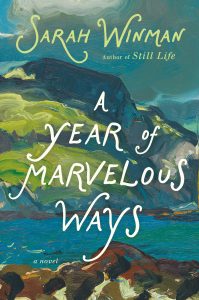
Magic when you least expect it: A Year of Marvelous Ways by Sarah Winman
 BY MARILYN PEMBERTON
What comes first, the plot, character or location?
For Sarah Winman, ‘Characters always come first … but place is also extremely important.’ Winman believes that ‘What place does is to show a character something they would never have encountered elsewhere. Or it reveals an aspect of the character that they wouldn’t have discovered in themselves elsewhere … When I encountered St-Just-in-Roseland in the Roseland Peninsula in Cornwall I found it an entrancing and bewitching place. It is a tidal muddy creek off the River Fal that has both a church and a boathouse. I simply asked the question – who would live here? The landscape answered,’ and Marvelous Ways was born.
Marvelous Ways –protagonist of Winman’s novel A Year of Marvelous Ways (Putnam, June 2026) – is eighty-nine years old and lives in a caravan by a creek in Cornwall, ‘outside the community as most “witches” or midwives did back in the day’ waiting for something, but she’s not sure what; she’ll know it when she sees it or him. Francis Drake, a soldier broken in heart and spirit after World War II comes out of the sea and is taken under her wing and, as Sarah Winman explains, ‘meets what he needs – healing and compassion and forgiveness.’
A Year of Marvellous Ways was first published in Great Britain (Tinder Press, 2015) and is now being released for the U.S. market, with appropriate changes to the spellings. The names of the characters in the book (Marvelous, Drake, Paper Jack, Peace) all ‘matter’ to Winman. She remembers how, when she was with her mother in hospital for a checkup, ‘A Nigerian nurse called out her name and we went with her. The nurse said to my mum, Why aren’t you called Winwoman? Neither my mum or I could answer this question. And she said, You have to understand, I come from a place where names matter. And I never forgot it, and I thought, OK – all these characters need “names that matter.” Even if it’s a burden. In some ways it will define them – but will also lead them to a form of truth and discovery. I also wanted names that felt incongruous to the time in which I’d placed the story.’
The characters, however, are not fully formed before Winman starts writing. ‘They grow as I write them. Through circumstance, through dialogue, through interaction. Everyone is seeking to be healed ultimately, not that they necessarily know it. But they are drawn to a place that makes this possible. Everyone is an outsider seeking connection.’

author photo by Patricia Niven
The characters are fictional, not so the place. Winman explains that ‘I know Cornwall pretty well, because I met it during childhood. My grandparents moved to Cornwall when I was five, so it has always played a huge part in my life. It is a magical peninsula, full of stories and myths and ancient saints and standing stones. You are never more than twenty miles from the sea, so the salt and sea mist become part of you when you are there. Your complexion changes. Your heart expands. You notice the clouds more, and how light moves across the waves and the meadows. You are drawn into the mystery of the place, and cannot help but be altered by it.’
Winman did have to do some research of ‘what was happening in Cornwall during this time. Learning about mining, about Cornwall’s role in D-Day landings. About the famous Eddystone lighthouse. About the seaports, about the role of women when there was no health service. When I knew what was what, then I could move the characters around that space and time and allow them to react to it.’
There is magic in the countryside and magic in Marvelous’s life, for wasn’t her mother a mermaid? ‘From the moment she tells Drake that her mother was a mermaid, we as readers know that we are entering the world of enchantment and make-believe. Drake comes to believe in the other – or chooses to believe – because his life gradually becomes richer for it.’ For Winman, the mermaid ‘represents the Great Mother. She is also Marvelous’ actual mother – a biracial woman who was brought over from America and lived as an outcast. It’s Marvelous’ father who tells Marvelous that her mother was a mermaid, and does so out of love. So that she grew up believing her mother to be unique and powerful and mystical, rather than how society, at the time, wanted to define her.’
Ultimately, Winman would ‘just like the reader to think this was an enjoyable story. That not everything is so clear in life and there is magic when you least expect it. Let’s open our eyes to the mystery. To the love of storytelling and the nature of healing through connection and words.’
About the contributor: Marilyn Pemberton has a passion for fairy tales that subvert and challenge social mores. Victorian fairy-tale writer Mary De Morgan was the subject first of a biography, then a fictionalised life in The Jewel Garden. Marilyn has published four novels from her historical series, Grandmother’s Footsteps, which include her own fairy tales as a means of critiquing the society in which her female protagonists live. Marilyn has also published two stand-alone historical novels, Sold for a Song and Under the Eye.