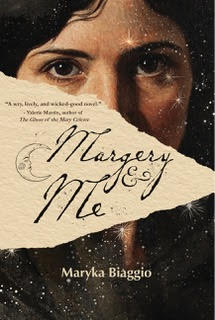
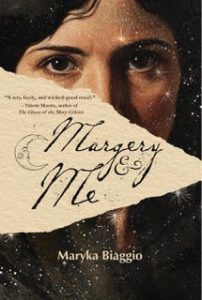
Launch: Maryka Biaggio’s Margery & Me
INTERVIEWED BY MARTHA HOFFMAN
Maryka Biaggio is a psychology professor-turned-novelist who brings forgotten lives back into the light. Her work has earned numerous accolades, including the Willamette Writers Award, Oregon Writers Colony Award, Historical Novel Society Review Editors’ Choice, La Belle Lettre Award, and a Publishers Weekly pick. Biaggio is celebrated for illuminating overlooked historical figures with psychological depth and narrative grace.
 How would you describe this book and its themes?
Margery & Me is based on the true story of 1920s psychic Margery Crandon, who astounded her followers and confounded scientists and magician Harry Houdini. Would Houdini be her undoing?
What drew you to this subject?
I write historical fiction about real people, and I found Margery Crandon’s story irresistible. It has so much intrigue—a reluctant medium who loses a brother she was close to, appearances by such luminaries as Sir Arthur Conan Doyle and Harry Houdini, the battle between science and the belief in the supernatural, and Margery’s rise from farmer’s daughter to high society wife.
Tell us about the research for this book. It seems like you had a fair number of primary sources to draw from.
I started with David Jaher’s nonfiction book The Witch of Lime Street, which is focused largely on Margery’s story but also explores the spiritualism movement that took hold after the devastating losses of World War I and the influenza epidemic. I consulted a few other nonfiction books, because I wanted this novel to hew closely to the real events—including the séances Margery held and the contest that led to her epic battle with Harry Houdini. I also read the actual Scientific American prize committee conclusions, some of which ended up in the novel.
Are any of your characters not historical figures?
All the characters are historical figures, although I did use some composite characters in the latter chapters to avoid overwhelming the reader with the many and varied scientists who studied Margery.
I’m assuming that your descriptions of séances were drawn from firsthand accounts. It’s interesting that attendees were not expecting to contact loved ones as much as witnessing psychic manipulation of objects, blowing horns, turning on Victrolas, etc. Was that typical of séances at that time?
All the effects I represented at Margery’s séances were recorded contemporaneously by people who had witnessed them. I didn’t need to stretch the truth or invent phenomena to astound the reader: A live dove was really conjured, clocks outside the séance room stopped, and roses and a megaphone floated about.
Although most séances of that period were focused on contacting loved ones, Margery’s séances were different. She never charged people to attend, unlike most spiritualists at the time. She became something of a celebrity in Boston, and invitations to her séances were prized by Bostonians and celebrities who came to call on her. Walter and his antics were the main attraction. So she was unusual in these respects compared to typical mediums of the day.
Writing the novel with a ghostly narrator certainly puts the book itself on a particular side of the debate over the veracity of Margery Crandon’s psychic skills. Do you yourself have an opinion about her gifts or was this just a fun concept for you to work with?
I wanted readers who were believers as well as skeptics to enjoy the novel, so I carefully and intentionally designed the narrative to appeal to both. Readers can draw their own conclusions as they go along, witnessing the effects that Margery produced and the tests that the scientists subjected her to.
Still, I understand that readers of today will generally not believe in ghosts and voices from the beyond. But in the 1920s there were many true believers, and I wanted to convey this in the novel—by showing Sir Arthur Conan Doyle’s strong belief in spiritualism and his promotion of Margery’s mediumship and by highlighting the reasons why Scientific American staged a contest for psychics. The scientists on the journal’s board were very serious about settling the public debate about psychics once and for all, assigning respected scientists and Harry Houdini to the examining committee and offering a sizeable cash prize to any psychic who could demonstrate bona fide supernatural phenomena.
How did your choice of narrator shape this story?
While I’m doing preliminary research and sketching some of the scenes, I typically spend weeks, sometimes months, searching for the “right” voice for the novel. I wait until a character starts speaking to me to actually settle on the narrator. And it was Walter who first spoke to me, and I found his salty repartee compelling and amusing. Having grown up with three boisterous brothers, it was not all that difficult for me to write from Walter’s perspective. In fact, once I got going, Walter happily took over the story.
Is it important to you as a writer to visit the places where your stories are set?
Not necessarily, although I take great care to research the places. I have visited Boston, but it was a long time ago—well before I started writing this novel. Still, I make sure that the places I include in my novels were in existence at the time.
It’s actually more important to me to capture the language and customs of the period I’m writing about. So I often read novels written at the time as well as newspaper articles to help me capture turns of phrase and dialogue that will ring true to the people and place. I want readers to feel as if they’re truly immersed in the time.
 Is there a specific building or object within the story that means a lot to you? Why?
Margery and Dr. Crandon resided at 10 Lime Street, an imposing Victorian home in the stately Back Bay neighborhood, replete with curious closets, cubbyholes, blind shaftways, and two flights of back stairs. Margery’s séances took place in the room on the fourth floor. It was a cozy room stocked with a specially designed table, a Victrola, a red lantern, and thick chintz curtains. From its windows, one could see the Charles River and the neighborhood’s twinkling gas lamps. So much magic happened there!
What is the best writing advice you have to share?
Develop the habit of writing regularly and then keep at it, not worrying about how rough initial drafts may be: Persistence is absolutely necessary when it comes to drafting the long-form novel.
What is the last great book you read?
Foster by Claire Keegan

HNS Sponsored Author Interviews are paid for by authors or their publishers. Interviews are commissioned by HNS.