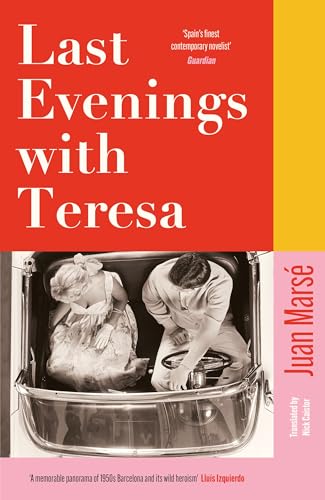
Last Evenings with Teresa
Juan Marsé’s exploration of class division in 1950s Barcelona, first published in 1966, has only just been translated into English, opening a wider audience to the enjoyment of this fabulous novel.
The prologue opens with a young couple walking through deserted Barcelona streets in the early hours of the morning. A forlorn wind swirls confetti around them, the remnants of the Fiesta Mayor, and we feel a poignant sadness as the world of festivity recedes and the world of normality returns.
We then follow the story of the young couple: Manolo Reyes – the Murcian, the Interloper, an unbelievably handsome petty thief; and Teresa Serrat – beautiful, privileged only child of a wealthy Catalan family, dangerously involved in left-wing politics at Barcelona University. As their two worlds collide, an absorbing story unfolds, and illusions and dreams are challenged. Manolo secretly believes he may be the illegitimate child of a marquis; Teresa nurtures an overly idealistic image of the working classes and the nobility of labour. In their passionate relationship, they come to learn from each other.
Marsé’s writing is poetic and lyrical (and beautifully translated). The narrative is cleverly constructed with movements between past and present, hints of the future and stylishly handled perspectives, including occasional passages of ‘stream of consciousness’. The clash of cultures – the peasant world of the Andalusian south with the world of wealthy Catalan elites – is well-handled, and Marsé’s mockery of left-wing student pretensions is excellent. Fifteen years after the fall of the Republic, its influence can still be felt: Pictures of Karl Marx and copies of Madame Bovary moulder in the corners of a former library now used as a dance hall.
This is a remarkable novel of ideas and character, capturing an authentic feel of post-war Barcelona and of a febrile, unsettled society in flux. Very highly recommended.