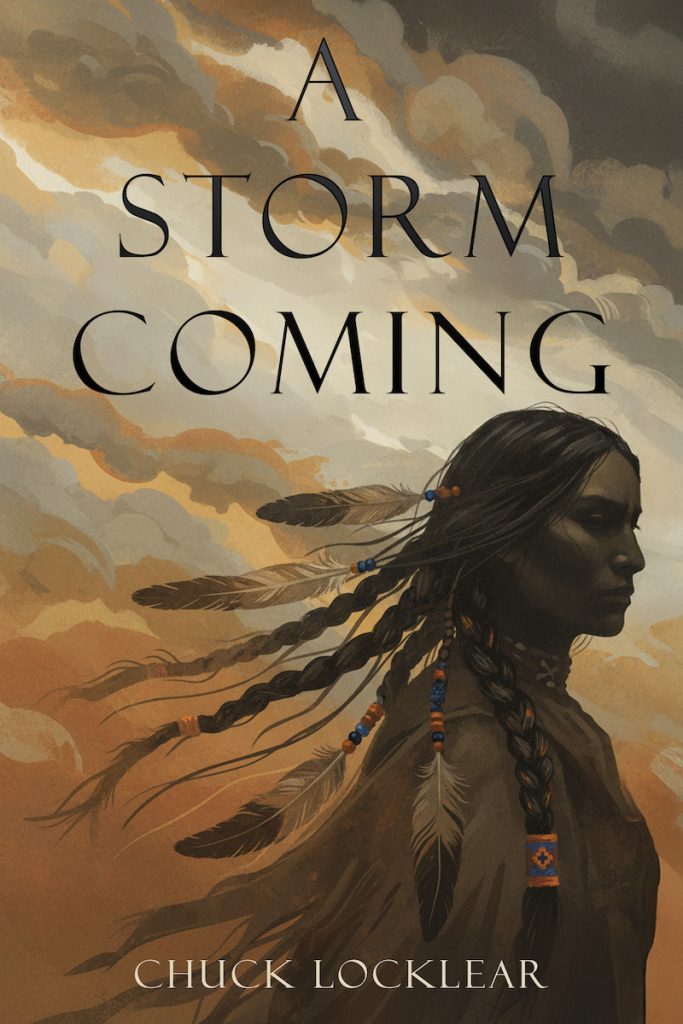
Launch: Chuck Locklear’s A Storm Coming
INTERVIEWED BY MALLY BECKER
Chuck Locklear is a retired educator, seasoned speaker, and longtime blogger. He holds a master’s degree in Curriculum, Instruction, and Leadership, and brings more than thirty years of experience as a teacher, administrator, magazine publisher, and motivational speaker. He now serves as pastor of WarrenHope in Warren, Michigan.
A proud member of the Lumbee Tribe of North Carolina—the largest Native American tribe east of the Mississippi—Chuck draws on his heritage in his writing.
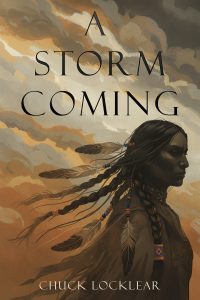 How would you describe your book and its themes in a few sentences?
A seventeen-summers-old Tuscarora woman, Runehu’hu, is unflinching until a handsome yet mysterious stranger arrives, recruiting allies to fight the English. She hopes for a wedding proposal, but he recruits her to spy against her own people instead. Runehu’hu—which means turtledove—reluctantly accepts her English name, Jane, “…just one syllable, plain.” It is a story about forbidden love, survival, and redemption.
What inspired you to write A Storm Coming?
A Storm Coming is the fictionalized account of my 7x great-grandmother. I’ve been researching this story my entire life. I am a member of the Lumbee tribe of North Carolina, but I didn’t learn where my blond hair and blue eyes came from until I was forty. It turns out my great-grandfather was Scottish and the illegitimate child of the first pastor of the Native American church that my father’s family still attends. So this story is about my grandmother’s side of the family tree.
What was the most surprising thing you discovered while researching this story?
I enjoyed traveling to the places where the story occurred, but I also spent time in libraries. Once, I visited a university archive that held a gunlock, the firing mechanism from a musket, an early long gun, dug up at an archaeological site from the 1580s. It provided physical evidence of the link between my people and the Lost Colony. There were many security procedures, and visitors were required to be supervised while viewing the artifact. I held in my hands a five-hundred-year-old piece of American history.
At one point, English settlers capture and enslave a Native American woman. Can you tell us more about how common it was for Native Americans to be enslaved?
The English began importing Africans after they’d exhausted the East Coast Native Americans as a source of enslaved labor. In other words, the enslavement of Native Americans was very common. Along with encroachment, it was a driver of the Tuscarora War. Core Tom, an antagonist and a real person, was sent by the Iroquois Confederacy of 1701 to push the Tuscarora into conflict with the English.
After the Treaty of Montreal, the Iroquois were no longer allowed to attack the French or French-allied tribes. A war-like nation, they saw the Tuscarora as a proxy to extend their influence. They wanted the Tuscaroras to fight the English and attack and enslave Siouan-speaking people, whom they called “round heads.” The Iroquois tribes would sell the slaves, fueling the Iroquoian economy.
There were two phases of the Tuscarora War. I wrote only about phase one, when two hundred Tuscaroras were sent to the English sugar islands as forced labor. The fact that it occurs is indisputable. Who was responsible and who profited is in dispute, with evidence suggesting various villains. I chose a person who I feel is the most likely villain.
You bring these long-ago settings vividly to life. How did you achieve that sense of immediacy?
Many of these places have disappeared. We have not preserved Native American history well. I often drag my wife on trips where we travel hundreds of miles to a site, only to find a historical marker and nothing else.
Another obstacle for writing about Native American history is that much of their time was spent outside. As a writer, you can’t describe the beautiful furniture or delicate wallpaper. So, knowing the flora and fauna of a region is necessary. I’ve done a lot of reading, and I have a dedicated beta reader group. These are mostly women who are from all over the world, and they help me with my character’s emotions.
A central theme of your story is the resilience of marginalized people. Can you speak more about that, and about whether the Tuscarora people continue to thrive today?
My own people, the Lumbees, don’t like to admit that they have Tuscarora ancestry. The Tuscarora, once a great nation, were losers, a defeated people. When called a Tuscarora, Lumbees often consider it a slur. My opinion is different; resilience is the story. Chief Cecil Hunt of the Tuscarora Tribe of North Carolina wrote an endorsement for A Storm Coming that states it correctly: “It tells the story of my people—a story that has not ended. We are still here.”
Despite the tragedy of the historical backdrop, the novel leaves readers with a sense of hope rooted in love and family connections. Did you know the ending to the story when you began or did it come to you as you wrote your characters “into life”?
Writing positive and encouraging messages has been my passion since I retired after 30-plus years as an educator, a career that I loved. After retirement, I took an assignment as a pastor in a poor area of Metropolitan Detroit. Providing hope is a guiding principle for me. So, yes, the balance was intentional.
Some authors write from the “seat of their pants,” letting the story move them forward. Not me. I am a “plotter.” I start with a plot and extensive character development. Obviously, I knew the tragedy of Tuscarora history, but I needed to find hope in the story. Connection to family has always provided hope to Lumbee people. The foundation of family led me to the themes of love, survival, and redemption.
 What advice can you offer a new writer of historical fiction?
Pick a popular time period, such as Tudor England. Or, write about a post-nineteenth century setting. I’m told by agents that the market is very cyclical and, right now, the historical fiction market is slow. Of course, my suggestion is to write to your passion. You will spend a lot of time on your project. Write about a topic you enjoy. Regardless, all new writers should expect lots of rejection.
What’s the last great book you read?
A Girl Called Samson by Amy Harmon

HNS Sponsored Author Interviews are paid for by authors or their publishers. Interviews are commissioned by HNS.