Allegro
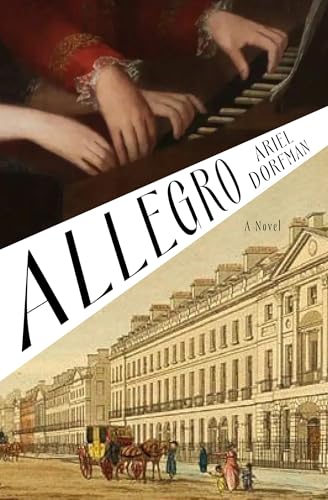
In Allegro, Ariel Dorfman imagines Wolfgang Mozart at three distinct stages: as a child, a young man, and toward the end of his life. As a nine-year-old prodigy in 1765 London, under the mentorship of Johann Christian Bach (the “London Bach”), Mozart becomes enmeshed in a feud that only the dead can settle. Did the oculist Chevalier Taylor blind Johann Sebastian Bach with inept, or even fraudulent surgery, as the younger Bach maintains, or is there a more honorable turn to the story, as the Chevalier’s son insists? As Mozart grows older, he returns to this unfinished tale, or it returns to him, like Bach’s last, incomplete fugue. With his mother’s death, when he is twenty-two, Mozart momentarily loses the music that once flowed through him, he says, “like a fountain, like a flood, like a lake and a sea and an ocean.” And when he faces his own impending death, toward the end of the novel, he needs the truth of Bach’s blindness and death more desperately than ever.
This lovely novel will be particularly meaningful to musicians, as it is structured in four movements (Allegro Ma Non Troppo, Adiante, Andante, Minuetto). Handel and J.S. Bach and their compositions are at the center of all conversations, all stories, all music, it seems, though both are already dead before the novel begins.
Dorfman’s “divertimento,” first published in Spanish in 2015, reads like an 18th-century picaresque, about tragedies but not itself tragic, charming, and somewhat distanced. For all the poverty, illness, loss, and death surrounding him, this Mozart delights the reader with his effusive appreciation of food, drink, women, and music, music above all. Music, he believes with a bone-deep optimism, can change the very shape of the world. I loved viewing that world through his eyes.