Regency Romance: Ensuring the Genre’s Appeal for New Generations of Readers
WRITTEN BY RAYMOND H. THOMPSON
 As with so much in life, there lies, at the heart of Regency Romance, a profound irony: the tension between the traditional pattern of romance and the realities of marriage during the nineteenth century. Scholars have remarked upon “the extent to which contemporary culture is as obsessed with this particular ‘Ur’-narrative as ever: the story of how two lovers meet, become estranged, and are then reunited under the aegis of an ‘unconquerable love’ has lost none of its appeal.”¹ Unlike earlier works in the Romance mode, such as Medieval Romance, however, Regencies are placed in a much more realistic setting, and in Regency Britain a patriarchal/misogynist culture assigned total power to the senior male in the family. Since this imbalance of power encouraged abuse, the marriage which concluded the Ur-romance could no longer be relied upon to produce the anticipated happily-ever-after.
Yet as sales have demonstrated, readers have been fascinated by Regency Romance since Georgette Heyer first created and popularized the genre in the 1920s. How have authors managed to ensure the genre’s appeal for a later age with different cultural values?
Largely by winning sympathy for the protagonists in their struggle against formidable odds, which is, of course, the traditional strategy in any story, but romances in particular.
The easiest part is to portray the oppressive patriarchal system in negative terms. There is, after all, much to criticize, ranging from thoughtless indifference and unkindness towards the less fortunate, to abuse of dependents. In an age of harsh punishment, wives and children could be beaten; servants sexually molested and dismissed if they complained; families left destitute by the improvidence of wastrel males more concerned with self-gratification than their responsibilities; and a grossly unfair double standard blatantly favoured the more powerful. Nor have these problems been resolved in modern times.
With such few rights, the vulnerability of women does evoke the reader’s sympathy, but to win more than pity at her sorry plight, the heroine must display admirable qualities, not easy at a time when women were taught to be submissive. Among the most credible are courage and fortitude in the face of adversity and the willingness to make personal sacrifices for others. Like Charlotte Lucas in Jane Austen’s Pride and Prejudice, many of the heroines feel it their responsibility to marry an unlikeable man to avoid becoming a burden on their family. Some even take up the more ambitious challenge to marry well in order to provide security for vulnerable younger siblings. Thus in Mary Balogh’s The Temporary Wife (1997), it is only for the sake of her family, which is in dire financial straits, that Charity Duncan agrees to accept payment to marry a man she knows nothing about. Even so, her conscience troubles her to the point that she eventually walks away, unwilling to be paid in return for practicing deception upon his family whom she has grown to care deeply about. As the author observes, her heroines “must all, however, have a basic dignity and integrity. They must be intelligent and ultimately sensible and sensitive to others.”²
Kindness to others, including servants and those in distressed circumstances, wins our respect, and many a Regency heroine engages in charitable works among crippled veterans of the Napoleonic Wars, indigent women, and orphans. Women’s traditional role as care-givers for children is also valued in modern Regencies, whether they be the heroine’s own younger siblings or the hero’s troubled wards. Charity Duncan excels at both, and she is typical of the many Balogh heroines who win admiration for their handling of children. “They must be capable of love, which always negates selfishness,” the author says.
In challenging circumstances, a sense of humour always helps, not only to underline the heroine’s fortitude, but to point out the double standards that make her life difficult. And to attract an eligible suitor, as Elizabeth Bennet discovers when Mr. Darcy unexpectedly proposes. Suzanne Allain is just one of the many authors who include “sparkling wit” among the desirable qualities in her heroines.
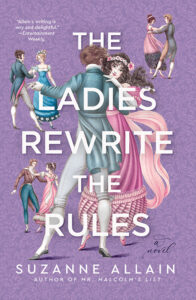
She also enjoys writing about “friendships between women,” and in her latest novel, The Ladies Rewrite the Rules (Berkley, 2024), a group band together in order to challenge the conventions of the marriage mart. Loyal sisters and wise (and often amusingly caustic) grandmothers and great aunts are another frequent source of support.
The problem was that, despite their privileges, upper-class women were severely limited in their options outside of marriage. Their brothers might seek a career in the military or the church, whereas without the uncertain support of wealthier relatives, a position as governess, teacher, or companion was all they might aspire to. In the snobbish, class-conscious society of the era, this meant loss of status, another concern that persists today.
The conventional education offered young ladies, moreover, left them woefully unequipped to earn a living in other ways, and only a lucky few could count on the support and encouragement of enlightened parents. Some Regency heroines do determinedly struggle to pursue careers in fields closed to them, notably medicine, science, and writing. A few even pick up skills as thieves and adventurers, investigators and spies, and there are documented instances of such figures in history, though (like dukes) not as many as figure in the pages of modern Regencies.
Creating a sympathetic hero, however, presents a much bigger challenge.
The more flagrant abuses can be located in an autocratic or neglectful father figure, or an irresponsible brother who gambles away his family’s inheritance, or perhaps even his vindictive wife; but too often the lifestyle of the young male aristocrat was frivolous, if not actually debauched.
As a result, authors have to work hard to make their hero acceptable: impatient fathers or outraged aunts may force a rake to find a wife and settle down, or risk losing his allowance and inheritance; military service fighting the French on the continent or at sea can teach a greater sense of responsibility; some may even grow bored with an idle life of gambling, carousing, and sexual indulgence.
To win our respect, however, the hero does need to learn important lessons, to recognize and regret his past misconduct, and to change his ways. The hero of The Ladies Rewrite the Rules is mortified once he realizes the distress he has caused by publishing a list of wealthy widows. Fortunately for him, as Allain explains, “Forgiveness is a big theme in my novels, as well as not being overly judgmental. In many of my books, similar to what Austen did in P&P, a character who the reader may start out viewing as the antagonist or villain of the piece is revealed by the end to be a lot more nuanced and have reasons for their behavior.”
For her part Balogh notes, “I have created heroes of all kinds, though they basically divide themselves into one of the two groupings of alpha and beta. I love both types. The assertive, often rakish alphas can be fun to deal with. I generally feel more tenderness toward the betas, who are quieter, more obviously sensitive. But with both types I look for a hard-to-describe quality of strength and integrity. The alpha must not be inflexible and unfeeling. The beta must not be a pushover. Both types must be willing to grow and change within the bounds of believability. Both must ultimately understand and accept that in their love relationships, especially with their heroines, there must be equality and trust and a deep friendship.”
And this, of course, is the crucial part.
The hero must not only offer his love, but be willing to share power within the marriage relationship, despite what the law dictates. This can be assured through pre-nuptial agreements, though it helps to have powerful friends and family to ensure they are adhered to. Nor does it hurt (so to speak) if some of these protectors have superior fighting and dueling skills.
In the final analysis, however, it is trust that is the decisive factor, which is why the process through which the lovers are reunited is often so challenging. The hero’s repentance must be genuine and involve actual suffering if he is to prove himself worthy of his lady, just as the heroine too must regret her own misjudgements and offer forgiveness to the truly penitent.
Thus at the conclusion of The Temporary Wife the hero, now Duke of Withingsby, tracks down Charity and pleads with her to return and take her place as his duchess: “I need you, my love… I need you so much that I panic when I think that perhaps I will not be able to persuade you to come back with me to Enfield. I need you so much that I cannot quite contemplate the rest of my life if it must be lived without you.”³
And since the hero is too ashamed of his past behaviour to declare his love to the heroine, it is she, fittingly enough, who proposes to him at the conclusion of The Ladies Rewrite the Rules.
Love and forgiveness? Is it any wonder that readers are drawn to Regency Romance when it shows the path to a kinder, better world? It offers a welcome reminder of hope, especially when the days darken around us.
References:
- Lynne Pearce, “Popular Romance and its Readers,” A Companion to Romance from Classical to Contemporary, ed. Corinne Saunders (Oxford: Blackwell, 2004), p. 521.
- Quotations from Mary Balogh and Suzanne Allain are taken from interviews conducted by email in November and December 2023, respectively.
- (New York: Dell, 2012), p.244.
About the contributor: Raymond H. Thompson is a professor emeritus of English with a particular interest in Arthurian tradition. He enjoys romances, particularly those by Jane Austen.
Published in Historical Novels Review | Issue 107 (February 2024)