On Seeing (And Not Seeing) Medieval London
by Bruce Holsinger
 One of the paradoxes of historical fiction is that it must both inhabit and invent its settings. Writers in the genre might perform months of research, pore through a dozen archives, spend weeks walking the back roads and visiting the buildings and streets that once defined their characters’ lives. Yet no matter how much research we perform, no matter how often we travel to the cities, towns, and landscapes portrayed in our fiction, we are faced, in the end, with the difficult task of invention — of making all or most of it up. When it comes to place, even the most rigorously researched historical novel demands creative license, as we flesh out in language those intimate details of structure, landscape or room we can never fully recover from the archive.
Every historical place and time, though, comes with its own unique set of challenges, as I’ve learned in writing novels set in late medieval London, during the reign of Richard II. The post-medieval history of the city proved all but catastrophic for anyone wishing to place a novel in that world. The built environment of medieval London is largely lost to us, victim of the Reformation, the Great Fire of 1666, the Blitz, and the sheer passage of time. The great Roman walls, which once circumscribed the Square Mile and defined the core of pre-modern London, were dismantled centuries ago, and while certain streets retain their medieval names, these byways are deceptive guides indeed to the ambience and sightlines of the fourteenth-century city.
There are numerous traces of medieval London and its environs if you know where to look for them, though, and one of the great pleasures in researching and writing A Burnable Book and The Invention of Fire have come in discovering those traces for myself, and working them into a scene, a character arc, a turn of plot.
Take Southwark. It was here, at the Tabard Inn (along the current Borough High Street), that the fellowship assembled for the pilgrimage imagined in the Canterbury Tales by Geoffrey Chaucer, an important character in both A Burnable Book and The Invention of Fire. It was in and around these Southwark haunts, just about six centuries ago, that my novels’ historical protagonist lived a good portion of his adult life. Beginning around 1377, the poet John Gower let a house and small chapel from the church of St. Mary Overie (now Southwark Cathedral), an Augustinian priory that sat in the shadow of Winchester Palace, house of the powerful bishops of Winchester. The ruins of the palace’s great hall and the door to the buttery are nicely preserved just up the street from the cathedral. Gower’s house was likely situated along the priory’s outer walls, signaling his double orientation toward the church and the outside world.
Southwark Cathedral is a bit off the beaten path, at least for tourists. During my visits to the church, I have often been the sole person in the place experiencing it as a sight-seer rather than as a parishioner or an employee. Gower’s tomb sits in a recess along the north aisle, with soaring ogees over three trefoiled arches, each poised above one of the allegorical figures of Charity, Mercy, and Pity. Garishly restored in the 1950s, the tomb depicts the poet in effigy, his head on a pillow made up of his three major works of poetry.
Standing in front of Gower’s tomb, leaning back against the pews, I’ve thought more than once about the often invisible pressures of place on the formation of literary character, particularly on those figures from the past brought to new life in historical fiction. Gower offers a wonderfully ambivalent case in point. He was a loyal and devout parishioner, by all indications, yet with a nose for iniquity that must have been sharpened by experience, and by the moral geography of Southwark itself, seat of bishops and taverners, prostitutes and Austin canons, chapels and stews. Such contradictions are ripe for the speculative reconstruction of character that historical fiction allows us to pursue.
Indeed, it is in these brief placings of character that some of the most interesting work in historical fiction occurs. Think of Hilary Mantel’s Thomas Cromwell, who slips with such ease in and out of his home at Austin Friars that the house becomes as much a part of the man as his limbs (“The paneling has been painted. He walks into the subdued green and golden glow”). Centuries later, in the World War II London depicted in Simon Tolkien’s Orders from Berlin, an agent named Charles Seaforth stands in St. James’s Park and watches a flock of geese rise with pastoral grace from the park lake, only to mingle in his vision with the vapor trails of planes engaged in aerial battles high above the city. In the same genre is Alan Furst’s Spies of the Balkans, a war-era noir that begins omnisciently, with a weather system on the Bulgarian-Greek border, before panning to a police officer in Salonika snapping aloft an umbrella that he then closes just before spying a melancholy sponge seller in the street market on Aristotle Square: “Marooned, he could only wait, for if his sponges got wet he’d have to carry the weight for the rest of the night.”
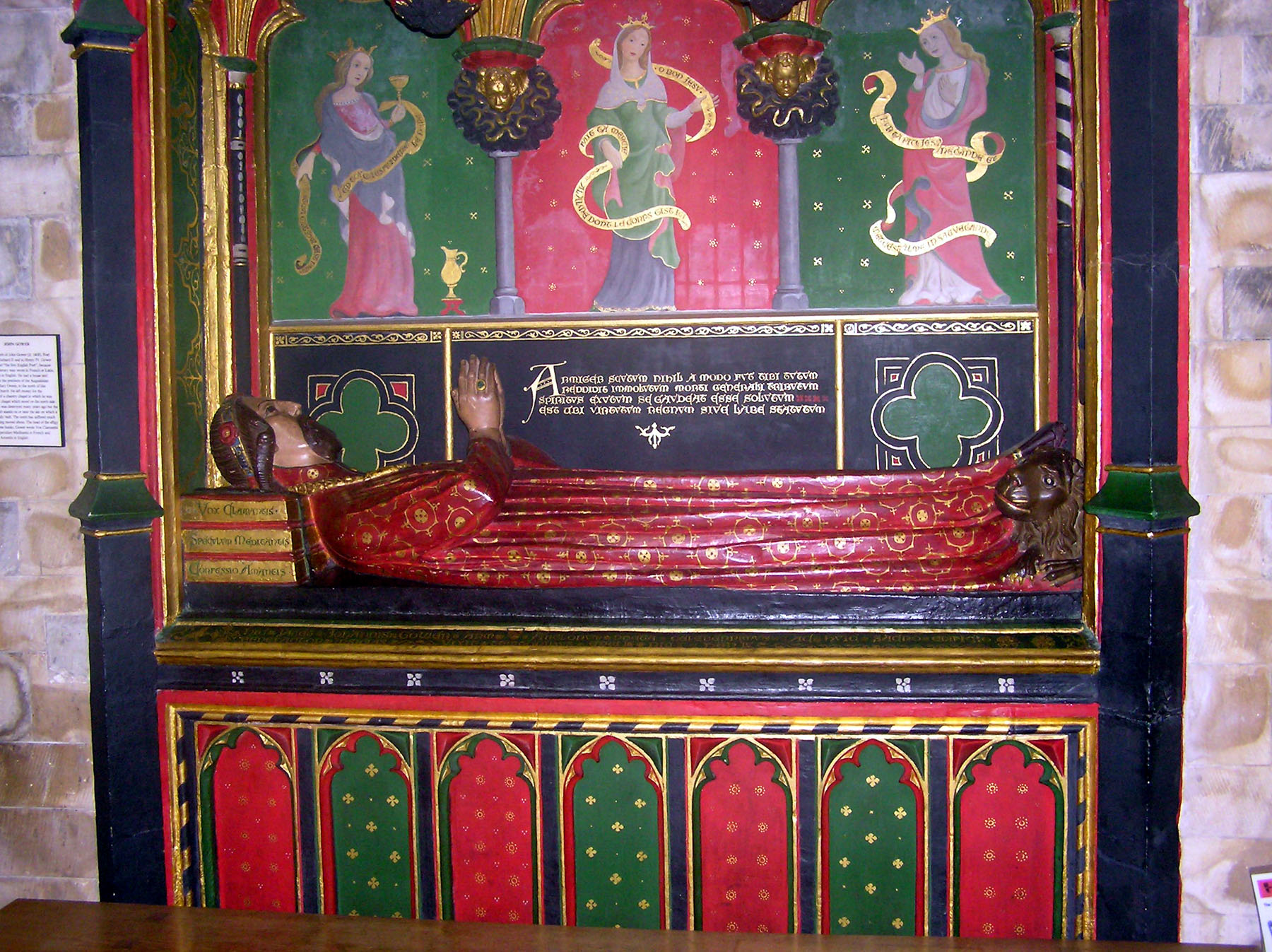
John Gower’s Tomb
Andrew Taylor’s The Scent of Death (2013) limns this relationship between place and character with particular grace. Set in revolutionary Manhattan during the last years of British rule, the novel features Edward Saville, a London clerk sent to New York by the American Department. One of the intriguing aspects of Saville as a historical character is the often opaque lens through which he views the roiling city around him. New York is still part of England at this point, and as an Englishman abroad in a revolutionary America, Saville must straddle two worlds, balancing his loyalties to the crown with his horrified vision of the half-ruined Manhattan that surrounds him.
But what if your character simply can’t see the setting you create for him or her — or can’t see it very well? A formidable challenge in writing from the historical viewpoint of John Gower has come in imagining and accounting for the poet’s blindness. We know that Gower was blind or nearly so by the early years of Henry IV’s reign (1399-1413). There are no records of the potential cause of his affliction, nor does he say anything about whether his blindness came on over a number of years or appeared suddenly at the turn of the century. I’ve been working on the assumption that Gower lost his vision gradually, over a long period of time. This is an unprovable hypothesis, of course, though there is an intriguing hint at the end of his Confessio Amantis (completed circa 1390) that the poet was already suffering from impaired vision at the time he wrote his long Middle English poem: “Myn yhen dymme” (“My eyes dim”), Gower’s narrator avows, locating the visual condition among a wider catalogue of afflictions assaulting him in his old age.
Gower writes openly about the failure of his vision in his Latin works, nowhere more movingly than in his poem ‘Quicquid Homo Scribat’ (here in R.F. Yeager’s translation):
That was the second year of King Henry IV
When I stopped writing, because I am blind.
My ability serves me no further, although my will does,
But my physical agency lacks the means to write more.
While I was able to write, I wrote very many things with zeal;
This part clings to the world, that part clings to God.
Nevertheless I have left to the world its vanities still to be written,
And with a final poem I write and I go to die.
With these and other passages from Gower’s work in mind, I’ve thought a lot about the implications of representing a visually impaired character in a genre that places so much emphasis on the historical accuracy of sights and sites. There are any number of models, of course, including Sharon Kay Penman’s Rhiannon in her Plantagenets trilogy. “The blind are often hidden away from the world, as if they are a cause for shame,” Rhiannon notes in a conversation with Eleanor of Aquitaine, though she has compensated for her blindness in myriad ways. More recently, in Anthony Doerr’s All the Light We Cannot See (2014), a blind girl’s father carves a wooden replica of nearby streets and buildings as a way of helping her navigate the town — which is also, of course, the novel’s setting.
In researching the treatment of blindness in Gower’s day, I’ve learned about medieval eyeglasses, corneal surgery (!), and other technological dimensions of the subject. I’ve also been struck by the frequency with which medieval writers (including Gower) draw on biblical and proverbial metaphors of blindness to discuss matters of morality, faith, and the nature of sin.
Near the beginning of The Invention of Fire, Gower reflects on the diverse sources of beauty around him, the many sights he will miss when his eyes finally fail:
Dusted arcs of sunlight in the vaults of St. Paul’s, crimson slick of a spring lamb’s offal puddled on the wharf, fine-etched ivory of a young nun’s face, prickle of stars splayed on the night. Color, form, symmetry, beauty, radiance, glow. All fading now, like the half-remembered faces of the departed: my sisters, my children, my well-beloved wife. All soon enough gone, this sweet sweet world of sight.
Gower, that is, experiences medieval London through the blurred lens of his encroaching blindness, which determines in part his relationship to the novel’s setting, his historical moment, even memories of his own family. For John Gower, to see the London of his day is to see a whole visual world soon to be lost. Perhaps historical fiction has a compensatory function in this respect, providing our own world with new ways of seeing pasts otherwise lost in the shadows of history.
 About the contributor: BRUCE HOLSINGER’S first novel, A Burnable Book (HarperCollins UK/William Morrow US, 2014), won the John Hurt Fisher Prize and was named one of the Best Mysteries of 2014 by the American Library Association. The Invention of Fire appeared earlier this year from HarperCollins (UK) and William Morrow (US).
______________________________________________
Published in Historical Novels Review | Issue 73, August 2015