New Voices: Hazel Gaynor, Natalie Meg Evans, Kristen Harnisch & Judith Starkston
by Myfanwy Cook
Hazel Gaynor, Natalie Meg Evans, Kristen Harnisch and Judith Starkston plant the seeds for future success with their debut novels.

The Dress Thief by Natalie Meg Evans
When we are children, we often start the stories we write with ‘Once upon a time,’ and our tales grow from that starting point. Natalie Meg Evans’s The Dress Thief (Quercus, 2014) was inspired by one of those fairy tale moments. She explains: “It started with a dressing-up box. A pine chest full of discarded dresses and hats. To a very small girl, it was a fantasy collection of Cinderella ball gowns and princess costumes. In reality, they were cast-offs from the 1930s, 40s and 50s, kept by my thrifty mother, and by the time I arrived, would have seemed stiff and over-formal. That off-the-shoulder cocktail dress with its silk fringing would have been hard to wear without solid underpinnings. The blue crinoline with its boned bodice and overskirt of peacock-eye chiffon was too much in a small, Midlands village where the grandest parties were social nights in the village hall. Hidden away in a pine box, they were relics of a life before marriage. Before career and responsibility.
“I could almost cry that I pranced about in all that vintage loveliness, putting the heels of oversized court shoes through fragile hems. If I could go back in time for one day, with a big suitcase . . .
“To write The Dress Thief, I subconsciously re-opened the box. As the story’s heroine, Alix Gower, works in haute-couture, I submerged myself in the styles of the 1930s and researched sewing, cutting and decorating techniques. Though no seamstress myself, I love that era of sinuous, bias-cut clothes. And I loved dressing Alix in fantasy gowns!”
In contrast to Evans’s novel, The Girl Who Came Home (William Morrow, 2014), by Hazel Gaynor “is ultimately about a Titanic survivor.” Gaynor “wanted to explore what happened in the immediate aftermath of the disaster — in the lifeboats, on the Carpathia, in the New York hospitals where survivors recovered.” She explains: “I was also interested in how the event affected survivors during their lifetime, many of whom – like [my character] Maggie — were unable to speak of Titanic for several decades. I also write about the event from the point of view of family and friends waiting to hear the fate of their loved ones.
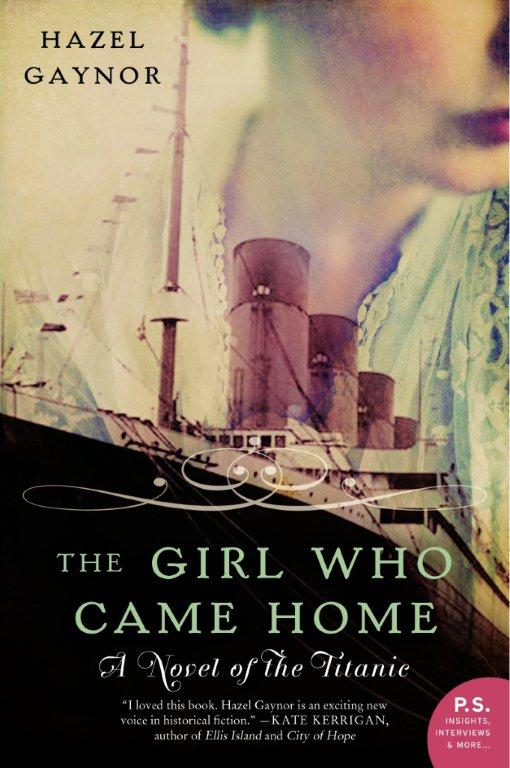
The Girl Who Came Home by Hazel Gaynor
“One hundred and two years on, Titanic still fascinates people. I hope that through Maggie, readers will experience the Titanic disaster, and her lasting legacy, from a perspective they might not previously have considered.
“The Girl Who Came Home tells the story of Maggie Murphy, a young Irishwoman who leaves Ireland and the man she loves to start a new life in America with her aunt. Along with twelve others from a small parish in rural Ireland, they travel on RMS Titanic. Seventy years later, Maggie confides in her great-granddaughter, Grace, sharing her experience of the traumatic events of April 1912.
“From the outset, I was clear that I wanted to explore the experience of a third class passenger. We know plenty about the opulence of the ship and of the wealthy Americans who travelled in first class, but very little about the poorest of Titanic’s passengers, many of whom were leaving their homes and family in the hope of finding a better life in America. I felt that it was these ordinary people who had the most extraordinary stories to tell.
“Living in Ireland, I was especially keen to understand more about the Irish passengers who travelled in steerage and boarded Titanic in Queenstown, County Cork. In survivor records, I discovered the name Annie Kate Kelly, which led me to the story of the Addergoole Fourteen – a group of Irish emigrants (friends and relatives), who sailed together on Titanic. I knew immediately that this group would form the inspiration for my novel.”

The Vintner’s Daughter by Kristen Harnisch
A name on a record provided the kernel from which Gaynor’s story grew and flourished, whereas for Kristen Harnisch, the birth of her novel began with a visit: “The inspiration for The Vintner’s Daughter (HarperCollins Canada, 2014) came to me in a flash. In October 2000, I was standing on the edge of a Vouvray, France vineyard, marveling at its pristine rows of Chenin Blanc grapevines and its ancient limestone caves. ‘This,’ I thought, ‘would be the perfect setting for a novel.’
“Questions flooded my mind as I toured the Loire Valley cellars. Why have these families chosen to make wine for centuries? How do they create fine wine and what obstacles do they face? Although the winemakers answered many of my questions, once I returned home, I wanted to learn more about the history of the wine trade in California. I delved into French and California wine history books, read years of nineteenth-century trade papers such as The Pacific Wine and Spirit Review, consulted a master winemaker, reviewed old maps and photographs at The Napa County Historical Society and toured several family-owned Napa vineyards. I was fascinated by what I discovered.
“Every bottle of wine contains nearly three pounds of grapes and the vulnerability of this fruit is striking: over the last century and a half, grapes have fallen victim to pests, rodents, frost, mildew and Prohibition in the United States. Still, with a precise blend of hard labor, science and art, winemakers continue to perfect the wines that fill our glasses.
“I knew that my heroine, Sara Thibault, had to possess a winemaker’s passion and grit. Even when she’s attacked, in the midst of her fear she finds her fury — that deep-seeded sense of self that lashes out in defiance. For every woman who has ever been assaulted, I needed Sara to fight back with all her might — and win. From this scene on, although Sara endures many moments of terror and doubt, she remains determined to prevail.”
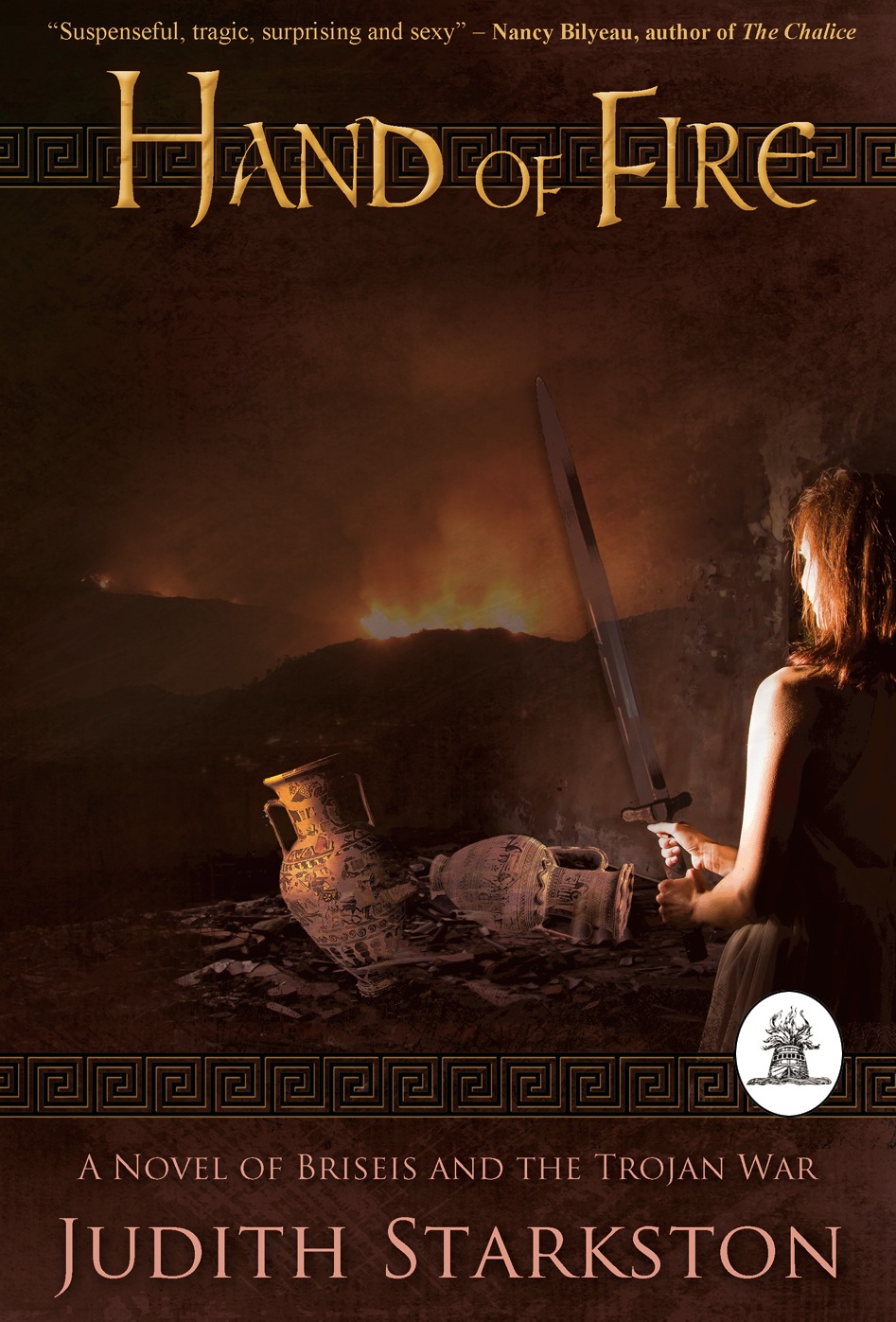
Hand of Fire by Judith Starkston
Judith Starkston’s inspiration for Hand of Fire (Fireship Press, 2014) “arose from silence and a question. The silence was Briseis’s — the captive woman Agamemnon and Achilles fight over in the Iliad. Homer devotes only a few lines to this pivotal woman, and I wanted to know her side of the story. In my read, the one thing we learn from Homer about Briseis is that there is a mutual love between Achilles and Briseis. How can Briseis love the man who destroyed her city, reduced her from princess to slave, and killed her husband and brothers? It can’t be an ancient version of Stockholm Syndrome. Achilles is a conflicted, half-immortal hero, a warrior who questions the value of war — a man who ponders the purpose of life. He’s not a brainwasher even if he is a mess emotionally.
“So I went hunting for an historical Briseis. The Bronze Age world around Troy and further to the east with the sister civilization of the Hittite Empire has been literally unburied during the 20th century and the huge cuneiform libraries of clay tablets that so compellingly portray this world didn’t appear in translation in significant numbers until recently. It’s the perfect time for a classicist turned historical novelist to find Briseis.
“In the dry and dusty clay, I found a living woman and the details of her daily life. Contrary to the oppressed women you stereotypically expect to meet in the ancient world, many of these tablets were written by powerful women, priestesses and queens who served as healers and intermediaries with the gods. The mythic tradition says Achilles also trained as a healer and he was a singer of tales, as were these women in their rites. From this clay-stored history, I imagine Briseis as one of these women, strong enough to challenge the greatest of the Greeks. I discovered from the tablets that she had enough in common with Achilles to bind them together — if I mixed in some circumstances that helped her overcome her emotional pain. I hope I’ve created an historically believable Briseis in a fast-moving tale that finally gives this mysterious young woman a voice the epic tradition denied her.”
Alix, Briseis, Maggie Murphy and Sara Thibault are all examples of how one tiny seed of inspiration can germinate and grow into powerful characters and engaging novels. They have all been “salvaged,” in Evans case from her “dressing-up box days,” but also from all the rich and unexpected coincidences and events that these debut novelists have experienced, which have enabled them to create a diverse range of new historical fiction to delight and entertain us.
About the contributor: MYFANWY COOK would love for you to tell her about any exciting debut novelists you discover. Please do email (myfanwyc@btinternet.com) or tweet (x.com/MyfanwyCook).
______________________________________________
Published in Historical Novels Review | Issue 69, August 2014