Mirrors of our Best Selves: Fallen for France by Elizabeth Letts
 BY LOUISE TREE
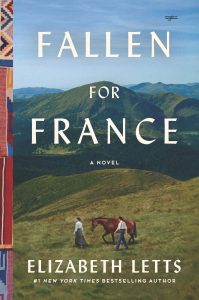
Elizabeth Letts is the New York Times bestselling author of books about remarkable horses. Fallen for France (Ballantine, August 2026), her latest novel, follows the journey of a fictional Arabian mare, born at the palace of the Sultan of Morocco in the unsettled time before the outbreak of World War I. Letts explains that ‘the original spark for the story was a single line I encountered in a wartime veterinarian’s account’ of the ‘horse breeds he’d treated at his hospital on the Western Front, and I was intrigued’ that ‘one was a Moroccan Arabian.’ The ‘idea that a horse from Morocco had somehow made it all the way to the Western Front, was the seed from which the rest of this story grew.’ This story binds a Moroccan boy, an English veterinarian and a French nurse to Tassa, an Arabian war horse.
As well as the horses who toiled and died on the front lines, she was also inspired by the colonial soldiers who were shipped from Casablanca to fight for France because Morocco had come ‘under French control’ in 1912. Letts explains that the Moroccan experience of the war ‘was not easy to research as there was very little scholarship,’ even though ‘Moroccan soldiers were highly decorated as contributors to the French empire. But after Morocco liberated itself in 1956, there was little motivation to memorialize’ these men. Their history is now being recovered: ‘there is more scholarship than there was when I started writing this book’ and she is optimistic that ‘soon there will be greater understanding of this important and mostly overlooked slice of World War I history.’
Asked about the transition from non-fiction to fiction, she explains that ‘Even though I write non-fiction, I think of myself primarily as a novelist. Historical fiction, in some ways, can be truer to the past.’ Both forms are a ‘reconstruction and I think historical fiction is more honest about that.’ Non-fiction is actually ‘more difficult, as you are trying to create a compelling story out of a fixed set of facts. As a fiction writer I have more tools in my toolbox—I can write dialogue and create interiority in a way that is much harder in non-fiction unless you have an actual memoir, diary, or interviews to draw on.’
Regarding research, Letts considers that ‘Readers recognize authority,’ which requires ‘a firm and granular command of your subject matter,’ but she advises writers to ‘not succumb to the temptation to parade your knowledge. Well-chosen details allow readers to feel the steadiness and solidity of your authority, but you have to be ruthless in also letting many things go if they aren’t absolutely germane to the central story you’re telling.’
author photo by Nina Subin
The novel begins in the High Atlas Mountains of Morocco, in an Amazigh community living a hard agrarian existence. Beddou, aged six, is indentured as a shepherd to a distant cousin, and his mother Aisha secretly gifts Beddou a string of amber beads. In creating Aisha’s character, Letts ‘drew deeply on my own mother-in-law, Rabha Ouchaou, who lived her entire life in a small village in the High Atlas following traditional ways. I have watched Rabha toil from dawn to dusk, walking high into the mountains to gather kindling on her back. I saw how she allowed her eldest son to leave home at a young age to attend school, knowing that—lacking any means of communication—each time he left, she had no way of knowing if he would return.’ Beddou’s epic quest to return home forms the emotional backbone of the novel. Letts reveals that as she ‘went through the editing process Beddou made himself the true center of the story, and I realized that, to make the story click, I needed to follow the string of amber beads.’
Aisha’s world is bordered by her community; but another character, Louhou, adventures into dance. Letts explains that a woman such as Louhou, ‘alone in Morocco at that time had few options, and entering the singing and dancing trade was one of them.’ To create her authentically, Letts ‘drew on oral histories of women who had actually followed this path’.
Meanwhile in France, Estelle is a woman in different circumstances, pressed into nursing by the occupying Germans. Letts’ ‘extensive reading of memoirs written by World War I nurses’ began with ‘English narratives, which were incredibly compelling,’ but not ‘right for creating Estelle: English nurses were generally trained, often living on personal means. French nurses were more likely to have been pressed into service, as Estelle was.’ Their memoirs described ‘going through soldiers’ pockets to find information about their families’, and ‘their experiences caring for colonial soldiers.’
Of these intersecting character journeys between Morocco and France, Letts says ‘I really do just shoot from the hip and let my own curiosity be the guide.’ She admits that ‘It’s hard to believe that a novel this complex, with such a tight interlocking narrative, was actually created by trial and error, but unfortunately, I’m not a planner. I don’t map anything in advance. For me writing is iterative. I layer on draft after draft, and the shape and themes and yes, even the plot emerge in the editing and revision. I don’t think my stories would have the same depth if I didn’t go through this process—themes and meanings emerge slowly over time, through the act of writing itself, and often I don’t recognize them right away.’
Beddou and his Arabian mare, Tassa, must survive against the odds, navigating a world at war. For Letts, horses ‘bring people together. In fact, we see time and again that warring humans can start to see past enmity when the fate of a horse is at stake.’ They represent ‘our longest relationship with domestication’ and this ‘can reveal what it means to be human. Nobility, courage, beauty, patience, and endurance are qualities we deeply admire in humans. These same qualities exist in horses largely because humans bred them over millennia. Thus horses become mirrors of our best selves.’
About the contributor: Louise Tree is a book reviewer and feature writer for the Historical Novels Review and judges the First Chapters Competition. She is currently working on a novel about a woman saboteur in World War II.