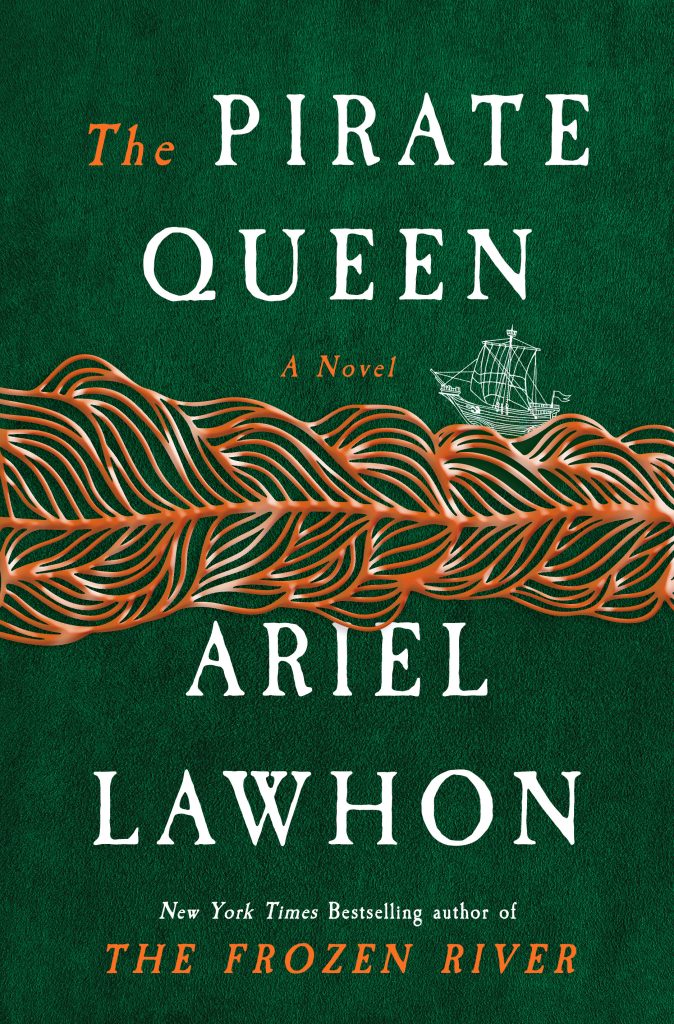
Maiden, mother, matriarch: the woman behind the legend in The Pirate Queen by Ariel Lawhon
 BY JENNY QUINLAN
If you’ve any interest in history, particularly about Ireland, strong female figures, or piracy, chances are you’ve heard of Grace O’Malley. A legend in Irish folklore, Grace is famous for becoming an Irish chieftain and building a fleet of ships to create an empire covering land and sea—both by legal and illegal means.
The story in Lawhon’s latest novel, The Pirate Queen (Doubleday, September 2026), features little of actual piracy and instead focuses more on how Grace was able to carve out and hold a position of power in an era when women were typically resigned to the household roles of wife, mother, and servant.
I asked Lawhon what drew her to writing Grace’s story. “I found Grace the way that I find most of my novels: by accident. The idea for The Pirate Queen came to me in the middle of the night while reading a book of essays. The first contributor mentioned that she wished she could have dinner with Queen Elizabeth I and her archnemesis Grace O’Malley, the pirate queen of Ireland. I gasped. I’d never heard of this pirate queen! I immediately tumbled down the rabbit hole of history and knew within hours it would be my next book.”
Though Grace has achieved legendary status in the years since her death, readers may be surprised to learn that Grace is not mentioned in contemporary Irish records at all and is only officially known through English records of her.
Lawhon offers some explanation for this. “Historians differ on this point. Some say that garden variety sexism is to blame. Grace was a female chieftain at a time when a woman’s leadership wasn’t widely accepted (even though Elizabeth I was on the throne at that time). Others argue that, though inspiring, Grace made little impact outside the west coast of Ireland. Here’s what I know: both of her husbands and all her sons were included in official Irish history. Make of that what you will.”
Lawhon’s Grace is a woman who inspires thousands of people to view her as their leader—men and women, noble and peasant—because she is bold, brave, fair-minded, and, perhaps most importantly, unafraid to challenge English oppression. She is perhaps most famous for her meeting with Queen Elizabeth I in 1593. What we know of Grace comes mainly from eighteen “Articles of Interrogatory,” questions put to her in writing on behalf of Elizabeth I in response to Grace’s petition to release her brother and son from captivity and to have ancestral lands that had been commandeered for English vassals returned to her.
Since fairly little is known about Grace’s life, I asked Lawhon how she separated fact from myth when writing about a figure who has taken on legendary status—or gave herself permission not to. “I truly believe that the marriage of fact and myth is what makes for the best stories. So I try to stay close to established historical fact while weaving myth into the inevitable gaps that one always finds in the record.”

author photo by Kristee Mays Photography
While Lawhon could have told a linear version of Grace’s life, she made the decision to tell Grace’s story based on the “eras” of her life, weaving three timelines together, moving backward and forward in time. “This is the first novel I’ve written where I cover a woman’s entire life. The inherent challenge in that was to maintain momentum. So I needed to skip broad swaths of her life, sometimes jumping forward ten years in the narrative. A nonlinear timeline allowed me to focus on her legendary exploits without making the story feel episodic.”
Lawhon also includes viewpoints from a number of men in Grace’s life, including both husbands, her brother, her loyal soldiers, and her archenemy, Richard Bingham. “That was never a decision that I consciously made. It happened by accident early in the writing process. I sat down at my desk one day just as Grace’s father got home from a trading mission. So I followed him off the boat and into the castle and before I knew it, I realized that he had something to say about a then five-year-old Grace. As the novel progressed, a number of men in her life elbowed their way into the story.”
Considering how Grace had to overcome continual resistance to a woman being in power, these viewpoints offer insights into the minds of both the men who loved her and those who despised her, while also offering further insight into Grace herself, creating a satisfyingly rich and well-rounded depiction. I recently attended the HNS conference in Ireland and spent some time exploring afterward, traipsing through a number of locations mentioned in the story and imagining them as Grace must have seen them. Lawhon’s deeply personal portrayal of a legendary woman weaves an emotional spell, and I thought of Grace often during that trip.
I asked Lawhon why she thinks Grace is still such a popular figure today.
“Because she was just so ballsy! A pirate. A chieftain. A mother. A warrior. She defied every expectation of her age—and many of ours. That kind of woman leaves a mark . . . I hope, when readers have read the last page of this book, they realize that extraordinary courage and defiance do not have to stay within the pages of a book. They’re meant to be lived.”
About the contributor: Jenny Quinlan is an editor and coach specializing in historical fiction. As founder of Historical Editorial, she has helped hundreds of authors achieve their publishing goals. She served three terms as chair of the Historical Novel Society North America Conference and founded the HNS Romance chapter. She lives on a farm in Virginia with her family and a spoiled-rotten German Shepherd.