Life Under My Belt: Kristin Hannah’s Commitment to Women’s Friendship & Telling Their Lost Stories
WRITTEN BY MARY TOD
 Kristen Hannah does not tackle light-hearted topics. Instead, her novels consider women and men facing tragic circumstances, life-altering decisions, war, drought, marriage breakdown, parental loss, and terrible truths. She writes about life, the power of love, and the bonds of friendship as well as the incredible courage women draw on during times of crisis and danger.
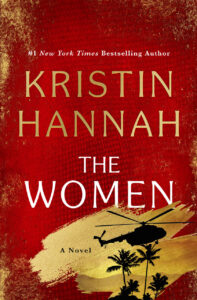
The Women (St Martin’s Press/Macmillan, 2024) is Kristin Hannah’s latest novel, a must-read story of the women who served in Vietnam. While the main character is Frankie McGrath, a young woman who trains to be a nurse and not long after graduation signs up for the army, the supporting cast includes two other Vietnam nurses who become Frankie’s lifelong friends, several doctors and soldiers Frankie serves with, and her parents, who strongly disapprove of her decision.
The story begins in 1966, a time when prevailing attitudes about women stressed their roles as wife and mother, and when the importance of attending college was to get an MRS degree. It was a time when nursing and teaching were the only acceptable careers and when women were expected to leave their jobs as soon as they married. Frankie’s mother reacts to Frankie’s decision to enlist by asking “what will we tell people?”, as if serving as a combat nurse brought shame on the family.
Shortly after arriving in Vietnam, Frankie is assigned to 42nd evac hospital, a 300-bed hospital not too far from Saigon where she provides care for VSIs—the very seriously injured. Her first challenge is to jump out of the helicopter that takes her to the hospital, and she soon discovers how terrible the conditions are. From then on Frankie’s world is filled with panic-stricken moments, grueling days and nights on duty, and circumstances that are far beyond her training. Inside the ER, Frankie is at first overwhelmed by the horror of it, the screaming patients, the shouting of medics and doctors, wounded men everywhere, and never enough time to help everyone. Kristin Hannah provides many little details to bring readers into that world, like the sight of a boot with a foot still in it.
The night air smelled heavy, like blood on metal. Empty sawhorses littered the triage staging area. Blood had turned the ground soft; pooled there and created mudpuddles.
Frankie’s friend Ethyl explains: “No one is ever ready for this. The worst part is that you’ll get used to it.” Later Ethyl adds: “We age in dog years over here, Frank.”
Sprinkled throughout the novel are letters from Frankie’s mother. It’s through these letters that we read of the protests and politics back home in America. Protestors carry signs with sayings such as Bombing for peace is like screwing for virginity or Impeach LBJ. Women burn their bras. Others burn the American flag.
Part One of the novel is set in Vietnam. The men and women Frankie meets there change her profoundly. Part Two follows Frankie’s path after she returns home from the war. It’s equally dramatic and compelling.
As someone who lived through the daily news of the Vietnam War and saw its impact on families and communities, Kristin knew she wanted to write about the women involved and first proposed this novel to her editor in 1997. Her editor suggested that she would be able to tell that story in a more powerful way if she were to wait. So, what’s different now? “I think that, honestly, I needed a bit more life under my belt to write this story, to really understand it and realize fully its importance. I also needed more experience with writing.” Had she written The Women twenty-five or more years ago, “it would have been entirely different. I am so much more committed to telling women’s lost stories than I was twenty or so years ago.”
The notion of women’s lost stories is key to The Women, whose characters were treated like second- or even third-class members of the armed forces both during and after their service.
Once the action shifts to Vietnam, the scenes are compelling and graphic, and the pacing is almost as frenetic as you would imagine that war to be. Hannah’s narrative and dialogue keep the reader immersed in the danger and chaos of that war, and in the ways that those who served coped with such circumstances. What motivated the author and prepared her to write such scenes? Kristin Hannah described how important it was to her “to be accurate and authentic in this novel, to truly show the reader what the nurses in Vietnam experienced on a daily basis. And yes, the scenes are graphic and visceral and relentless sometimes. That was my intent.” Much of this came from the research she did and the conversations she had with nurses and doctors who had been there, but it was also a choice she made because of the PTSD that so many of the medical veterans suffered as a result of their service in country. These veterans were often denied treatment at home and told that because they weren’t “in combat” they couldn’t suffer emotional trauma. Hannah wanted to show the fallacy of such thinking.
I’ve read many of Kristin Hannah’s novels, my first being The Nightingale, her breakout WWII novel. While WWII was vastly different from the Vietnam War in terms of scope and purpose, Hannah was able to bring a personal perspective to writing The Women. The biggest difference, of course, was that she remembered the Vietnam era. She lived through it. “I was young—in elementary or middle school—but the war cast a huge shadow over my youth. I had a good friend whose father was shot down and lost; he never came home. I saw how the veterans were treated when they returned to America after their service. All of it resonated with me and made me want to tell this story and shine a light on the veterans’—especially the women’s—service.”
As Kristin Hannah says, “now is the perfect time to look back at this era; that’s why I decided to write the novel at this time. America is again divided, and I believe we all need to be reminded that we are stronger when we focus on what we have in common, rather than what divides us. Also, it’s important now because the Vietnam veterans are in their seventies, eighties, and nineties. We need to remember their service, thank them, and do what we can to help and heal them.”
Now that The Women has been published, Kristin Hannah is hearing from a lot of readers who lived through this time—from men and women who served, from their children, from people who lived through the era and didn’t realize what the veterans went through. “I am just really glad to get this conversation started.” Like many of us, she keeps hearing about the healing that still needs to happen for these veterans and their families, and she hopes that this book can help that in some small way.
There are so many issues that find their way front and center in The Women: military service and the price of it, duty, patriotism, friendship, trauma, PTSD. But at the centre of the novel is the often overlooked and forgotten role of women in the military, particularly in the Vietnam war era. However, Hannah is quick to point out that this issue “extends to all women in the military, especially those who deploy, as well as the difficulties presented in returning from war.”
Friendship is a critical theme in The Women. Ethyl and Barb, the combat nurses who became Frankie’s closest friends during the war, continue to be close, supportive friends after the war. Kristin Hannah admits that she “literally can’t seem to write a book where female friendship isn’t a key element. I think that’s because I believe in it so fiercely. Our girlfriends matter so deeply to us. I love to emphasize that.” And she does it superbly in this novel as well as all the others I’ve read.
Heroism is another important theme. In Frankie’s father’s study, there is what he calls a hero’s wall which is featured throughout the story. The only pictures on the wall, except a few family photos, are of men. Why was it so hard for people of that time like Frankie’s father—or even people today—to think of women as heroes? Kristin Hannah shares her perspective: “I think that women’s heroism and courage and military service are routinely overlooked and/or minimized. We are conditioned by history books and news accounts and school curriculums to focus on male achievement and courage. It’s about time we recognize and remember The Women.”
Several of Kristin Hannah’s novels are contemporary; others are historical fiction. She loves to write both genres and feels that each has its own challenges and benefits. She loves “the world building and educational opportunities that come with writing historical fiction” and equally loves the relevance and timeliness that come with writing contemporary fiction. Hannah says that she never knows what’s coming next.
Whether you have memories of the Vietnam war or not, The Women is such a powerful story that you will be carried away to that time and place.
About the contributor: M.K. (Mary) Tod writes historical fiction. Her latest novel, The Admiral’s Wife, won three Indie awards. Mary can be contacted on Facebook, Instagram, and Goodreads or on her award-winning blog, A Writer of History.
Published in Historical Novels Review | Issue 108 (May 2024)