Launch: Robert Matzen’s Season of the Gods
INTERVIEW BY LESLIE S. LOWE
Robert Matzen is the author of the international bestseller Dutch Girl: Audrey Hepburn and World War II (GoodKnight Books, 2019), Mission: Jimmy Stewart and the Fight for Europe (GoodKnight Books, 2016), and eight other books. He has appeared on MSNBC’s Morning Joe, FOX News primetime, i24, and many other U.S. regional and national broadcasts and his byline has appeared in the Wall Street Journal. Season of the Gods is his first novel.
How would you describe this book and its themes in a couple of sentences?
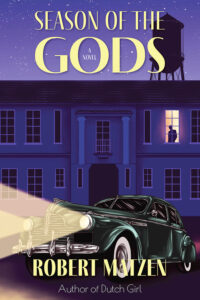
In 1941, the only female executive at Warner Bros. motion picture studio finds an unproduced stage play and fights like hell to influence the studio to purchase the rights and make a film of it in the early days of World War II. Then she helped to guide it through the production process. The picture became Casablanca.
 What inspired you to start writing historical Hollywood fiction and what has been most rewarding about it?
I have spent my career in historical nonfiction but in this case couldn’t get close enough to my plot and characters with nonfiction. I had to tell this story through the freedom of historical fiction. I was influenced by Michael Shaara’s approach in The Killer Angels about the battle of Gettysburg. That book has haunted me ever since I first read it.
Your books all seem to cover Hollywood around U.S. war periods. How is this latest novel different from the other books you have written?
This is my first attempt at historical fiction. Those who have read it so far say they feel like a “fly on the wall” as greatness is created. Really, that’s the beauty of this type of fiction: you can thoroughly research real people and their actions, speech patterns, and experiences, then imagine specific conversations. All of a sudden, your story becomes 3D.
Why the focus on this topic now? Is there a key historical event you found in researching that inspired you to write this story to convey a message relevant for today?
It’s the story of unsung heroes who have been pretty much lost to history—Irene Lee, who found the story and championed its development, and Phil and Julius Epstein, twin writers who crafted most of the great lines we all know so well today. “Round up the usual suspects,” and so on.
How do the characters transform within the story over the series? What did that journey mean to you as you wrote it?
I started telling the story of the twin writers, but, before long, Irene Lee, “Renie,” had taken over the narrative. She remains, after 80 years, a force that cannot be contained! I didn’t know going in that she grew up just over the hill from me in Pittsburgh. That was spooky.
How do you think the reader will connect with Irene Lee or other characters in the book?
We all have dreams and face great challenges in our personal and professional lives. Here are regular people like us who have to figure things out under great pressure, incredible pressure. And they’re doing it as their personal lives are falling apart in some cases. Add to that, many of the people involved in Casablanca had just fled Nazi-occupied Europe, and this was their chance to fight for the cause. The times were so uncertain for everyone, and here we are today, living in uncertain times.
What are you working on now? Is it connected to this novel or your other work in any way?
I’m working on the prequel to Season of the Gods, which tells other great stories of real people at Warner Bros. in the run up to World War II. And Renie and the boys will be in this one as well.
How did you balance the research with writing the story? Did you get to do any interesting interviews for your research?
I went back into the production files for Casablanca and also researched Irene Lee, the Epsteins, and all the other major and minor players in the production. Phil Epstein’s son Leslie, who is a writing professor at Boston University, was a great influence in the development of the characters of his father and Uncle Julie. Not to mention that he took his editing pencil to the manuscript!
You have a varied background. How has your life experiences been incorporated with or assisted you in your writing?
Great question! As a screenwriter, I have experienced the creative process of developing a screenplay. As a filmmaker, I have worked on soundstages as a director, producer, and dialogue coach and can realistically portray film production in the golden age. And I have walked the Warner Bros.’ lot and been a research rat in the Warner Bros. Archives.
 Every author has their own publishing journey. Tell me about yours.
I’ve been writing for a very long time. My first book sale (after years of rejection slips) was to Bantam Books, and it was my great fortune that LuAnn Walther saw something in my work and signed me up. But then there were more years of rejection slips and near misses—especially in the area of historical fiction. As for process, I write 1,000 words an evening. They don’t have to be good words, but if you write 1,000 words an evening for 100 evenings, you have a rough draft.
What advice would you give to other aspiring historical writers?
Walk the ground you’re writing about, and I mean that literally. Place is so important to historical fiction. Also, be authentic to the times. I’ve seen authors use “Ms.” before character names in WWII books! Ms. wasn’t invented until the 1970s! I have seen people describing paramedics in 1939! This morning I read historical fiction where a character brings her cardboard coffee cup to her desk and takes off the lid in 1947. What?! Little things like that can break the spell and breaking the spell is fatal to what you’re trying to do. Be authentic; pay attention to the details of the times you’re exploring.
What is the last great book you read? Why?
A Gentleman in Moscow by Amor Towles was the last great book I read. It cast a spell from the first page to the last and was beautifully written.