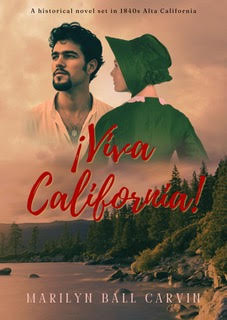
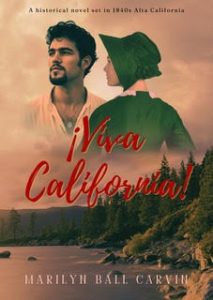
Launch: Marilyn Ball Carvin’s ¡Viva California!
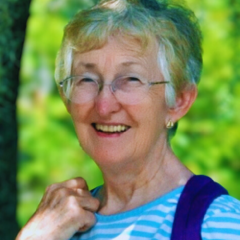
Marilyn Ball Carvin, a California native, holds a B.A. from Mount St. Mary’s College in Brentwood (now a university). She and her husband raised four children plus a variety of cats who found them. She researched and wrote ¡Viva California! over a period of 25+ years, and her short stories and poems can be found in the three volumes of The Truth That Can’t Be Told anthology published by the Lake Forest Writers’ Roundtable.
 How would you describe ¡Viva California! and its themes?
Texas has been lost. In Alta California, illegal immigrants have been straggling up from the southern deserts, over the eastern mountains, and down from Oregon. What are Californios to do as the newly-arrived Americans ignore Mexican laws, Norteños clash with Sureños, hostile Indians raid ranchos, and settlers, in return, burn their rancherías?
Into this turmoil wonders a young Irish dreamer, burdened with guilt and blaming his brother for his troubles. He seeks a bit of land, true love and God’s will, but in such confusion, where is God?
At Sutter’s Fort, an Irish American girl, fearing her future, surrounded by wild beards and buckskin, prays and asks God, “Why?”
As the chaos of California brings these two together—along with brother Billy—they must confront the past, the turbulence of their feelings, rebuild their Faith, and together forge a future.
What inspired you to start writing?
I still remember Heidi by Johanna Spyri, the Betsy, Tacy & Tib series by Maud Hart Lovelace, and the tears reading Old Yeller, so they must have inspired me to write a few short stories in grade school. I wrote a column reporting for my high school in the Glendale News Press and then a column in my college’s publication. I told bedtime stories about four little bears to our four children and wrote poetry. My daughter introduced me to Diana Gabaldon’s work. When I read The Outlandish Companion, I felt the urge to start a novel.
What part of your life experience most affects your writing?
I was surprised when my characters somehow began acting out my journey from anguish through a “dark night of the soul” to gratitude and joy. Our family summers in Tuolumne Meadows in Yosemite National Park in California inspired scenes where Michael wonders if heaven is here, and man is blind to it.
What made you choose the setting for this book?
Diana Gabaldon’s Outlander series starts in Scotland. I figured it would have to be Ireland for me, but knew it would take too much research. Since I know at least some of California’s history and landscape, I decided to bring my Irishman here!
You wrote ¡Viva California! over the course of 25 years. How did you research this story?
I searched library and used bookstores, read old Irish and California history and novels, visited historic buildings on vacations, and am still finding items online I would like to have included. I wrote historical societies and locations with questions. (I have found AI a poor source of valid history information—if it couldn’t answer my question, it made up an answer!)
What’s one interesting fact you learned while researching ¡Viva California!?
I had not realized that Mexico had secularized the missions in 1833 and all the social, political and religious repercussions of that act.
How did you get to know your characters? Which one was your favorite to write?
Several newsletters listed questions to ask characters about their family, goals, viewpoints, etc. But I really got to know them by writing.
I had decided my protagonist would be Irish, and along with California history, I read numerous novels set in Ireland in the 1800s. I never want to read another “famine” book again! I decided the main character’s name would be a combination from some of my ancestors.
I chose “Ellen,” my grandmother, for the female lead. However, I soon realized I had to include Ellen Murphy (a member of the first wagon party over the Sierras) in the story and couldn’t have two of them. But while my “Ellen” had been answering the questions, she wouldn’t show up with any other name. She finally consented to “Róisín,” but with a pout and a changed personality!
“Bad boy” Billy seemed to come up with the best dialogue, but he soon became too serious, and my pouty Róisín became more fun to write.
What do your readers mean to you?
I wanted the readers to taste the flavor of old Mexico and impress them with the fact that California was once part of Mexico. When I finished, my wish was if a reader were experiencing a crisis of faith, they would find consolation in the spiritual journey my characters traveled.
Hopefully, a reader will be impressed with the conundrum the Californios faced at the time—knowing a war between Mexico and the United States was imminent. I regret I wasn’t capable of doing more with the indigenous cultures. However, when my character compared the treatment of the Indians with the oppression of the Irish by England, I considered it a noteworthy sub-theme.
 What is the best writing advice you have to share?
My advice to historical writers would be to not imitate Diana Gabaldon’s approach. I planned to cover 1845 to 1850—I only made it to 1846. With no outline in mind, my characters inched their way through the pages. You can “pants” it to a point, but it would have been easier if I hadn’t deliberately ignored all the structural advice I read. I should have at least had a timeline of historical events and could have goaded my characters to hurry up! I know it should be a series. But don’t hold your breath. I love the writing, but the tech is moving too fast for me!
I belong to the Lake Forest Writers’ Roundtable, and they’ve been so helpful throughout the process, I feel I should mention my fellow writers’ books here. The Delphi series by Casey Dorman, Barb DeLong’s The Keeper’s Code, and The Story of Her by Elizabeth Conte are examples of some good reads! Elizabeth’s have all won awards. The author Tallulah Moore “adopted” me, and guided me through the “tech swamp” to publish. I encourage everyone to read her cozy fantasy murder mysteries—so much fun!
What is the last great book you read?
The Hummingbird’s Daughter by Alberto Urrea. I wish I had read his work earlier in order to add more of the flavor of old Mexico to ¡Viva Calfornia!

HNS Sponsored Author Interviews are paid for by authors or their publishers. Interviews are commissioned by HNS.