At home with the Boleyns: The House of Boleyn by Tracy Borman
 BY KATE BRAITHWAITE
When we think of the ‘House’ of a great family, what comes to mind? Lineage, dynasty, coats of arms, family trees, vast wealth? Take away the capitalization, however, and the house in question becomes a family home: in this case, Hever, the iconic 14th-century castle and estate in Kent, the childhood home of Anne Boleyn.
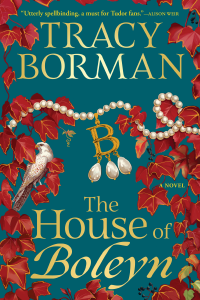
In The House of Boleyn (Grove Atlantic, August 2026), Tracy Borman, lauded historian and novelist, sets Hever at the heart of everything. She describes writing a novel about Anne Boleyn as “a long-cherished dream,” explaining: “I’ve studied the Boleyns throughout my career as a historian and in dramatising their story I really wanted to bring a fresh perspective. The idea for centering it at their beloved home came to me from one of my favourite TV shows: Downton Abbey. I thought it would be fascinating to see the Boleyns in their natural habitat and explore what life was like for those who served them.”
Anne’s story is one that has endured across the centuries. “To millions of history fans across the world,” Borman says, “Anne Boleyn holds the same powerful and magnetic appeal that she wielded over Henry VIII and his court 500 years ago. Partly, this is because her story is so dramatic and controversial that it is irresistible to novelists, historians, film-makers and history fans across the globe. But a large part of Anne’s appeal is down to the sheer force of her personality. All the contemporary commentators were at pains to stress that she was not beautiful. And yet thanks to her charisma she had an army of admirers at court – chief among whom was the King of England himself. I think as well, Anne is the most relatable of the six wives for modern audiences: she wasn’t willing to fit the mold imposed by Tudor society of a meek and submissive woman. She had ideas, opinions, ambitions, and wasn’t afraid to voice them, even when it placed her in danger.”
Almost all the action in the novel takes place at Hever, with the narrative told from a range of points of view. The actual date of Anne’s birth is unknown, but Borman adopts the earliest likely year of 1501, and the story follows Anne from age eleven onwards, beginning in 1512. Whoever is at Hever throughout the following decades, as Anne’s dramatic tale unfolds, becomes the narrator of the novel. It’s an approach that allows Borman to introduce new perspectives and lesser-known characters, and “give readers an entirely new take on their famous story.”

author photo by Sophia Spring
This approach brings surprises. Borman singles out a character who takes on new importance in her novel: “Anne’s grandmother, Lady Margaret Butler, was one of the wealthiest and most powerful women of her age, and yet she has largely disappeared from history. She would have wielded a considerable influence over the household at Hever and her granddaughter in particular, so I loved bringing her to life. But readers beware: there’s a sudden and tragic twist to Margaret’s story… and it happened in real life.”
Familiar characters are also explored in a new light, for example, Jane Boleyn, Lady Rochford, wife of Anne’s brother George. “So often,” says Borman, “she’s portrayed as the villain of the Boleyns’ story. The theory is that she gave Thomas Cromwell evidence of an incestuous affair between her husband and sister-in-law Anne which sent them both to their deaths. But I found not one shred of evidence to support this: in fact, Jane seems to have been trying to save them. I loved rehabilitating Jane in this novel and creating a much more sympathetic – and true to life – version of her character.”
And that’s not all. Borman also has a new theory on “who really held Anne’s heart.” Reflecting on the difference between her non-fiction and fiction writing, she explains: “With fiction, I can let my imagination run wild and fill those frustrating gaps left behind by the sources. For The House of Boleyn this was particularly true of Anne Boleyn’s relationship with Henry VIII. Even though it’s one of the most famous relationships in history (and started exactly 500 years ago this year!) we only know half of the story. Seventeen of Henry’s love letters to Anne survive (in the Vatican archives, intriguingly) but none of her replies. We know he was obsessed with her, but what did she think of him? It was a joy to be able to tell her side of the story in this novel.”
Did Anne love Henry? Or if not Henry, then who does Borman think Anne was really in love with? Read The House of Boleyn to find out.
About the contributor: Kate Braithwaite is the author of five novels, including The Scandalous Life of Nancy Randolph (Joffe Books). An editor for the Historical Novels Review, she also publishes SIS-stories, a substack about sister relationships in history and fiction.