Launch: Linda Rosen’s Abandoning the Script
INTERVIEW BY KATHERINE MEZZACAPPA
Fitness professional turned novelist Linda Rosen, after living most of her life in New Jersey (and only a short trip into NYC) now lives with her husband in sunny Florida happily wearing sandals all year long. Linda’s novels are set in the “not-too-distant past” and examine how women reinvent themselves despite obstacles thrown their way—and they always feature a piece of jewelry! When she’s not writing, you’ll find Linda on the Pickleball court, in the pool, or reading with her feet in the sand.
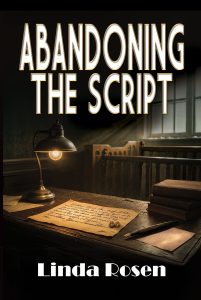 How would you describe Abandoning the Script and its themes?
Lucy never wanted the ring on her finger or the baby in the crib, but in 1922 there isn’t much she can do about it. She’s forced to make a painful decision and leaves behind a life she can no longer endure.
Three decades later, her daughter, Anna, uncovers a shocking secret in her grandmother’s journal that’s been hidden away for years. It casts doubt on everything Anna believes. Among the clues is the story of a pair of earrings, hinting at truths that defy what Anna has always known. Devastated and determined to understand her past, Anna embarks on a journey to unmask the truth only to discover the past isn’t just something to uncover—it’s something that could determine her future.
Abandoning the Script is a journey into the secrets that can define us and the courage that might set us free.
Do you write in other genres than historical fiction? What draws you to this genre?
Historical fiction is my genre. There’s a romance to the past, and I enjoy exploring it, setting my characters and scenes in time gone by, especially finding the words to vividly bring it to life.
What was the spark behind writing Abandoning the Script?
Several sparks inspired my novel. The first was discovering the Heterodoxy Club in The Lions of Fifth Avenue. Learning about these unconventional women of the early twentieth century and the subjects discussed at their secret meetings fascinated me, and after further research, my characters began to take shape.
I also wanted to explore a question inspired by real-life stories I’ve heard, and of one of the Heterodoxy women: How could a mother ever abandon her child? That question led me to create Lucy, my protagonist, and give her a backstory I hope readers will understand and sympathize with.
Finally, my love of writing about female friendships played a role. I’ve been fortunate to have lifelong friends since childhood, and I wondered what would happen if one of us suddenly disappeared. Combined with my tradition of weaving heirloom jewelry with hidden secrets into my novels, the story was born.
As a reader, I found plenty of contemporary resonance in this book, even if it describes events of a century ago. Was that by intent, accident, or a realization for you too?
I have to say, it’s all three. It’s my intention, in all my books, to weave women’s equality issues into the story and, sadly, many times those issues resonate with us today. Though when I first started writing, I didn’t realize I was going to do that, so I suppose one could say it happened by accident, and once I realized I was doing that, it became my intention.
Your protagonist is unconventional in her time: a would-be actress, a smoker. She’s also middle-class, which in theory should give her more agency but in practice not. How did you derive her character?
Lucy is a composite of several women from the Heterodoxy Club. I’m drawn to women who were considered unconventional simply for wanting intellectual, artistic, and personal freedom. Lucy is upper middle-class, educated, and theoretically has more agency than many women around her, but she is still constrained in ways that are often invisible, and some quite visible once you read the story. Combine that with my own imagination in creating her backstory, and Lucy was born.
You have a great eye for period accuracy: the shellac of the phonograph record, the Foot-o-scope, or the weaving in of historical figures such as Margaret Sanger, Anthony Comstock, and Etta Caulfield. Tell me a bit about your research process: what you leave in, what you leave out.
Thank you! Finding those details is one of the joys of historical fiction. Hot Bed by Joanna Scutts was invaluable for learning about the Heterodoxy Club. Along with newspapers, websites for descriptions of clothing, furnishings, and everyday objects, I also spoke with actors and women who remembered the 1920s, a mother who had abandoned her child, and children whose mothers had left them.
Living near New York City, I walked the neighborhoods where Lucy and Anna lived to capture the atmosphere. In fact, recently I was driving through Greenwich Village and passed Thompson Street, where Helen and Crystal lived, and felt as if they were alive, that I could stop in and say hi. A true highlight of my research was chatting with Fiona Davis who introduced me to the Heterodoxy Club.
Which character did you find most challenging to write and why?
Lucy is the most challenging character I’ve ever written. Once she told me her backstory, I understood her and was able answer the question that set this story in motion—how can a mother abandon her child?
Abandoning the Script reads convincingly as if it is not just a novel set in the 1920s, but written in the 1920s. Tell us something about the literary influences on the novel’s style and voice.
Thank you for the beautiful compliment. I can’t pinpoint any novels or authors in particular, though I am drawn to books by Fiona Davis, Susan Meissner, and Patti Callahan Henry to name a few, so it’s possible those have, unconsciously, influenced my style.
What are you working on now?
A story set during the devastating 1928 hurricane in Delray Beach, Florida, with a gold locket that holds a secret photograph.
 What writing tips would you like to share?
Be the camera, use your zoom lens to give us the scensory details—the dust on the tabletop, the depression in the seat cushion, the sweet scent of apple cake baking in the oven, then pull back and bring us into the rest of the room.
What is the last great book you read?
That’s a tough question. I’ve read so many, but I’ll say The Bookclub of Troublesome Women by Marie Bostwick.

HNS Sponsored Author Interviews are paid for by authors or their publishers. Interviews are commissioned by HNS.