Launch: Barbara Kent Lawrence’s Both Sides of the Pond, My Family’s War: 1933-1946
INTERVIEW BY ELLEN IRWIN
Dr. Barbara Kent Lawrence is the author of many articles and nine books, including an award-winning dissertation. A former professor, she has taught courses in anthropology and sociology, research, and writing non-fiction and memoir. Lawrence grew up in New York City and Washington, D.C., then earned a BA in anthropology from Bennington College, an MA in sociology from New York University, and an Ed.D. in Administration, Policy and Planning from Boston University.
How might you briefly summarize Both Sides of the Pond?
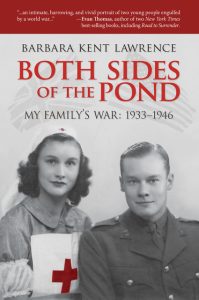
She captivated audiences until war demanded more of her and her beloved brother.
In 1939, British film star Barbara Greene begins a life-changing romance with Joe Kennedy Jr., son of the American ambassador. But as Europe edges toward catastrophe, her life takes an extraordinary turn. Crossing the Atlantic, Barbara trades scripts for survival, eventually flying across the eastern United States to rally support for Britain in its darkest hour.
Meanwhile, her brother Kent is thrust into the brutal reality of combat, from the chaos of Dunkirk to relentless campaigns in North Africa, Sicily, and Burma. His war is fought in mud, fire, and sacrifice, hers in courage, reinvention, and defiance.
Together, their intertwined journeys reveal a powerful, deeply personal portrait of World War II, where love endures, dreams are shattered, and ordinary people are called to extraordinary acts.
Both Sides of the Pond is a vivid, emotionally charged story of resilience, romance, and the true cost of war.
Your novel takes us on a journey of your own family members as characters. Who were they to you, and what made you want to tell their stories?
In 2007, I found the photograph that now graces the cover of Both Sides of the Pond. The subjects are my mother, actress Barbara Greene, and her brother, Kent. Their beauty and innocence struck me, knowing what they would later face as World War II enveloped their lives. My parents died within months of each other when I was thirty. Discovering the photograph of my mother and uncle years later made me want to know their stories.
I hardly knew my uncle because he lived in the UK and I in the US, and I was not close to my mother. Learning their stories has helped me appreciate them, and for that I am grateful.
What internal challenges did your characters face amid the external challenges of war? What did you learn from them?
My uncle could have avoided joining the military. He was too old to be drafted, at least at the beginning of the war, and he worked in a protected industry. Despite this, he enlisted only a few days after war was declared. He was assigned to the Royal Army Service Corps and left with the British Expeditionary Forces for France in early 1940. As a woman, my mother could have avoided serving altogether. She might have joined other actresses entertaining troops but instead joined the Voluntary Aid Detachment to serve in hospitals. They were deeply patriotic and determined to fight against the Germans to protect Great Britain from invasion, teaching me that if you care about something, you must act to protect it.
Are there any special tidbits about the characters from primary sources that grabbed hold of you while researching?
I was fortunate to find many people who either knew my mother or uncle during this time or could interpret original sources such as war diaries, service records, ship’s manifests, and passenger lists. Three people, however, stand out.
Major Philip Malins was a Driver in the Royal Army Service Corps and served with my uncle in France. His stories about marching into Belgium as the German Army invaded, seeing refugees trying to escape south, and then escaping himself to the beaches near Dunkirk, were essential to learning about what my uncle had experienced.
When I found the passenger list for the voyage of the Warwick Castle, on which my mother sailed from Glasgow to Saint John, Canada, I reasoned that I might find a man who had been a boy on the voyage to help me know what the passengers experienced. A man would be less likely than a woman to have changed his name, and if that name were distinctive, he might be easier to find. And there, only a few places from my mother’s name, I found Humphrey James Marten-Smith. I found his address in England and wrote him. About three weeks later, the phone rang and a British voice said, “I’ll be gobsmacked.” Jim became a close friend and ally, sharing many details of the trip I could never have uncovered without him.
I spent many hours in the John F. Kennedy Library searching for confirmation that my mother had loved Joseph Kennedy, Jr. One day I opened a file to find three letters, one from my mother to Ambassador Kennedy telling him she could not meet him on the day he had invited her for lunch, a second from my grandmother thanking him for flowers he sent her while she was in a hospital, and a third marked “C.”
Librarian Stephen Plotkin, who had already helped me in many ways, explained that “C” meant “Confidential” and that I could not see the letter. Then he added, “But she was your mother. I’ll get it for you.” In the letter, my mother told Ambassador Kennedy that she was in love with his son, but she also seemed to understand she would never marry him.
You have been published extensively in academic journals and magazines related to your professional fields of study. What made you choose to move into historical fiction?
I wrote the first draft of Both Sides of the Pond as non-fiction but felt frustrated by the result. I had written my dissertation about the influence of culture on aspirations in Maine and from that developed a love story—a forbidden relationship between a summer girl and a year-round boy. I wrote the novel Islands of Time from the girl’s perspective, and then a sequel narrated by the boy: The Other Island, Ben’s Story. Writing these novels made me think that writing Both Sides of the Pond as an historical novel would let me create dialogue and diaries to hold the story together if I based them on the facts I unearthed.
 What encouragement would you give to aspiring authors in our genre?
Write. Write about something or someone you care about. And read Anne Lamotte’s book Bird by Bird. Accept her advice to write a “shitty first draft.” Give yourself and the draft some space and read it aloud, then ask a few people you trust to read it and be open to their criticisms and suggestions. You don’t have to agree with them, but you do need to learn what is true for you.
And find your own process. Mine involves playing a game of Simple Simon to tune up my brain before I begin organizing my work list and writing. Some may find this process ridiculous, but it works for me. You must find what works for you.
What is the last great book you read?
James by Percival Everett

HNS Sponsored Author Interviews are paid for by authors or their publishers. Interviews are commissioned by HNS.