Launch: Kate Khavari’s A Botanist’s Guide to Tradition and Treachery
INTERVIEW BY MALLY BECKER
Kate Khavari is the USA Today bestselling author of fiction ranging from historical mysteries to high fantasy epics. She spent the majority of her childhood memorizing Sherlock Holmes’s and Poirot’s greatest quips. She lives in the Dallas-Fort Worth area of Texas with her husband, two children, and a lovely garden that contains absolutely no poisonous plants.
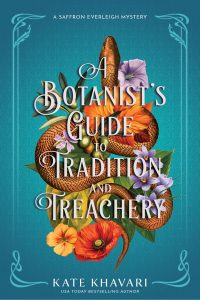 How would you describe A Botanist’s Guide to Tradition and Treachery?
In the 1920s, botanist Saffron Everleigh is on the adventure of a lifetime: an expedition to the ruins in Smyrna, Turkey, with her fiancé, Alexander. But sabotage and missing artifacts quickly endanger her career and presence on the expedition. When a fellow crew member dies suddenly, Saffron is targeted as the main suspect. She and Alexander must find the real killer and prove they have nothing to do with the larger conspiracy plaguing the expedition.
What drew you to set this mystery in Smyrna, Turkey, in the 1920s?
I visited Turkey many years ago, so I tried to combine what I remembered of the warm culture and beauty with the details I learned of the history of the country and its development. Smyrna itself was chosen off-hand because it was a place with plenty of archaeological interest for Saffron and her companions to investigate, but as I researched more deeply, it became more interesting.
The Smyrna Catastrophe of 1922, right at the end of the Greco-Turkish War, saw half the city burned to the ground as Greek soldiers fled Turkey. That recent history added a cool extra layer to the various conflicts brewing in the background, especially because Saffron’s fiancé is Greek, which positions the police against him.
Your descriptions of the archaeological dig are wonderful! What were the most valuable resources you found for readers who want to learn more?
Thank you! I spent so much time working on my understanding of the geography and historical layers of the agora (marketplace), so it’s so nice to know it plays out well on the page. The agora had been explored in fits and starts over the century preceding Saffron’s 1924 dig, so I found the historical record closest to that time, one done by a Turk in 1932, and used that as a guide for how much of the agora and surrounding structures might have already been dug up.
Now, the site is mostly dug up and much has been rebuilt. The local government of Izmir (Smyrna’s contemporary name) has several excellent online tours I spent much time studying, as well as numerous travel blogs, vlogs, and a lot of time squinting at Google Maps!
Saffron is an outsider in Smyrna. Does the unfamiliar environment and language shape the way she solves crimes?
In London, Saffron has gathered various resources over the course of four other mysteries: she’s on good terms with some police inspectors, she’s got access to libraries and laboratories and experts at the university, and she has two pals who are always on board for a bit of mischief in the name of solving a crime!
In Turkey, she has none of that. She’s only got Alexander, who, at long last, has come around to the idea of her sleuthing, and in fact must do some investigating of his own to prove her innocence. There is a cultural clash with her very modern, very Western way of doing things, and that puts her in contention with the local police inspector investigating the murder. Plus, at some point, she is put behind bars and must work with Alexander to put together the clues without getting to do all the sleuthing herself.
Alexander Ashton is Saffron’s love interest and a fellow scientist. His Greek family background complicates the story, particularly in his clashes with law enforcement.
That was a wrinkle in history that certainly worked to my advantage in the plot of this story, since his heritage reinforces the judgments the local inspector levels against both him and Saffron. It was an opportunity to show just how much is going on in Smyrna in the background of this foreign expedition team coming in to work at the agora, and a chance to portray the local Turkish characters three-dimensionally. Some held prejudices and trauma in the wake of the back-to-back wars they went through, while others embraced the visitors or shrugged off their presence.
What’s your approach to plotting a historical mystery? Do you begin with the crime, the historical context, or the character arc?
This particular story started with the desire to honor the long tradition of sending your sleuth abroad to an exotic (to them) location, where murder and mayhem will thoroughly ruin their vacation.
I’m a huge fan of Agatha Christie’s Poirot mysteries set abroad, particularly Murder in Mesopotamia, and so an archaeological dig site became my setting. The character arc certainly inspired the plot of this story, particularly the arc of Saffron and Alexander’s relationship. He’s been reluctant (and at times outright hostile!) toward her working on investigations, and so this story had to force him to reckon with that, and forces Saffron to utterly rely on him in a way that, for a driven, competent woman seeking to prove herself, is very uncomfortable.
This novel marks a new stage in Saffron’s personal arc. What do you see as the biggest challenge she’ll face going forward?
The conclusion of this book puts Saffron in a precarious position in more ways than one for her return to London. She’s going to have to make difficult decisions in every sphere of her life in the next book! And yes, there will be another Saffron Everleigh Mystery!
What is the best writing advice you have to share with new historical fiction writers?
My best advice for all writers is always to keep writing! Your skills will only grow with every new project, and we can’t get hung up on just one story, waiting for it to get published.
My specific advice for historical fiction writers is to take whatever historical element that you love and run with it. Make it a selling point of the piece. For me, the science of botanical poisons fascinated me, and it’s become an essential part of each mystery and one that readers enjoy reading about.
What’s the last great book you read?
The Facemaker by Lindsay Fitzharris

HNS Sponsored Author Interviews are paid for by authors or their publishers. Interviews are commissioned by HNS.