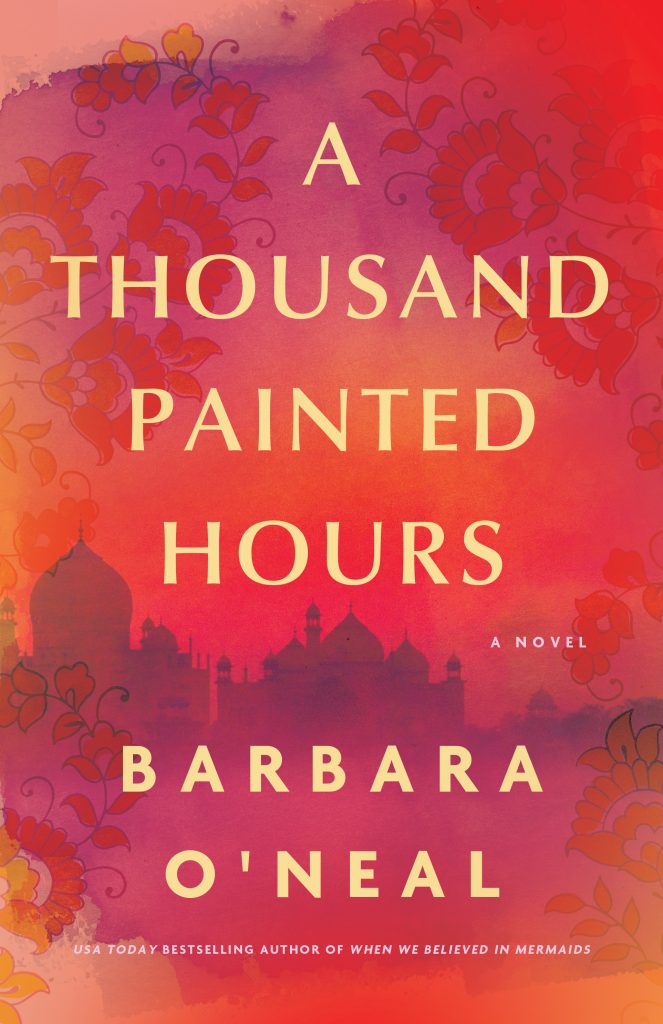
Launch: Barbara O’Neal’s A Thousand Painted Hours
INTERVIEWED BY WAHEED RABBANI
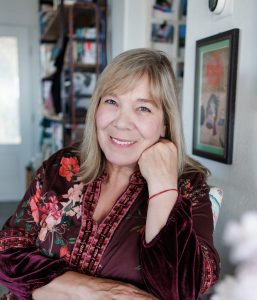
Barbara O’Neal is the author of more than a dozen award-winning, bestselling novels, including the runaway bestseller, When We Believed in Mermaids. Barbara is an avid traveler and passionate cook. When not writing, she loves to walk long distances. She has completed the Camino de Santiago in Spain and climbed to the top of Pikes Peak in her hometown of Colorado Springs, Colorado. She and her British husband currently reside in a beach house on the Oregon coast.
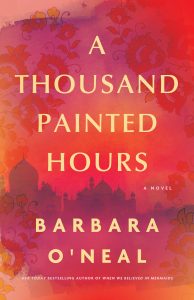 How would you describe A Thousand Painted Hours and its themes?
A British artist and a Sikh prince fall into a love that carries them from prewar England to India, Kabul, and the London Blitz. As empire, marriage, war, and family duty pull them apart, they must decide what price they are willing to pay to be together or resolve to let go.
It seems this is your first historical fiction novel. Why did you choose to write about this period in British Indian history?
In an earlier period of my career, I wrote quite a few history-heavy historical romances. The market shifted toward time periods that didn’t interest me, and I was doing well with my contemporary work, so I let it go. I remain an avid amateur historian and have vast collections of material on the Blitz, the Bloomsbury artists and writers, the era of the British Raj, and the history of the twentieth century in England. My abiding interest in India has shown up in other books, notably The Art of Inheriting Secrets and The Last Letter of Rachel Ellsworth.
What was the inspiration for the intriguing title, A Thousand Painted Hours?
I brainstorm with a small group of writer friends about such things, and in one of those sessions, A Thousand Painted Hours emerged as the clear winner. It holds time and artistry in a way that really appealed to me.
If you’ve been to your novel’s settings in person, what details from your journey did you weave into the story?
My husband is English, so I’ve spent quite a lot of time in England, in London and in the countryside, and have toured northern India, so the settings were all quite clear in my mind. I love the desert austerity of some parts of India and the richness of the mountains. And truly, there is no place lovelier than the Kentish countryside. All those flowers! All that greenery! The dripping willow trees!
Is there a specific place or object within the story that means a lot to you?
One of the sparks for the story was an Anthony Bourdain episode on India. He interviewed a lonely, ancient maharaja who lived in a weary palace somewhere in the mountains, and the feeling of the place stuck like a shard of glass in my heart. The falling-down houses in England also catch my imagination, both palaces and great piles of relics of times gone by.
Which of the novel’s two main characters challenged you the most?
I felt both of them quite clearly, honestly. They had been in my imagination for almost four years before I started writing, and Elsie became so insistent that I listen to her story that she inserted herself into my last novel!
However, working to make sure I got Tanveer on the page in a way that felt clear and truthful was a lot more stressful than with Elsie—I did a tremendous amount of research and also had several sensitivity reads to help uncover places I might have gone astray. That said, I’m sure I have missed the mark at times. I really, really wanted him to be Sikh, because I admire and respect the faith so much, and it is often misunderstood, especially in America, where people have a lot of misconceptions about turbans.
Given the emotional ending of the book, do you plan a sequel? Or, if not, what book is next in your writing plans?
I tend not to write sequels, though you never know what the muses will ask for. I did not want to leave these characters behind at all, so the possibility is higher with these two. Of course, up next in that historical timeline would be the Partition, which would be… a lot.
The book I’m currently writing is a novel about Hawaii set in two timelines, 1929 and the modern day, which grapples with some of the same ideas as in A Thousand Painted Hours—who belongs to a place? How have the forces of colonialism shaped the way we see the world?
 Based on your writing experience, what advice can you share with HNS members, particularly regarding the first-person point of view and alternating timelines?
I find first person a very compelling way to draw readers into a world they might not be familiar with. It’s much more intimate, and it orients a reader instantly into whatever world we are giving them. It can also spare some of the awkwardness of colloquial language that is technically correct but sometimes off-putting to less patient modern readers.
Letters—of which there are many here!—also perform that intimacy function. Who doesn’t like to read the personal letter of someone? We get right into the heart and mind of the letter writer, even if they’re keeping us somewhat at bay.
Alternating timelines are, for me at least, a way to cover vast expanses of time. Creating a top story that carries a lot of urgency (the Blitz in this case) can help carry other time periods that might need to move in a more measured way. Once upon a time, we loved big epics, but readers are less likely to invest in a thousand pages of linear story time. (Although don’t tell Abraham Verghese!)
What is the last great book you read?
Like many other people, I absolutely loved Lady Tremaine by Rachel Hochhauser.

HNS Sponsored Author Interviews are paid for by authors or their publishers. Interviews are commissioned by HNS.