Launch: Joel Mark Harris’s The Ivory General
INTERVIEW BY ELLEN IRWIN
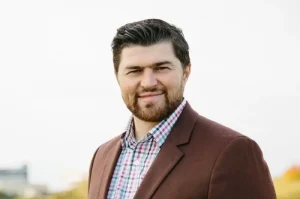
Joel Mark Harris is an international Amazon bestselling ghostwriter and fiction author. His first novel, A Thousand Bayonets, won an Editor’s Choice Award and the Pinnacle Achievement Award for Best Thriller. His feature-length film, Neutral Territory, won ten awards and played in festivals across the world.
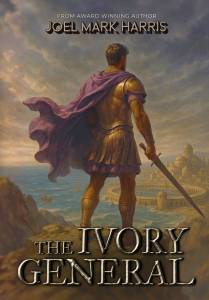 How would you summarize this novel in a few sentences?
The Ivory General is a historical epic of ambition, courage, and destiny set during one of the most consequential wars the ancient world has ever known. While the legendary general Hannibal Barca brings his might against Rome, a young noble named Scipio begins his long and uncertain path toward becoming the only man who can stop him. On the opposite side, Blanco, a Carthaginian soldier, must learn the brutal realities of war and what it means to be a man.
What was your inspiration for writing a story set during the Second Punic War, from the perspective of characters on opposing sides?
I was watching the show Spartacus and thinking about how sick and tired I was of the usual books we get about Julius Ceaser, Marc Anthony, and Pompey. I looked around for other interesting time periods, and to my astonishment, I only found a few books on the Second Punic War, which has just as many interesting aspects as Caesar’s Civil War, if not more.
It has Scipio Africanus who (spoiler alert) eventually defeats Hannibal. It has Quintus Fabius Maximus Verrucosus, known as the Delayer, and who arguably invented guerrilla warfare. His Fabian strategy was used by George Washington in the American Revolutionary War. Then, of course, it has Hannibal himself. I don’t think I need to go into his feats.
Both Blanco and Publius desire to prove themselves during a time when there are great obstacles to their desires. How do you relate to them? How might readers relate to them?
This first book is, at its heart, a coming-of-age story. It follows two young boys searching for their place in a world that seems, in many regards, too large and too indifferent to notice them. Neither feels fully seen—by their parents or by the society around them—and that quiet sense of invisibility pushes them toward rebellion. Yet each responds in a different way, shaped by the paths laid before them and the choices they must make.
As the shadow of Hannibal’s war stretches across their lives, both boys are forced to grow faster than they ever imagined, discovering that the search for identity often unfolds in the crucible of conflict.
In the end, their journeys are not only about war and history, but about the universal struggle to be seen, to belong, and to become the people they are meant to be.
Was there an historical figure, fact, or cultural element you came across in your research that gripped you and influenced your telling of The Ivory General?
There are many fascinating historical figures from this period, but what captured my imagination most was Carthage itself. Almost nothing survives from the city or the civilization that built it. Unlike Rome, whose history was carefully preserved, Carthage was largely erased, leaving us with only fragments and the accounts of its enemies. As a result, we know surprisingly little about the people who lived there, the streets they walked, or the lives they built along the shores of the Mediterranean.
I often think of Carthage almost like a historical Atlantis—a powerful and influential city that once dominated its world, yet now exists mostly in echoes and ruins. It’s strange to imagine that a city capable of challenging Rome for control of the ancient world could vanish so completely from the historical record.
That mystery is part of what drew me to write this story. We have plenty of stories about ancient Greece and Rome, but very few about Carthage. Fiction allowed me to step into those lost spaces of history and imagine the lives of ordinary people who would otherwise remain invisible—soldiers, families, merchants, and dreamers whose stories were never written down but were no less real.
Were you able to travel to any of the destinations you wrote about in this novel? If so, how did the experience enhance your story?
Yes, I was able to go to Rome for some research but sadly not Carthage itself. It was embarrassingly my first time in Rome, but I was able to spend a couple of weeks there taking in the sights. Scipio’s family tomb was closed, but my girlfriend and I managed to sneak in. It was an unbelievable experience.
 Are you planning on writing further novels in this historical era?
Yes, I really want to explore Carthage more. The Ivory General is the first book in the Chronicles of Iron and Ivory, which continues the journey of Blanco and Scipio. But I also have a whole prequel planned that centers around Blanco’s father and his experience during the First Punic War.
You are an international bestselling ghostwriter, the founder of The Writer’s Manor, a community for authors telling powerful stories, and the author of over 50 books, including an award-winning debut novel under your own name, A Thousand Bayonets. What is the best writing advice you can share with other writers of our genre?
Oh, that’s a tough one! For historical fiction writers, I think allow yourself to be playful in your time period. I’m not too much of a stickler for detail. I understand those who are, but I always believe the story comes first. Regardless, just be curious. It’s so easy to start doing research these days. There are some wonderful stories out there that I don’t believe have been told properly.
What is the last great book you read?
A surprisingly good read is Catilina’s Riddle by Steven Saylor. It’s a murder mystery set in ancient Rome.

HNS Sponsored Author Interviews are paid for by authors or their publishers. Interviews are commissioned by HNS.