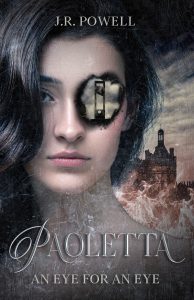
Launch: J.R. Powell’s Paoletta: An Eye for an Eye
INTERVIEW BY CAROLYN NEWTON
Originally from the UK, J.R. Powell currently lives in Germany, where he works as a translator and editor. He has long been fascinated by history, especially the French Revolution and the Napoleonic era, and also enjoys juicy, twist-filled thrillers. The idea for Paoletta first came to him while living in Paris. Paoletta: an Eye for an Eye, is his debut novel and an article on the novel has appeared on NationalWorld.
How would you describe this book and its themes in a couple of sentences?
Paoletta: An Eye for an Eye is a gritty, female-driven historical thriller set in the dark heart of the French Revolution – a stark reminder that in times of chaos, innocence is the first to fall, and vengeance always comes at a cost paid in blood.
 What drew you to Paoletta’s story and inspired you to write this book?
I wanted to create a piece of historical fiction with the grit and energy of a modern, nail-biting thriller. The French Revolution has always interested me, yet it remains surprisingly underrepresented on the historical thriller scene. What makes the Revolution particularly compelling is how relevant it still feels today – a time of unbridled greed and ambition, of civil war and repression, of authoritarian figures willing to spill blood to cling to power. Of course, the Revolution and the Napoleonic era that followed laid the groundwork for the Europe we know today,
Opting for a young female protagonist was tricky. When we picture the chaos and carnage of Revolutionary Paris, or high-stakes tales of betrayal and revenge, we don’t automatically conjure up women leads, at least not ones that appear delicate, unthreatening or ill-equipped for the task ahead. That’s why I created Paoletta Cadoville as a thin, petite, and seemingly unassuming figure. Her appearance allows her to slip under the radar for both readers and her fellow cast, giving her an edge that her male counterparts might not enjoy.
Some might argue it’s a cliché to set a novel about the French Revolution in Paris, especially given the legacy of classics like A Tale of Two Cities or The Scarlet Pimpernel, and the fact that other cities – Lyon or Bordeaux, for instance – experienced even bloodier upheavals. But Paris is a city I know well, having lived there for four years and being drawn in by the city’s history. Despite Napoleon III’s sweeping boulevards and the devastation of the Second World War, many parts of Paris remain strikingly unchanged since the Revolution. Away from famous landmarks like the Louvre and the Palais du Luxembourg, which still carry that history in their stones, it’s very easy to wander the pokey little passages of the Marais or the Latin Quarter and imagine shadowy figures, hidden blades beneath their coats, lying in wait in the darkness.
Your book is steeped in the history of 18th century France. How did you research this period to craft Paoletta’s story?
As someone who reenacts the Napoleonic Wars, I’ve become quite familiar with how it feels to wear clothing of the time. Mostly wool and cotton, it’s heavy, sweaty, often itchy, and far from comfortable. The shoes have a knack of aching if you stand in them for too long. It’s easy to believe that people were mildly dehydrated much of the time, given the lack of running water. I also know how to load and fire flintlock muskets and pistols – and how unreliable they can be – a ‘skill’ that came in handy when writing Paoletta.
My research extended into daily life: the foods people ate depending on their wealth, the perfumes women carried in trinkets concealed on their person, what passed as medicine if you ever had the misfortune of having to visit a convincing physician or a barely trained barber-surgeon. I even found an online converter for old currencies. Yet, the French Revolution remains extraordinarily complex, especially if we consider what was going on in the rest of Europe and the colonies. One of the greatest challenges was ensuring the accuracy of events, understanding their chronology, and deciding which ones my cast would realistically know about, react to, or be affected by.
Having lived in Paris, I was also able to visit many of the real locations where I set scenes, approaching them less as a resident and more as a researcher. Experiencing these spaces firsthand helped me visualize how my characters might move through them, what they could see or hear, and how feasible their actions would be. In some cases, visiting a location inspired me to rewrite entire scenes from scratch.
What is your educational and occupational background, and how has this affected your writing?
I’m a translator and editor who has worked for a number of organizations in Geneva and elsewhere, though I’m currently at the United Nations. Most of the texts I handle professionally are a world apart from writing a thriller, but having an in-depth understanding of how English works offers a deeper appreciation of the grammatical and stylistic tools available to create certain effects and evoke specific emotions in readers, something also honed through reading the work of other authors.
 Who is your favorite side character and how does he or she serve to support Paoletta’s journey?
They’re all rather unpleasant characters in their own way – I wouldn’t want to spend too much time with them in the real world, but Lyle Spice and Lucie Dufour were particularly enjoyable to write. Lyle, pompous and sly, has a talent for goading Paoletta into action by deliberately provoking her, something that serves both his interests and, at times, backfires. In doing so, he draws out her rebellious streak in Paris, pushing her toward decisions that either strengthen her resolve or chip away at her morality, depending on how you interpret them. Lucie Dufour, however, is fanatical yet deeply human – vulnerable to jealousy, doubt, and weakness. Through Lucie, Paoletta learns how fickle emotions can be and how easily cruelty disguises itself as charm or conviction. Lucie also exposes a selective kind of humanity, one that makes people seem likeable even as they reveal their darker sides.
What is the best writing advice you have to share?
As cliché as it may sound, let characters write themselves. You can try and map out every little quirk, twitch and doubt your characters may have, but I find that, ultimately, they do their own thing.
What is the last great book you read?
Blood & Sugar, Laura Shepherd-Robinson.
HNS Sponsored Author Interviews are paid for by authors or their publishers. Interviews are commissioned by HNS.