Launch: J. G. Harlond’s The Doomsong Voyage
INTERVIEW BY LESLIE S. LOWE
J. G. Harlond is the award-winning author of The Bob Robbins Home Front mysteries, The Chosen Man trilogy, and the new Doomsong series. Creator of the infamous Ludo da Portovenere, J.G. Harlond (Jane) writes historical crime novels set during the 17th century and World War II. She is currently working on a Viking-age historical fantasy series for younger (and not so younger) readers. Jane has also written a number of school textbooks for Oxford University Press. Leslie Lowe interviews her on her latest release, The Doomsong Voyage.
How would you describe this book and its themes?
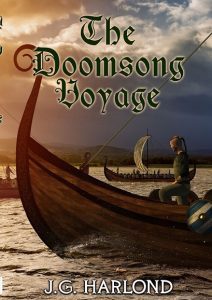
A coming-of-age historical fantasy. A lazy young tale-maker is tasked with finding a merciless Viking to lead people to safety before a volcano erupts.
 What inspired you to start writing historical fiction and what has been most rewarding about it?
The great Dorothy Dunnett inspired me, set me off on my travels as a young woman, but when I first started writing fiction, she held me back. Was I good enough? I doubted my ability, found and lost an agent, let life in the way. When my Spanish husband was posted to the Hague, however, I discovered a wicked conspiracy behind 17th-century tulipmania. As a result, my wily rogue Ludo da Portovenere set sail from Genoa (where I’d lived before) to create mayhem in Holland then make mischief for monarchs across Europe during the 1600s. My reward for waiting so long to get published was discovering some jaw-dropping but little-known historical scandals, bringing them back to life, and being offered a publishing contract. Which was Very Satisfying.
How is this latest novel different to A Doomsong Sword? How are Davor and Finn different?
I began The Doomsong Sword after a project on Norse myths and legends for a big publisher was cancelled. I’d become hooked on the subject so I re-worked the Volsung Saga Dragonslayer element using the fictional Davor. I then began to study Viking Age history and moved the story of the legendary Volsung sword into the 9th century, creating Davor’s descendent, Finn. Davor and Finn are imaginative tale-makers and both confront terrifying dangers. Davor was aided by a white wolf: Finn has help from a strange girl, who may be a shape-shifter. They share character traits, but their challenges differ greatly.
Why the focus on Norse Viking history now? Is there a key historical event you found in researching that inspired you to write this story to portray a key message for now?
I grew up on a Viking battlefield and knew almost nothing of the history – Tudors and Stuarts at school, political history at university. Now, however, I have a son living in Sweden. I spend time on the Baltic each year and I’ve become aware of the skills and courage required to go a-viking in open boats. The key event for The Doomsong Voyage is a recently verified early medieval weather catastrophe. Finn is tasked with saving climate refugees, which is something we can all relate to now.
How does Finn transform within the story? What did that journey mean to you as you wrote it?
When Finn sets out on his voyage, he’s a victim of his own imagination, gradually he learns to ask ‘why’ and take control of events. We have a large family and I was an educator for many years, I’ve watched adolescents grow through difficult phases and turn into splendid adults. They didn’t have to escape from merciless pirates, but I was examining how some people survive and succeed, and even benefit from facing up to scary challenges.
How do you think the reader will connect with Finn and Master Odo in this book?
Master Odo began as a Gandalf figure but while he is all-knowing, Odo is not always benevolent. Hopefully readers see this and fear for Finn, then sail into and out of danger with him.
How did you balance the research with writing? Did you find any interesting historical facts while researching?
The trouble with research is knowing when to stop. I have found some real gems down rabbit holes though, so I tend to dig pretty deeply. For the Doomsong series, I’m indebted to the historian Neil Price, whose Children of Ash and Elm (2020) gave me the climate crisis behind Fimbulwinter – which I tweaked for fictional purposes. I was also struck in other reading by how sophisticated trade between the Mediterranean and Scandinavia had become by the 9th century. Viking history isn’t just one bloody battle after another.
If I have to choose one special detail, it’s from the Anglo-Saxon Chronicle, stating how 23 longships sailed into a Devonshire estuary. This must have been utterly terrifying. If I had lived there then I would have seen them from our house. There was nowhere to hide and no means of escape. This is for the next story, though.
What are you working on now? Is it connected to the Doomsong adventures?
Work-in-progress is The Doomsong Legend, which brings Finn and Seren, a British thrall, to Wessex, and into Celtic and Anglo-Saxon history.
 You grew up in North Devon, England and now live in Andalucía, Spain. How has your life and work experiences, especially teaching international students been incorporated with or assisted you in your writing?
Moving from one country to another and meeting people of many nationalities heightened my awareness of how we have to adapt to new environments and cultures very different to those of our parents’ upbringing. I am also interested in how genetic inheritance informs our personalities and life choices. This, and being a stranger in a strange land, runs through my historical crime and fantasy novels.
Every author has their own publishing journey. Tell me about yours.
My writing life began decades ago with school textbooks, which taught me to work under pressure to tight deadlines but did not involve me in any form of marketing. This part came as a nasty surprise when my first novel was published. As a hybrid fiction author, I maintain my work discipline, but I really struggle with the self-promotion expected nowadays.
What advice would you give to other aspiring historical writers?
This is the best and the worst of times for a new author. Find reliable (alpha) beta-readers, use a professional editor, enjoy the time at your desk – and don’t delete first drafts, because one day they may be useful.
What is the last great book you read? Why?
I’ve just finished S. G. MacLean’s Damian Seeker series. Atmospheric scene-setting and clever crime-writing. Seeker has the dourest charisma I’ve ever encountered.
HNS Sponsored Author Interviews are paid for by authors or their publishers. Interviews are commissioned by HNS.