Launch: Della Leavitt’s Vivian’s Decision
INTERVIEWED BY REBECCA ROSENBERG
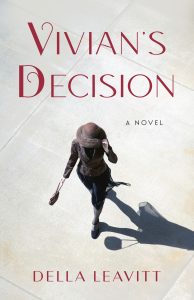
After careers in technology and mathematics education, Della Leavitt‘s debut historical novel, Vivian’s Decision (April 2026, She Writes Press), takes place in 1956. Della earned a grant from the City of Chicago’s Department of Cultural Affairs & Special Events (DCASE) and a fellowship from the Newberry Library while writing this novel.
How would you describe Vivian’s Decision?
Vivian Jacobson and her husband, Mel, Chicago-born children of Russian Jewish immigrants, face an unwanted fifth pregnancy and are grappling with having with a fifth child or following a referral to a storefront abortionist.
 What was the “spark” that made you realize you had to tell Vivian’s story, specifically within the setting of 1950s suburban Chicago?
I was always curious about the life of my mother’s Russian immigrant Jewish mother who I never met. I recalled how one of my late aunts shared a phrase she’d heard when a hostile druggist rebuked her sickly, pious mother: “If you don’t want this baby, I’ll take him!” I tried to imagine what brought my sickly grandmother to the druggist that day.
My Grandmother Della bore seven children, five at home in their tenement flat on Chicago’s West side. She died young and each of her children named a child in her memory. I wondered if Grandmother Della’s lack of control over childbearing shortened her life.
In early drafts, Vivian’s Decision was Vivian’s Jewish immigrant mother Hannah’s story. During subsequent revisions, as I explored Hannah’s daughter Vivian’s life, it became clear that mothers in the 1950s faced similar constraints to those of preceding generations.
In 1956, Vivian is a typical overwhelmed, mother of four when she’s faced with a similar, but all-too-familiar, critical decision as her immigrant mother. The choice of a 1950s upwardly mobile suburban Jewish family aiming to assimilate amid anti-Semitic housing restrictions was important in order to portray how an ordinary middle class Jewish family might agonize over taking this illegal action when faced with an unwanted pregnancy.
The 1950s are often romanticized as an era of suburban perfection, yet Vivian’s internal world is much more turbulent. What drew you to explore the “hidden” domestic anxieties of this specific time period?
Post-WWII, 1950s societal pressures for women to conform to the ideal of perfect homemaker and wife were more intense given preferential employment to returning GIs and fewer professional options for women outside the home. Added to that, Vivian was isolated and overwhelmed by the demands of caring for four young children under six years old.
Despite those pressures, Vivian and her husband Mel have more of an egalitarian relationship than a stereotypical one. When Vivian is distraught over a fifth unexpected pregnancy, Mel is reluctant for Vivian seek a termination from her trusted obstetrician, but ultimately, Mel respectfully cedes the ultimate decision to his wife, unusual for those times.
The “invasion” of seventeen-year cicadas is a recurring image in the novel. What was the inspiration for using this natural phenomenon as a backdrop to Vivian’s realization of her pregnancy?
Yes, the seventeen-year-cicadas became a vivid, visceral image as I imagined how suburbia must have felt like a foreign country to Vivian Jacobson who was born and raised in a crowded, multi-ethnic Chicago neighborhood. The noise and the mess of the cicadas that also scared her children, dovetailed with the chaos and stench Vivian had to contend with in a crowded home with overflowing, diaper pails awaiting pick-up from the diaper service.
The cicadas represent a natural infestation out of her control. Vivian had now escape from the children and the cicadas because Mel took their only car to commute to his family’s multi-generational business, a delicatessen-turned tavern in Chicago’s Maxwell Street market (similar to NYC’s Lower East Side), six long days/week.
Vivian’s Jewish heritage and the shadow of the immigrant experience play a significant role in how she views her choices.
As the novel unfolds, Vivian learns family secrets including when her Jewish immigrant mother faced a similar predicament, including when she was pregnant with Vivian herself. During the day-by-day week of final decision-making, Vivian and Mel also consult with their suburban rabbi who is more modern than those from the Orthodox shuls where they grew up with in their old Chicago neighborhood. From this rabbi, they learn even his family faced a similar quandary. Their remains in their hands when this rabbi informs them that the Jewish religion does not dictate a clear-cut action.
Vivian’s relationships with the women in her life—her mother, her sister, and Aunt Ruthie—show a spectrum of how women handled “the female predicament” before Roe v. Wade. Which of these secondary characters was the most challenging to write?
Yes, there are instances in the novel describing how women from both Vivian’s and preceding generations—both Jewish and non-Jewish—faced this predicament pre-Roe v. Wade. Another key female character is Vivian’s next-door neighbor and confidante, Jackie, who shares her own story, and importantly, introduces Vivian to Pulitzer Prize-winner, Gwendolyn Brooks’ poem, “The Mother (1945).” I received a license from Brooks Permissions to quote four lines and assure it be used “neither pro nor con abortion.”
I state the obvious to say that abortion has become an increasingly polarizing issue across today’s political spectrum. Yet despite efforts to codify restrictive laws surrounding reproduction options, abortion remains a deeply personal choice, no matter one’s political stance or religious beliefs. There are many reasons why a woman might consider taking this action.
I was a member of the Chicago Women’s Liberation Union and celebrated alongside the women of Jane, the underground abortion collective, on the night of the Roe v. Wade decision. I am outraged at nationwide legislation in recent years that usurps critical reproductive decisions from women and their families, endangering women’s health and sending us back to the dangers of the last century despite medical advances.
The two most complex and enigmatic secondary characters to write were Vivian’s unmarried older sister Ethel and her mother’s American-born, non-conforming, family friend, “Aunt” Ruthie Lavin. I seek to explore them further so I’m working on my next novel featuring these two women in 1930s Chicago. Ethel is seventeen in 1931. Aunt Ruthie widens her world by taking her along to Chicago’s artsy, bohemian Towertown neighborhood, frequented by anarchist Emma Goldman and hoboes, too. This area surrounds the Newberry Library (open since 1887). The Newberry faces Bughouse Square, site of many political speeches and polemics.
Mel is depicted as a loving husband, yet there is a profound silence between them regarding Vivian’s deepest fears. Why was it important to show that even in a “good” marriage of that era, a woman could be profoundly alone in her decision-making?
Yes, Mel and Vivian have a deep, loving relationship. However, this important decision is one that women have contemplated throughout time for various, individual reasons. A woman always alone despite what action she takes or doesn’t take. A truly loving partner recognizes that the aftermath and consequences ultimately belong to her no matter what she decides.
What is the best writing advice you have to share?
I would say find the structure that fits your novel best. After many revisions of Vivian’s Decision, I ignored a guiding principle I’d heard about how to use backstory. With only a heading to depict the change in time, I abruptly broke into the action and let the backstory unfold, sometimes for several pages. Many early readers reported how this style immersed them in the story, not take them away from it as I’d been cautioned. There are sections that take place in the 1920s, 1930s, and 1940s, while the main story that takes place over a few weeks in the spring of 1956.
What is the last great book you read?
Kin by Tayari Jones

HNS Sponsored Author Interviews are paid for by authors or their publishers. Interviews are commissioned by HNS.