Launch: Ben Bergonzi’s A Cruel Corpse
INTERVIEW BY DAVID CONNON
After a varied career in education and heritage, including spending time as a museum curator and as a manager of historical document digitization, Ben Bergonzi now works mainly as a reviewer and writer. His previous published book was Old Gramophones and Other Talking Machines. Born in the north of England, he has spent most of his life in the Midlands and the south of England; currently he lives with his family on the cusp of London and the Chiltern Hills.
What is your “elevator pitch” for A Cruel Corpse?
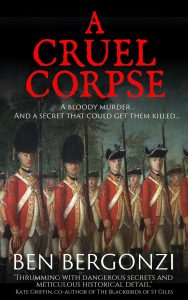
Imagine a female soldier, on the run from a powerful lover-turned-pimp. The military life, in a remote garrison, offers safety and stability. But what if a senior soldier is murdered and she is a prime suspect? Her only alibi would overturn her masquerade and that of the loyal friend who helps her. She has no choice but to turn detective, to try to solve the murder, however lethal this is for her and her friend.
 What inspired you to start writing?
Exploring another person’s mind and feelings has always fascinated me. ‘What would it be like to be …’ and ‘What if this happened?’ Since school, I have always enjoyed inventing characters and putting them into dangerous situations drawn from everyday life, or everyday life in the past. I grew up in Warwick where the High Street contains two medieval gateway arches. The local cinema used to show historical epics, such as Spartacus, El Cid, and Mary Queen of Scots.
As a teenager, I was captivated by Katherine by Anya Seton, and I started a novel also set in the 14th century. I moved away from writing fiction as a museum curator. I later digitized historical books and manuscripts. Old objects carry great stories within themselves.
The inspiration of A Cruel Corpse happened ten years ago. In the Warwickshire Fusiliers Museum, I saw a picture of Hannah Snell, an 18th-century female soldier in the regiment. That led to a short story set in Carlisle, where a female soldier uses her ability to disguise herself in a dress to solve a murder. Crime novelist Howard Linskey encouraged me to work it up into a novel.
Your story weaves together the theatre, the military, drumming, and an 18th-century apothecary. How does your occupational background affect your writing?
I gain background knowledge from reading, looking at pictures, and visiting old buildings and museums. Museum curation taught me to quickly research how an object was used. This knowledge adds realism to a story. Observing people in the workplace – how they talk and think – gives interesting details. Sometimes those details emerge later in my writing.
The Sealed Knot society, re-enacting the battles of the English Civil War, introduced me to historical military life. I was able to take part in battles with perhaps 3,000 soldiers on the field. We were all in our regiments with our flags and drums and officers, and then we went back to our encampments. We had to drill and march around and ‘hurry up and wait’ as real soldiers do. The experience taught me about soldiers’ camaraderie, the joking and banter that gets them through the day. Coupled with reading such books as The Journals of Corporal Todd, written in the mid-18th century, this was a great background.
You dedicated the book to your wife. How did she help you in your journey of writing the book?
Ewelina provides a lovely home and is great company. Unlike me, she is extremely practical and thrifty. This has helped us to be able to afford to retire early from salaried work, and thus have more time for our personal interests, writing in my case, gardening in hers.
During the hardest parts of writing and editing, what particularly inspires or encourages you?
The plot and backstory were difficult to get right. I wanted the story to start with female Hayden Gray (incognito as a soldier), and the discovery of Sergeant Beatty’s dead body. I had to explain to the reader, very early on, why she is there as a soldier, how she is managing it, and why Beatty, even dead, is a danger to her. It is a complicated setup. I wrote the first draft in first person, from Hayden’s point of view. I rewrote it in third person.
I heard my characters’ voices and felt their feelings. But I had to step back and consider my readers – what will be logical and believable for them? Great encouragement came from a long-term writing buddy (from a different fiction genre) and from a reviewer through the Historical Novels Society. Both gave excellent, actionable feedback.
What was the most enjoyable part of working on your book?
I enjoyed incorporating factual stories from history and paying tribute to favourite songs, poems and films. There is a high bar for research when writing battle scenes, such as Prestonpans. I enjoyed writing about a dishonourable defeat from the point of view of one of the losers.
 What have you learned about the human condition through your research and writing?
When a conversation between two people is going well there is a ‘third force’ there that leads it in certain directions. In the same way, when writing dialogue, the plot changes in unforeseen ways. I like novels where characterization and action come through dialogue, where the narrator doesn’t tell us what to think. Great exponents of this method are Nigel Balchin (A Small Back Room), Iris Murdoch, and Patrick O’Brian.
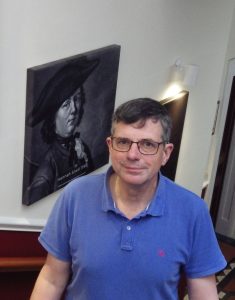
The past is the same game but with different rules. People have always been out for themselves, pledged to do anything for their mates, and enjoyed life with sex, drinking or good company. But in the past, there were strict laws of status and hierarchy, and the severely normative effects of dress standards. Until the twentieth century, few women ever wore trousers or breeches. Hannah Snell and other woman soldiers (including her American counterpart, Deborah Sampson) were exceptions to the rule. (Image left shows Ben with a museum painting of Hannah Snell.)
What is your next project, and how far advanced is it?
My next book is half finished. It will take Hayden and Jasper back to the world of the London theatre at a time when (as happened in fact) Prince Charles Edward Stuart made an incognito visit to England, well after Culloden. There will be a third book, in which they go to America.
What is the last good book you read?
Laura Shepherd-Robinson’s The Art of a Lie, published this month, combines detailed 18th-century research with one of the most fiendishly clever plots I have ever come across in any thriller, modern or historical.
HNS Sponsored Author Interviews are paid for by authors or their publishers. Interviews are commissioned by HNS.