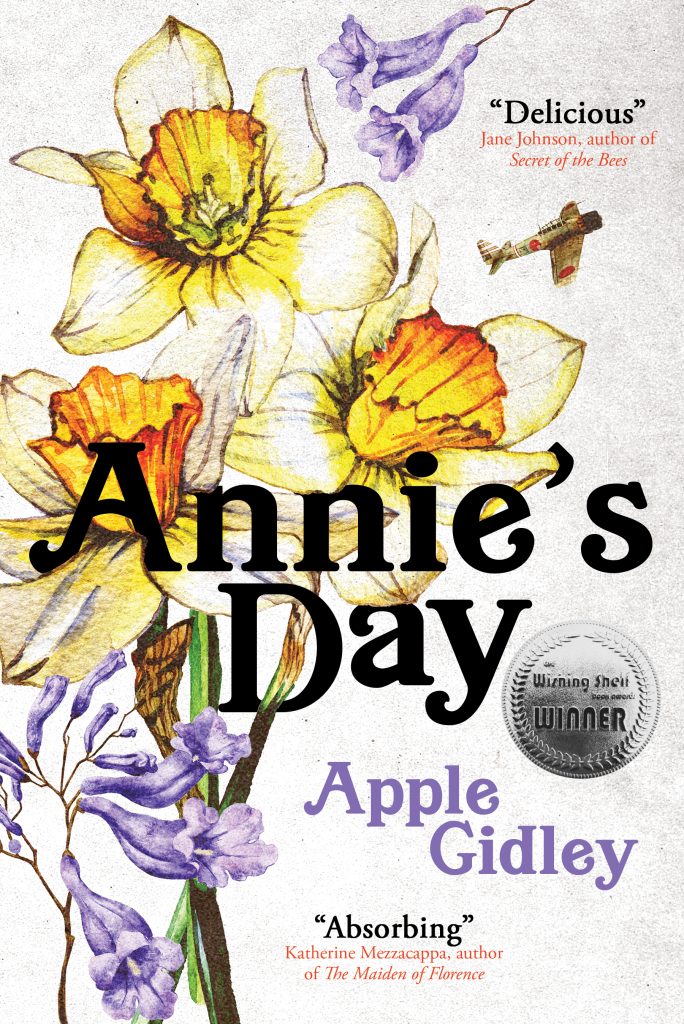
Launch: Apple Gidley’s Annie’s Day
INTERVIEWED BY LESLIE S. LOWE
A nomadic life has seen Anglo-Australian Apple Gidley live in twelve countries as diverse as Equatorial Guinea and the Netherlands, the experiences and cultures of which are reflected in her books.
She is the author of six books, predominantly historical fiction, and is currently published by Vine Leaves Press.
 How would you describe this book and its themes?
The fall of Singapore and the Japanese advance and subsequent retreat on New Guinea from an Australian army nurse’s perspective during World War II. Annie’s Day is a story of loss, hope, and fortitude as well as the power of female friendships.
What inspired you to start writing historical fiction? What has been the most rewarding about it?
I’ve always enjoyed history and culture, driven by a curiosity about the many countries I have called home. It is exciting bringing the past to life through fiction, which shines a light on sometimes little-known parts of the world or little-known events.
How is this latest novel different to your other books?
There is a theme in all my books—that of strong women daring to delve into a man’s world. Annie’s Day follows that trend, in that Annie defies her father when she enlists in the Australian Army Nursing Service.
I write geographically, rather than about a particular period. Fireburn and Transfer, the sequel, tell of the Danish West Indies thirty years after emancipation and the leadup to the islands’ sale to the United States in 1917.
Have You Eaten Rice Today? is a novel about the communist uprising in 1950s Malaya—a war that wasn’t a war!
Finding Serenissima was my first foray into contemporary fiction. In my naivete, I thought there would be less research. I was wrong. It was just a different kind of research.
Is there a key historical event you found in researching that inspired you to write this story with a key message relevant now?
Sadly, there always seems to be a war somewhere. Much has been written about men in wartime, and about the ‘backroom’ women—such as at Bletchley, as well as some wonderful biographies about women in wartime.
I wanted to write about war from a nurse’s perspective and about the resilience of women in sometimes unbearable situations.
Annie’s Day had been bubbling since my mother died in 2005. Her wartime experiences, not often spoken about, fascinated me, so I got her army records from the Australian army archives, and I was off. The novel follows her army movements, but the story is fictitious.
How does Annie transform within the story? What did that journey mean to you as you wrote it?
Encouraged by her mother, who believed in equal educational opportunities for boys and girls, Annie becomes defiant at her father’s evermore dismissive attitude. She is a strong character with a sometimes sharp tongue, which is gentled as the years pass, and by the stalwart friendship of her fellow nurses, no matter the physical distance.
I wanted to write a hopeful story that, despite the horrors of war, told of one woman’s courage and determination to lead a good and joyful life.
How do you think the reader will connect with Annie in this book?
It is a hopeful book which shows, despite regrets and sorrow, happiness is possible.
How did you balance the research with writing the story? Did you find any interesting historical facts while researching?
It is easy to get bogged down in research which, while interesting, does not move the story along.
Yes, I found something that truly shocked me—a cover-up by the Australian government about the 1942 Japanese massacre at Radji Beach.
What are you working on now? Is it connected to Annie’s Day or your other books in any way?
No. The next one will be a darker story, although again written from a woman’s perspective. But who knows? The characters tend to take on a life of their own, and I become their spokeswoman.
You were born in England and have called many countries home. How have your life and work as a magazine editor and cultural trainer been incorporated into or assisted you with your writing?
I left England at a month old and spent my first six years in Nigeria—for many years I told people I was African. By that reasoning I could add another ten nationalities to my list!
I believe in order to travel and live well in another person’s country, respect and curiosity are key. I hope my books incorporate some of that knowledge and the lessons learned.
I would like to think that having edited a regional magazine for an international charity, my own editing skills would be terrific. They aren’t. Killing one’s darlings is hard. I’m so grateful to all the editors I have worked with. They have made me a better writer.
Every author has her own publishing journey. Tell me about yours.
My process! Oh boy. Well, I’m a pantser rather than a plotter, and my stories are character driven. I invariably start with a place and period that interests me and, as I research, the main characters begin to evolve. Next, I write thorough character studies, which helps them come alive and makes their dialogue authentic.
I was fortunate my first book, Expat Life Slice by Slice, was taken on by Summertime Publishing, who specialize in expatriate writing. Fireburn, my first novel—well, not my very first, that one languishes deep in a drawer—was rejected about twenty times. Some of the rejections were quite pleasant, but rejections nonetheless!
It is gut-wrenching, and imposter syndrome gets a huge boost. However, I did believe in the book, and had pertinent and helpful comments from beta readers, so decided to go the hybrid route. I was fortunate with OC Publishing, who nurtured me through the process with remarkably little pain. They also published the sequel, Transfer.
Then, Vine Leaves Press, an indie publisher, took me on and have published my last three novels. Success is difficult to chart. My books sell, but it remains difficult to get mainstream bookstores to stock indie-published books, and that is frustrating. I get asked to speak at book clubs, which is fun as I love hearing a reader’s take on my work.
 What advice would you give to other aspiring historical writers?
Get your facts right! I believe it is the author’s responsibility not to mislead a reader with incorrect or massaged facts.
If I have to change a time frame to fit the story, I will explain why in the author’s notes. For example, in Have You Eaten Rice Today? I had the ancient printing press used by the communists discovered in 1952, when in fact it was found in 1953.
What is the last great book you read?
Alone in Berlin by Hans Fallada, translated by Michael Hofmann, first published in 1947.

HNS Sponsored Author Interviews are paid for by authors or their publishers. Interviews are commissioned by HNS.