Hollywood celebrity entertains troops during World War I: The Star of Camp Greene by Joy Callaway
 BY DENISE MORAN
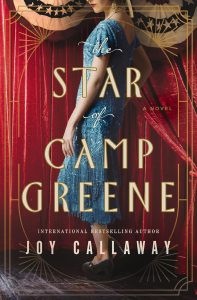
The Star of Camp Greene by Joy Callaway (Harper Muse, May 2025) presents the story of Calla Connolly, a famous singer and actress who entertains United States troops both stateside and at the front during World War I.
Joy Callaway is an international bestselling author of historical fiction and Southern contemporary romance. She said she drew inspiration for Calla Connolly after reading newspaper archives about Elsie Janis, whom she described as: “a renowned Broadway star who was over on a tour in London and engaged to a British stage actor when the war broke out. Her fiancé was quickly called to war and perished. Elsie returned to America and, wanting to do something to help the cause and honor her fiancé, approached General Pershing about performing at the front lines in order to lift the spirits of the men about to face the unthinkable. General Pershing declined at first, suggesting she perform at the stateside army camps as a sort of trial run. Elsie would succeed in her tour and make it to the front, all while funding her own shows and travel. Later, her performances sparked the idea to form the USO during World War II.”
Callaway added: “Although my main character, Calla, is different from Elsie in many ways, the two women share the same backstory.”
The book’s heroine contracts Spanish flu while she is entertaining troops at Camp Greene National Guard Training Camp in Charlotte, North Carolina.
Callaway noted that “there are striking similarities between what we experienced with COVID-19 and [what they experienced with] the Spanish flu especially when it comes to protocol. Masks, keeping a distance of six feet, and city-wide shutdowns were all implemented during the Spanish flu outbreak.”
The procedures were so similar that during the editorial process of her book, Callaway was asked if the protocols she described were, in fact, true to the time or adopted from our more modern experience with a pandemic.
“The key difference between COVID-19 and Spanish flu, at least from my research,” Callaway stated, “was that Spanish flu initially tended to strike the young at terrifying rates. I actually have a letter to this point from the president of Marshall University to my great-grandfather who was hoping to enroll when the pandemic subsided. Additionally, there was no vaccine available either as vaccines weren’t developed for the flu yet and understanding of viruses wasn’t as concrete. Despite the few differences, I think readers will understand the magnitude of the Spanish flu pandemic because of what we lived through with COVID-19.”
The author based her book in Charlotte, North Carolina.

author Joy Callaway
“I’m from Charlotte and currently live in Charlotte,” Callaway said, “so I had the opportunity to visit what would have been Camp Greene many times while I was writing the novel. There’s not much left of Camp Greene, but at one point it encompassed 8,000 acres, stretching from what is now uptown Charlotte to Gaston County, and housed nearly 60,000 soldiers – doubling the population of Charlotte at the time – between 1917 and 1919. The Dowd House, an old farmhouse that served as one of the camp’s headquarters, still stands, and road names like Remount Road, which paralleled the Camp Greene horse stables, still nod to the camp’s presence. There are also ruins of practice trenches in the woods in the Camp Greene neighborhood. Otherwise, evidence of the camp is completely gone. Many of the soldiers were housed in tents, and the other more permanent structures were dismantled and removed in 1919 when the camp closed.
“As a native Charlottean, it means a great deal to write about my hometown’s history,” Callaway noted, “especially because that bit of history is mainly forgotten. I absolutely loved combing through the archives of the Charlotte Observer and photographs of World War I era Charlotte, learning about what it would have been like to live here in a different time. Charlotte was a small town back then, very opposite to the large city it is today.”
Callaway believes bringing the past back to life “can teach us an immeasurable amount. It can warn us of horrors we should never experience again. It can embolden us through stories of women and men who dared to do the right thing despite adversity. It can encourage empathy. Writing historical fiction is unique in that it allows the writer and the reader to not only learn about a certain era or historic figure but also feel what it would have been like to step into another person’s shoes and live in the past. I think that it’s about as close to time traveling as you can get.”
About the contributor: Denise Moran has written two books for Arcadia Publishing on Hampshire, Illinois, and on Genoa and Kingston, Illinois. She was a freelance reporter for 19 years for The Chicago Tribune.