History & Film | Hamnet & Shakespeare as a Film Character
WRITTEN BY KRISTEN MCDERMOTT
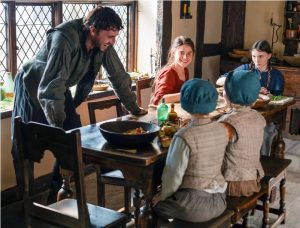 When my mother-in-law called to discuss the film Hamnet with her resident Shakespeare professor (me), she noted that, while she had read the novel the film was based on when it came out in 2020, my father-in-law had not. At Paul Mescal’s smoldering first appearance on the screen, he whispered to her, “Is he gonna be Shakespeare?”
To borrow a line from the Bard, that is the question: How did Shakespeare become Shakespeare? It’s telling that, in Maggie O’Farrell’s lauded novel, the poet and his wife, Agnes (the name recorded for Anne Hathaway in her baptismal record), are referred to only by their first names. In Chloé Zhao’s 2025 film adaptation of Hamnet, Shakespeare’s full name is only spoken a few times at the very end, as Agnes seeks her husband in the busy London streets, heading for the Globe Theater to see his new play, which shares a name with their young son who died in 1596.
That loss is one of the few historical details we actually have on record about Shakespeare’s life. His baptism, marriage, death, and the deaths of his family members, are all recorded in Trinity Church in Stratford-upon-Avon. A few other documents include his will, some cheaply printed copies of individual plays, a few real estate deeds and lawsuits, and of course, the folio edition of his plays, lovingly collected and published by his colleagues seven years after his death in 1616.
On these bare fragments of fact a long fictional tradition has been built to explain just how the glover’s son from a small market town in the Midlands became the greatest writer of English plays. Much of this fiction has been presented over the years as biography, beginning shortly after his death, when a poet named William Davenant, who claimed to be Shakespeare’s illegitimate son, shared stories of the poet’s youth and romantic exploits. None of these seem to be based in anything other than Davenant’s wishful desire to become a literary celebrity, but they fed a centuries-long tradition of imagining Shakespeare as larger-than-life in both talent and intellect. Beginning in the 20th century, however, both fiction and biography have countered that romantic image of the lone, divinely-inspired figure of genius, the “Soul of the Age,” with depictions of Shakespeare as a writer-for-hire, inspired more by money than by the classical muses, and (at times) perhaps even a plagiarist of his colleagues’ work.
Chloé Zhao and Maggie O’Farrell’s 2025 adaptation of Hamnet is part of a growing collection of film interpretations not of Shakespeare’s plays (there are hundreds), but of Shakespeare the man. The last three decades have seen several big-budget, full-length film explorations of the biographical Bard, including Shakespeare in Love (1995), Anonymous (2011), and All is True (2018).
The L.A. Times calls the list of Shakespeare-bio films “surprisingly short,” but Shakespeare as a character has made hundreds of appearances in fiction, drama, and film/TV, frequently in contexts that poke fun at our own tendency to think of the Bard as a kind of patron saint of English-speaking culture if not a superhuman figure himself.1 Four “biographical” feature films, however, seem to be inspired by the trend in Shakespeare biography that dominated the first decade of the present century, with bestselling, revisionary treatments of the historical life of Shakespeare from scholars such as Stephen Greenblatt (Will in the World, 2004), Bill Bryson (Shakespeare: the World as Stage, 2007), Charles Nicholl (The Lodger, 2008), Jonathan Bate (Soul of the Age, 2008), and James Shapiro (1599: A Year in the Life of Shakespeare, 2005, and The Year of Lear: Shakespeare in 1606).
Each screen Shakespeare offers us a different take on the psychology of a literary genius. Shakespeare in Love, arguably the most popular of the four films, was designed, according to its producer, Edward Zwick, to be a “behind-the-scenes” comedy about the making of Romeo and Juliet; Kenneth Branagh’s hugely successful Henry V and Much Ado About Nothing had renewed interest in Shakespearean film in the 1990s.2 This Shakespeare is an incurable romantic who struggles to reconnect with the youthful passion that inspired his poetry. The goal of this film’s dazzling script, written by the late playwright Tom Stoppard from a story by Marc Norman, is to create a Shakespeare not out of historical fact but out of his own words in a playful, knowing way. Joseph Fiennes’ Shakespeare is moony and boyish, an opportunistic actor/writer who only becomes serious about his work when he learns about the real price of love from a brilliant young woman, Viola de Lesseps. Gwyneth Paltrow’s heroine is a complete fabrication; her plan to disguise herself as a boy to play the role of Romeo in Shakespeare’s new play (and win the heart of the playwright at the same time) reflects our own modern desire to give women a more active part in the cultural world of Shakespeare’s theater. While the romance of Shakespeare in Love is pure fantasy, it does offer a surprisingly accurate depiction of the practical aspects of play writing, rehearsal, and production, and possibly significantly encouraged public interest in the “authentic” productions of the newly-built Shakespeare’s Globe Theatre in London.
The less said about the 2011 film Anonymous the better; its fantasy Shakespeare is a “drunken oaf,” an extortionist and murderer who frames the idealistic courtier Edward de Vere, who has been allowing the poet Ben Jonson to claim authorship of his brilliant plays. Director Roland Emmerich and writer John Orloff have combined almost every known conspiracy theory about the Shakespeare “authorship question” into one fever-dream of a historical thriller. Rafe Spall’s handsome but amoral Shakespeare is the equivalent of a modern day “tech bro” – an amoral, narcissistic self-promoter who succeeds in a new form of mass media by exploiting the talent of more idealistic, less ruthless artists.
A more realistic and heartfelt attempt to explain Shakespeare’s life drives Kenneth Branagh’s All is True. The 2018 film, in which he directed himself as the poet, finds 49-year-old Will in retirement at his home in Stratford in the year 1613. Branagh, arguably the most successful Shakespearean actor of the late 20th century, was inspired by the same question that inspired O’Farrell’s Hamnet: what was the link between the death of Shakespeare’s only son and the play that shared his name? Branagh chose to answer this question in retrospect, having the playwright return home after the burning of the Globe Theatre, to reconnect with the memories of the son he has mourned for 17 years.3 Again, the women of Shakespeare’s life take center stage in this version, as the sad, bewildered poet rekindles his love for his wife, Anne (played by Judi Dench), and learns that his memories of his son as a brilliant young poet were false – his daughter Judith was the actual author of the boy’s poems. The plot is as much about his adult daughters’ efforts to forgive their father for his long absences as it is about their father’s attempts to mend his own relationships. Nostalgic visits from his affectionate patron, the Earl of Southampton (played by Ian McKellen) and his friend and rival Ben Jonson (Gerard Horan), create an elegiac mood, which is lightened by the witty dialogue by screenwriter Ben Elton, Branagh’s frequent collaborator, who also created a comic TV series about Shakespeare’s home life, Upstart Crow (2016-20).
Critics were respectful of the film but noted that it was largely a vanity project for Branagh: an opportunity to work with Dench and McKellen, two other towering Shakespeareans near the ends of their careers, and to imagine the legendary historical figures as ordinary aging family men and women, grappling with domestic rather than literary concerns. All is True and Hamnet share the impulse to “humanize” Shakespeare by presenting him in the context not of the stage but of his lovingly re-created home and neighborhood. Branagh’s Shakespeare spends most of his time renovating his garden and eating meals with his family, reveling in the peace and quiet of sleepy Stratford; Zhao’s Shakespeare, however, is a caged tiger, a young man bursting with ambition who finds the cozy confines of that hometown stifling.
Zhao and O’Farrell’s Agnes is the invention of Hamnet, while their Shakespeare adheres closely to the few facts that we know about him. That even less historical evidence outlines the life of his family didn’t discourage renowned feminist scholar Germaine Greer from convincingly imagining Anne’s life in Shakespeare’s Wife, the 2008 nonfiction bestseller that was an immediate influence on Maggie O’Farrell when she chose to focus on Anne/Agnes in Hamnet.4 The film’s star, Jessie Buckley, quietly but powerfully reveals Agnes’ inner and outer lives as a mother, herbalist, and healer whose place in her own society, while invisible to the men of her world, is in its own way as consequential as the poet’s status in the literary world.
Will, played by Paul Mescal, is a serious, kindly adolescent who loves his mother and siblings and resents his abusive, overbearing father; he grows up quickly when Agnes (eight years his elder) decides that he will be her path out of her stepmother’s grim farmhouse and encourages Will to impregnate her. While she adapts joyously to Shakespeare’s family home and to motherhood, her husband chafes at the thought of life as a glovemaker like his father. In O’Farrell’s imagining, Agnes is the one who (with the help of her devoted brother Bartholomew) engineers a plan to send Will to London to seek orders for gloves from the theaters. A flashback scene that is not in the novel depicts the happy family – Agnes, Will, and their three children – performing plays in their back garden, explaining Agnes’ insight that such a life would make her discontented husband happy.
Mescal’s gentle “beta male” version of the poet, a doting family man who offers his wife friendship as well as status, resonates with today’s tastes in male protagonists. One specific change from the book to the movie supports this characterization of Shakespeare as a modern ideal: the novel’s Agnes is angrily aware that her husband is having affairs in London, while the film’s Will remains a faithful partner.5
Greer and other scholars of women’s lives have recently developed a historical portrait of the influential community of hardworking women that organized and even financed much of Elizabethan society, although (until recently) invisible to historians of the period. The “girl boss” version of Shakespeare’s mostly-female family is very much of the present moment, and may account for the enthusiastic embrace the film has received from audiences and critics alike. And although its Agnes is a fiction, the biography Hamnet presents may well be the most accurate of all. At the time of this writing, the film has won numerous film festival awards and is expected to dominate the Academy Award and Golden Globes this spring.
All these examples remind us that the literary works we prize are inseparable from the human imaginations that created them, and that our own desire to understand those imaginations requires us to become storytellers in our own right, inventing the details of a long-past life when they are not available to us in documented form. The sights and sounds of the past that film adds to those stories give us a unique opportunity to empathize with the men and women whose cultural contributions remain with us today.
References:
- Shrodt, Paul, “The surprisingly short history of movies about Shakespeare,’ L.A. Times, 5 December 2025. https://www.latimes.com/entertainment-arts/awards/story/2025-12-05/hamnet-movies-about-shakespeare-guide
- Zwick, Edward, Hits, Flops, and Other Illusions: My Fortysomething Years in Hollywood, New York: Simon & Schuster, 2024, p. 116.
- Kellaway, Kate, “Maggie O’Farrell: ‘Having to bury a child must be unlike anything else,’’ The Guardian, 22 March 2020. https://observer.com/2019/05/kenneth-branagh-all-is-true-shakespeare-vulnerable-side-interview/
- Riefe, Jordan, “Kenneth Branagh on Finding Shakespeare’s Vulnerable Side as Star and Director of All Is True,” The Observer, 11 May 2019. https://observer.com/2019/05/kenneth-branagh-all-is-true-shakespeare-vulnerable-side-interview/
- Shachat, Sarah, “Hamnet Changes the Maggie O’Farrell Novel’s Approach to Time,” Indiewire, 30 November 2025. https://www.indiewire.com/features/general/hamnet-movie-book-differences-hamlet-1235162820
About the contributor: Kristen McDermott is a Professor of English at Central Michigan University and reviews for HNR. She’s authored books on Renaissance drama and entries in The Dictionary of Literary Biography. Her in-progress novel, Stratford’s Will, won an Honorable Mention in the 2024 HNS First Chapters Competition.
Published in Historical Novels Review | Issue 115 (February 2026)