Greece & Rome: Mythology, Legends, and Novels
BY PETER TAYLOR-GOOBY
 Why are we so fascinated by the ancient world? Over eight million people climb up to the Parthenon in Athens every year, so many that the Greek government plans to cap visitor numbers. Five and a half million come to stare at the exhibits in the British Museum, where just over half the galleries are devoted to Ancient Greece and Rome, most notably the Elgin Marbles.
Novels about ancient Greece and Rome currently attract considerable attention, perhaps because of the richness and variety that these cultures present. The history of Greece and Rome was recorded by contemporary writers from Herodotus to Tacitus. The ancient world also created its tales and legends, from the Trojan War to the Golden Fleece or the love of Dido and Aeneas. In addition, there is a complex and interlinked mythology that includes stories of gods, goddesses, Titans and heroes from the creation of the world to the love affairs of Zeus, the journey to the underworld, the Labours of Hercules and the founding of Rome. They also provide an important literature that reinterprets and occasionally makes fun of those legends and myths: from the Odyssey to Euripides’ Medea to the Lysistrata of Aristophanes. All this has been further reinterpreted in our own culture in the works of Shakespeare (Coriolanus, Troilus and Cressida), Marlowe, Bulwer-Lytton, and many others. It now forms the basis for a new round of reimagining.
One tradition draws on history and seeks to engage the reader with the reality of the ancient world, so far as we can access it. A leading author is Conn Iggulden, whose novel Tyrant (Michael Joseph/Pegasus, 2025), the successor to Nero (2024) was published in June this year. In a recent interview, he compares the timeline of history to the bones of Richard III dug up in a Leicestershire car park in 2013. That is just a starting point; his readers need to engage with the history he recounts, to “feel the breeze in their hair, hear the promises they know will be broken” and grasp what it felt like to see Rome burn. The defining characteristic of people, he believes, is empathy. Modern readers will participate in the experience of real people from the past finding their way in a world alive to them but history to us, and that is what he provides. In his series on the Persian wars against Athens he seeks to make the reader understand what it was like to fight, to be a refugee, to win and to lose in that war.
Marguerite Yourcenar’s Memoirs of Hadrian (1954) takes a major historical figure, the emperor who held to Roman Empire together through some of its most bloody confrontations, and helps us understand what duty meant to him and how his tragic and controversial love affair with Antinous shaped his life.
These novels place us in the world of the Greeks and Romans, assuming that they were people rather like us and had the same beliefs and values, that they would react in the same way as we would if transported to Nero’s court. A different approach imagines the events of the past from the point of view of those directly involved, from the perspective of men who believed that duty and the endless quest for glory should govern men’s lives, while women were incapable of making the choices that men did, and slaves were, as Aristotle puts it, no more than a kind of intelligent animal.
The consciousness of Greeks and Romans was shaped by legends and myths very different from our traditions. What if you believed that your world was inextricably enmeshed with the supernatural, your life was ordered by gods and goddesses with overwhelming power but the lusts and desires of squabbling teenagers, or that you owed it to your parents or your city to revenge yourself on another people who had never done you any harm?
This is the world of Mary Renault, who wrote pioneering novels telling, for example, the tale of Theseus and his rise to the throne of Athens (The King Must Die, 1958 and The Bull from the Sea, 1962). Similarly, Pat Barker’s powerful retelling of the Trojan Wars from the point of view of the women who are bit players in the originals imagines how Briseis, sex-slave of Achilles; Electra; Clytemnestra; Cassandra; and her servant Ritsa (The Silence of the Girls, The Women of Troy and The Voyage Home, Hamish Hamilton, 2019-2024) might have understood their role in a war started by men, how they were victims in that war but succeeded in changing the outcomes in radical ways. My novel The Immigrant Queen (Troubador, 2024) portrays the rise of Aspasia, lover of Pericles, from her inferior status as a woman and an immigrant, to her triumph as the only woman invited to join Socrates’ circle, the founder of the first academy for women in the city, a respected and widely-quoted author and as a celebrated wit.
A third approach takes mythology seriously as more than legend and uses it as a resource, alongside history to include goddesses and gods among the characters and as central to the plot. This enables the author to use the supernatural to involve the reader in what might have been the experience of people in that world so close to and so very different from ours.
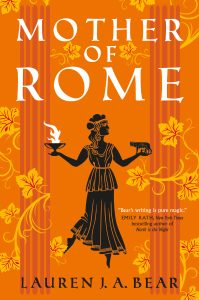
One example is Lauren J. A. Bear’s recent second novel, Mother of Rome (Titan/Ace, 2025), which tells the story of the foundation of Rome from the viewpoint of Rhea Silvia, the mother of Romulus and Remus, but imagines that Rhea survives when her father is forced from the throne. She becomes half-spiritual herself, watching over her children and the creation of a great city with the help of her cousin Antho. The novel interweaves mythology (is it really the god Mars whom Rhea makes love to in defiance when her uncle compels her to become a Vestal Virgin? Is the god of the Tiber ever-present in her life?).
Lauren explains how she understands the importance of the stories of former civilisations: “Of course, they entertain, and that’s important, and sometimes they teach a moral, but perhaps most essentially, they also reveal the soul of our ancestors. What did these people value and fear? When we engage with voices from the past, we connect to our shared human history. We get this magnificent opportunity to commune over time and place.”
This is an opportunity she takes up with great success. But she and many of the authors who write about the ancient world seek to do more: She agrees with Conn Iggulden: “Any time a reader can connect to what a fictional woman feels thousands of years ago is a good thing. The ultimate goal of fiction, after all, is to foster empathy across humanity.”
The problem lies in creating “a character for a modern reader that still feels authentic to the novel’s setting … There’s a scene early in the book in which Numitor invites Rhea into his room, but she must stand to the side while the men discuss business. Every woman can relate to that feeling of not being invited to the table. Antho is forced into a marriage she does not want out of filial duty. I think many modern readers can relate to a life under oppressive parental expectations.”
“The magic of retellings … lies in the manipulation of point of view. Modern readers care about perspective. They want to know what women did, how the enslaved felt, what the villains thought, etc… Writers today get to subvert the tales we have been told, to fill in the gaps and cracks.”
It is this subversion of the dominant traditions in the culture of the ancient world that is at the heart of what many of those who seek to reimagine the ancient world are doing. In Mother of Rome, Lauren wanted to give the women character and agency, but to do so in ways that felt authentic. She wanted to “honour the setting…” For example, “neither of these women are trained in warfare, so how can they demonstrate their strength? … They utilize what they have available. For Antho, it’s her docile reputation. She performs her Latin duties perfectly as a cover for her rebellion. Rhea embraces her primal, essential energy – the animal within. Neither of them has to deny their femininity to achieve their goals; instead, they expand the definition of what it means to be a woman. I find that more compelling than just giving them a sword.”
And then there are the universal experiences: love and death. “Rhea mourns. She lusts and longs. She struggles against a patriarchal system that would tell her what she can and cannot do with her body. These are ancient struggles; they are modern struggles.”
The ancient world offers a richness to reader and writer because we know that it embraces mythology and legend alongside history. Different authors approach the challenge of connecting the reader with people who lived by different rules in a different time from several directions: an immediate engagement with the choices and experiences that are contained in history as Conn Iggulden and others pursue; an enriching of that world with myth and legend from the character’s point of view as Mary Renault and I have; or a full-blown interweaving of myth, legend and history as in the world created by Lauren Bear. The past is a distant country and people lived differently then, but there are many ways in which it can inform and enhance our own reality.
References:
1. Conn Iggulden
Q&A Facebook Interview, 30 April 2025.
About the contributor: Peter Taylor-Gooby is an academic, social commentator and author of The Immigrant Queen (Troubador, 2024), the true story of Aspasia ,who rose to become the only woman in Socrates’ circle, the founder of Athens’ first academy for women, a philosopher in her own right and the lover of Pericles.
Published in Historical Novels Review | Issue 113 (August 2025)