Bleeding on the Page: Graeme Macrae Burnet and Historical Murder
WRITTEN BY GORDON O’SULLIVAN
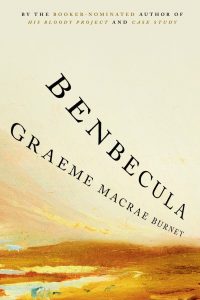 Benbecula (Polygon/UK, Biblioasis/US&Can.), the new novella from Scottish writer Graeme Macrae Burnet, is part of the Darkland Tales series which describes itself as “dramatic retellings of stories from the nation’s history, myth and legend.” The author sat down recently with the Historical Novels Review to discuss his fictional retelling of a real 19th-century murder on the remote island of Benbecula in the Outer Hebrides.
The genesis of Benbecula actually occurred when Burnet was researching his Booker-nominated novel about another historical murder, His Bloody Project (Saraband, 2015); he just didn’t recognise it at the time. Although he was struck by the Angus MacPhee murder case, from a similar era but grounded in the bleaker Hebridean landscape, it was “kind of tangential to what I was doing at the time.” When asked to be part of Darkland Tales, though, Burnet remembered the case and went digging in the National Records of Scotland in Edinburgh. There he found an “absolute treasure trove of material.” Reading the precognition statements which “in Scots law is what a witness will say in court,” the author recognised immediately that “here I have enough material to write a short novel, a novella.” The documents themselves, their “tactile nature … they come tied up with ribbons,” added “a feeling of proper investigation” to his new writing endeavour.
His Bloody Project saw Burnet creating faux documents to simulate historical authenticity but in Benbecula, in a sort of mirror imaging, the author used real historical documents to fuel his fiction. While he was writing, however, there was sometimes a strain between fact and fiction. “When I was writing the incidents to do with Angus, which were based on the documents, I did feel a constraint, and I found it harder to bring these scenes to life, because I was constrained by the facts, or at least the facts as I knew them, whereas with the fictional parts involving Malcolm [the brother of Angus and the narrator of the novella] in his later life, I felt the normal freedom of writing fiction.”
Did the author feel that he had learnt anything from the writing of His Bloody Project that bled into Benbecula, or were they very separate? The research that Burnet did for His Bloody Project “absolutely stood me in good stead for Benbecula … I maybe went back to refer to a few of the same sources, but I didn’t feel I had to go back and start again.”
Although sticking to the historical record provided some constraints, it also produced a determination to be true to the known history. Burnet wanted not to be tied to but inspired by the actual history. “I wanted to be very faithful to the facts as they are known, or are knowable.” That included visiting the Outer Hebridean island of Benbecula so that the author could be “completely faithful to the terrain and geography.” Burnet even took a copy of the hand-drawn map of the murder scene from the archive with him to ensure complete authenticity. “I used that to go and find the location of the murders.” Feeling that it was “really important for me to have been in this precise spot,” his visit allowed him to “see the shoreline stretching in this direction and in that direction.” Crucially it allowed the Scottish writer to be “true to that landscape” that “hasn’t changed in the 150 years” since the murders.
The process of writing this dark tale was unsurprisingly not all sunshine and light. Writing in the first person with a character like Malcolm MacPhee in Benbecula, did it become unsettling? “Sometimes just kind of thoughts tumble out of Malcolm’s head, and he’s clearly suffering from delusions of some kind … And I was writing the book, and the winter here in Glasgow was really, really brutal this year … It was very dark. I just moved house. My heating wasn’t working.” Add in the psychological challenge of “going into this mental space of Malcolm, who’s in this isolated cottage and an isolated, barren landscape” and you have “quite a dark place to go to … and to stay in.” Despite these imaginative and practical difficulties, Burnet remained steadfast. “Once you’ve made your decision of how you’re going to tell the story, you know, you got to stick with it.” It might explain, though, why Benbecula is a novella!
While Benbecula is a tragic story of murder, the empathy that the author feels for his characters and the circumstances that they’re living in is beautifully expressed in the novella. “I’m not aiming for objectivity. I am aiming for empathy, because I feel empathy.” When writing His Bloody Project, the author educated himself “about the history of what had gone on in the Highlands specifically in relation to the clearances, and specifically in relation to the conditions that the crofters lived under.” Malcolm MacPhee suffers a similarly hard life on the island of Benbecula, and for the author “it’s very hard not to sympathize … with the ordinary people of the land.”
Burnet was concerned that his sense of empathy wouldn’t be shared by the readers of Benbecula. “I felt like I was writing from inside the character, and this is a very dark character with few redeeming features; I’d sort of worried that readers might find this quite alienating.” This reader wasn’t alienated but rather felt sympathetic towards his characters, and that’s exactly what the author was striving for. He always wants “readers to engage with the characters … to have a kind of emotional relationship, or an empathetic relationship, or a relationship where they maybe don’t like the character.” That is the start of the process for the writer: “When we’re reading fiction, if you’re not engaged on that level, then you’re not likely to then engage on a sort of intellectual level either.” Burnet always seeks “that sort of human engagement.”
Consider this reader fully engaged by Benbecula.
About the contributor: Gordon O’Sullivan is a freelance writer and researcher.
Published in Historical Novels Review | Issue 115 (February 2026)