Back “With a Vengeance”: Bestselling novelist Riley Sager talks about his latest thriller
 BY KATE BRAITHWAITE
“If there’s one recurring theme throughout all of my books,” Riley Sager tells me, “it’s that history always repeats itself.”
His books, nine of them including With a Vengeance (Dutton, June 2025), are well-known and much-loved for their spills, chills, sharp characterization, and propulsive drama. Sager’s output is equally rapid fire, with a new novel releasing every year, since Final Girls in 2017. I have — checks list — read each and every one of them, so learning Sager’s next outing was a historical thriller strongly piqued my interest. Would With a Vengeance be a departure for him? Should readers expect a markedly different type of story?
Not according to Sager. “So many of my books feature plots in which events of the past haunt the present, and With a Vengeance is no different. In this case, though, the past is World War II and the “present” is 1954.
“Although I’ve written two other books that take place completely in the past, they were set in the early eighties and nineties. Since I was around then and remember those time periods well, I don’t consider either of those books to be “historical.” That makes With a Vengeance my first that I think could accurately live up to that description.”
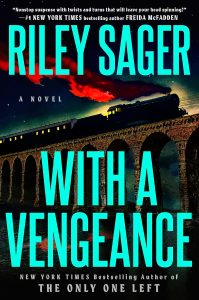
The story opens on a moving train. Anna Matheson, for reasons not immediately explained, has invited a select group of people to travel overnight from Philadelphia to Chicago, on the Philadelphia Phoenix, a luxury sleeper train. It’s a dark December night in 1954. There are only eight passengers on board, and already one of them is dead.
“The Phoenix,” says Sager, “is very much a fictional creation, although I cobbled it together from various other trains I learned about during my research. There’s definitely a bit of the 20th Century Limited in its DNA, along with the Orient Express, of course. I knew from the start that I couldn’t set the book on a real train because it had to serve the story and not the other way around. So I created it with plot, and not reality, in mind. Because every car and its position on the train plays an important role in the story, I took a lot of liberties in terms of design, layout, and even route. For example, Pullman cars were the standard on trains of that era, but I couldn’t use those because the plot required something different. The book is full of little things like that. I like to think of the Philadelphia Phoenix as a “movie train.” Something that feels real while at the same time has little to no basis in reality.”

author photo by Michael Livio
For the reader though, the train works — and that’s because Sager did his due diligence, learning the rules before breaking them. He explains, “My research ranged from general “The History of Trains”-type documentaries to books about streamliner trains of that era to searching for obscure, nitty-gritty details like actual train schedules from 1954.” Like many historical novelists, Sager enjoyed the process, even while he acknowledges disappointment that much of what he learned never made it into the finished book. There were surprises along the way too: “One thing that surprised me was all the amenities that existed on some of these trains. They really were hotels on wheels, with a whole crew of workers making life pleasant for passengers. I became irrationally jealous of people who got to experience that heyday of luxury rail travel. No offense to modern trains, but they pale in comparison.”
And it wasn’t just trains that Sager was concerned with. Logistics were a major factor at play. “Having everything take place on a train during a single night required almost military precision in moving the characters around. I had to think of the train as a Clue board, with Mr. X in the observation car while Mrs. Y is in the dining room while Mr. Z is dead in the lounge because of a poisoned martini.”
Poison? Anonymous invitations? Murders (and yes, they do pile up) on a train? If any of this sounds familiar, it’s because it’s supposed to. Reading With a Vengeance I had the sense of an author enjoying himself.
“From the very start,” Sager says, “I intended the book to be a throwback to another era. I’m a big fan of mid-century clothing, design, film, and fiction, and wanted to tap into the inherent glamour of that time period. Agatha Christie is an obvious influence, as are the films of Alfred Hitchcock. At the same time, I made sure to be mindful of the expectations of my regular readers. My usual suspense and twists and thrills are all there. They’re just dressed a little fancier this time around.”
Enjoying his nods to detective fiction and characters referencing movies like Strangers on a Train, The Narrow Margin and The Lady Vanishing, I asked Riley Sager if movies were much on his mind as he wrote: “Oh, absolutely. I was inspired to write the book after watching a wealth of recent movies that had amazing scenes on trains. Bullet Train, Indiana Jones and the Dial of Destiny and, yes, Mission: Impossible — Dead Reckoning. They all got me thinking that it might be fun to set a book entirely on a train. Part of the appeal was taking what’s expected of that kind of story—the inevitable confrontation on the roof of the moving train, the inconvenient train tunnel, someone pulling the emergency brake—and either leaning into it or trying to subvert it.”
Whether Sager’s ‘movie train’ will hit the big screen remains to be seen. He explains, “Unfortunately, Hollywood is such a fickle place that I’m not sure a movie will ever come to pass. All of my books have been in some form of development for film or television, with nothing ever quite making it to the finish line. I tend to stay out of it, let the experts in Hollywood do their thing, and focus on writing my next book. But if With a Vengeance were to actually get made, I’d be thrilled to see it.”
For now, readers will find thrills aplenty in Sager’s dramatic story, as he keeps the pace his fans have come to expect, with carefully added historical detail: “Because of the book’s historical nature, the main challenge was having to constantly fact-check what I was writing. That deadly martini, for instance, required research into the ingredients of common rat poison in the 1950s, the physical response if ingested by a human, rodent problems on the railroad in general to necessitate the presence of the rat poison on a train, and how martinis were commonly made in 1954.”
And while he gave me no hint of whether his next book will be historical or contemporary in its setting, the past will always play a significant part. “Even if something I write is set entirely in present,” Sager promises, “you can be certain that the past will also be there, lurking in the background.”
About the contributor: Kate Braithwaite is an HNS editor and the author of four historical novels, including The Scandalous Life of Nancy Randolph. Her latest outing is a psychological thriller, The People Next Door (Joffe Books, 2025).