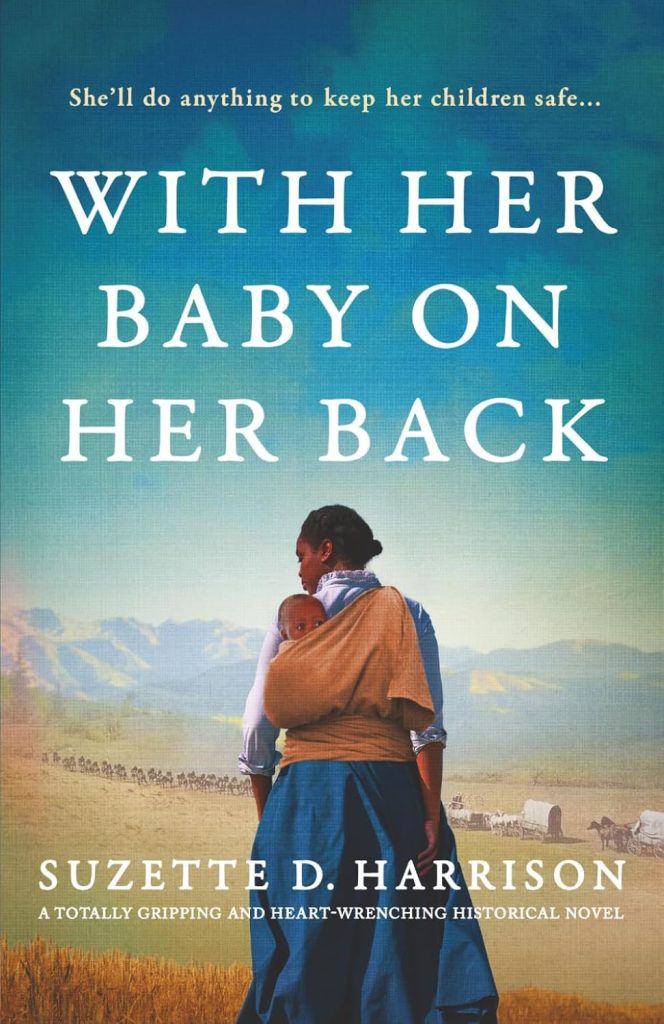
With Her Baby on Her Back
Historical novels overflow with women of little agency living under trying circumstances. Among them Harrison’s 19th-century protagonist stands out, not only for the tremendous hardships she endured, but also for her strong resolve to care for her loved ones. Zanitha (Zinnie) is based on a remarkable historical figure, Biddy Mason, whose story is well worth knowing.
In 1848, Zinnie, a midwife and herbalist, and her children are enslaved on the Mississippi estates of Ryland Tolliver when he, a new Mormon, decides to uproot his entire household to head west to the Salt Lake Valley with other families. Zinnie’s three daughters, including baby Hattie, were fathered by Tolliver, as were, most likely, her half-sister Lovie’s children. After preparing the wagons, Zinnie is horrified to learn she’s expected to walk behind them. The journey is beyond arduous, and Harrison places us right alongside Zinnie as she passes through farmland, grasslands, treacherous rivers, and mountains, while carrying her nursing infant, watching over rambunctious children, at the beck and call of the haughty and cruel “plantation people.” “Yet we couldn’t relinquish living,” remarks Zinnie.
A parallel narrative introduces Lynette Stanford, an elementary school teacher in present-day Texas and divorced mother of a neurodivergent pre-teen. She hopes to get her master’s degree for career advancement. Unlike the modern halves of many dual timelines, her story develops with rich, exuberant detail. Realistic dialogue enhances her warm relationships with close friends and family, including her beloved Granny, who has early dementia. Lynette’s finds in a dusty attic prompt stories about distant ancestors whose true identity Lynette aims to uncover.
Some readers may want stronger interplay between the two threads, but they intertwine satisfactorily by the end. It’s a heartrending yet triumphant story about the strength of family and the importance of honoring the past.