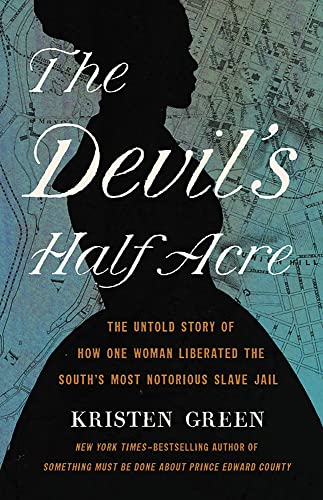
The Devil’s Half Acre: The Untold Story of How One Woman Liberated the South’s Most Notorious Slave Jail
In The Devil’s Half Acre, journalist Kristen Green takes up the formidable task of telling the story of a woman whose life is sparsely documented. That woman is Mary Lumpkin, and her story, what we know of it, is a compelling one. Born into slavery, Mary as a young girl came into the possession of Robert Lumpkin, a dealer in enslaved people whose jail in Richmond, Virginia, was justly known as the “Devil’s Half Acre.” There, the mixed-race Mary was taken by Lumpkin as his concubine and would bear him five children while living in his jail and forming friendships with similarly situated women. Having inherited the property from Lumpkin upon his death in 1866, Mary leased the property to a missionary who used it as a school for freedmen. Ultimately, the school became Virginia Union University, still around today as a historically Black university.
I found this to be a fascinating, though often grim, book, especially in its detailing of the peculiar domestic relations of slave traders, many of whom, like Lumpkin, fathered children with enslaved women and eventually sent their offspring to the North or Midwest to live in freedom. Green’s research included tracking down Mary’s descendants, some of whom were startled to learn of their roots in slavery in that their families had lived as whites for generations.
Green’s book is not only about Mary Lumpkin, however, but about the ever-contentious topic of how Richmond—and, by extension, the rest of the country—should deal with the more troubling aspects of its history. It is an issue that seems nowhere near to being settled, but books like this remind us of the importance of continuing to tell such stories.