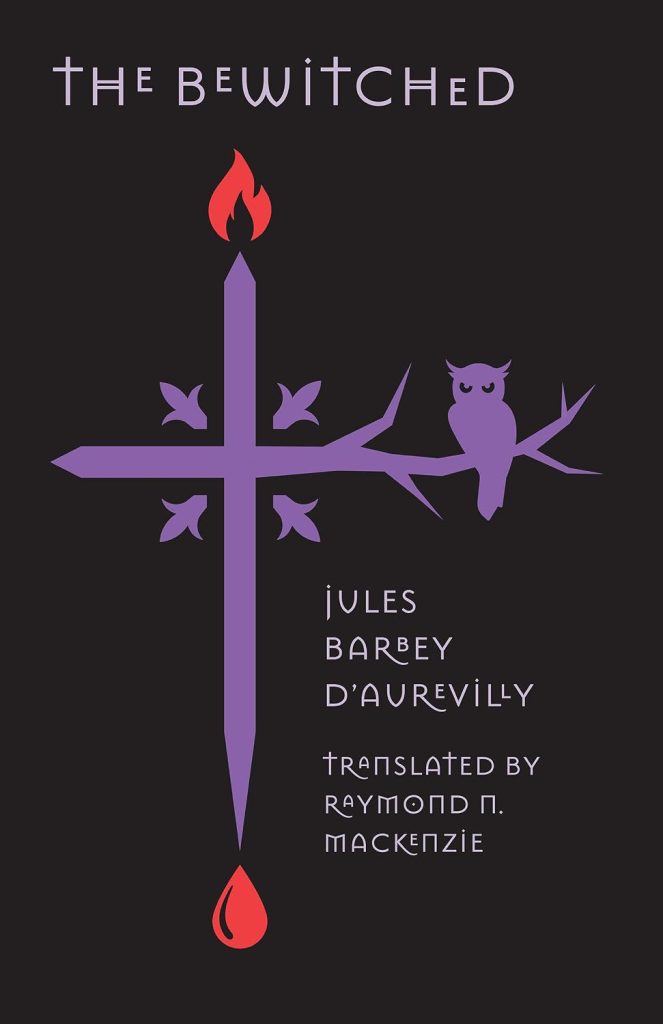
The Bewitched
The first English translation since 1928 of Jules Barbey d’Aurevilly’s 1855 novel, The Bewitched, reflects a resurgence of interest in this 19th-century French writer, born in Normandy in 1808.
Set in post-revolutionary France in 1803-04, the narrative opens with two travelers on the Lessay moor, one of whom harkens back to the Chouan rebellion in Normandy in the 1790s, where the revolutionary suppression of the church and conscription efforts were widely resented by a mixture of local peasants and surviving aristocrats. One Chouan, a disguised priest named l’abbé de La Croix-Jugan, fought to kill blues (revolutionaries) in defiance of his priestly orders. His face is grotesquely disfigured in battle, and when he returns to Blanchelande village, he covers it with a black hood. Later, when churches reopen, he becomes a source of devilish fascination in the village.
D’Aurevilly’s themes of class distinctions, Catholic religious rites, counter-revolution, evil, cruelty and blood, are examined in proximity to the darkly gothic Lessay moor, where travelers disappear, adding an unsettling sense of place. Rumors abound in the village that a beloved aristocrat, Jeanne Le Hardouey, who married beneath her station, has fallen in love with La Croix-Jugan or perhaps has been “bewitched” by the priest’s satanic charm. Jeanne comes to a mysterious and untimely end, and her husband, Maitre Le Hardouey, a profiteer enriched from church and aristocratic land, suddenly disappears.
Mme. Clotte, an aristocrat whose hair was sheared off by the blues, though paralyzed and unable to walk, crawls to her friend Jeanne’s funeral, where violence ensues. The novel slowly and eerily builds up to a startling conclusion in which its themes become intertwined but not unraveled. Known as an explicit and decadent writer in his day, the translation captures the essence of d’Aurevilly’s complex, unsettling and dark tale.