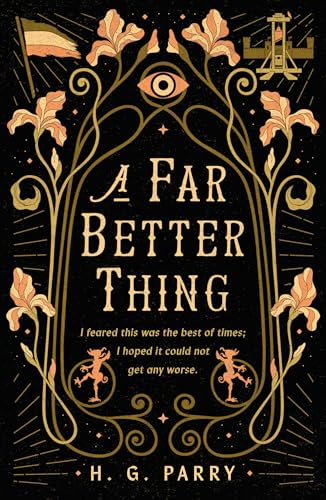
A Far Better Thing
A good literary adaptation explores a question whose answer enriches the original, just as (to my mind) Pride, Prejudice, and Zombies supplies a far more satisfying rationale for Charlotte’s marriage than Austen’s novel does. Similarly, H. G. Parry takes the uncanny similarity between Charles Darnay and Sydney Carton at the heart of A Tale of Two Cities and makes it the result of fairy mischief: Darnay is the changeling left behind when the fairies stole Carton as a baby. It explains so much.
From this basis, Parry weaves a wonderful story both parallel to and in line with Dickens. Like the original, A Far Better Thing begins in the Old Bailey courtroom in 1780, where Charles Darnay is on trial as a French spy and ends in France some twelve years later. The intersection of Darnay’s and Carton’s lives with each other and with Dr. Manette and his daughter follows the same trajectory. But where Dickens’s cynical and dissolute Carton often seems merely a foil to the principled Darnay, here he is a survivor of the horrors of forced servitude to the fairy world. His alcoholism is still partly due to his nihilistic character but also provides temporary relief from the fairies’ relentless malicious surveillance. Unlike others in the sketchy half-world of fairy-raised mortals, Carton is uninterested in fairy politics, pursuing a purely personal vendetta. The personal and the political intertwine, of course, Madame Defarge’s vendetta and fairy vengeance overlapping in surprising ways.
Parry’s Carton remains as dry and dedicated to his own moral vacancy as Dickens’s, a major feat for a first-person hero. Carton is pessimistic beyond redemption, numb, and focused on self-preservation and for all that a magnificent guide through revolutionary France and this delightful novel.