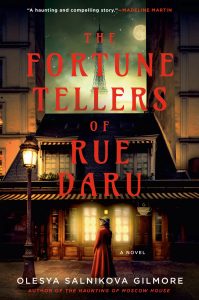
Paranormal Intrigue Among Russian Émigrés in Paris: The Fortune Tellers of Rue Daru by Olesya Salnikova Gilmore
 BY LAWRENCE W. POWERS
Paris in the mid-1920s: recovering from the depredations of World War I but playing host to expatriate writers and artists from around the world. It is a bustling metropolis full of life and laughter, creative endeavor, and the promise of new beginnings for many people.
In one particular section of the city, the northwest corner of the eighth arrondissement, is a short street, Rue Daru, named after a French statesman and soldier under Napoleon. It’s claim to fame, however, is the presence of the Alexander Nevsky Cathedral, a 19th century Orthodox Russian church, which parted from the Moscow Patriarchate after the 1917 revolution. As such, it became a religious and cultural center for both the Russian upper classes and lower classes that sought refuge in Paris, before and after the Bolshevik uprising.
Less famous, but the locational nexus of Olesya Salnikova Gilmore’s novel The Fortune Tellers of Rue Daru (Berkley, March 2024) is the Samovar, a tearoom owned by Valentina (Valya) Lenormand. Valya immigrated from Russia in 1899 with her daughter, Svetlana. She has a personal tragic history due to interactions with the tsarist monarchy, complicated by secrets and vengeful consequences after her arrival in France.
But more than tea, coffee, and pastries are served at Samovar. During the day there are fortunes told, mainly for the benefit of women who believe in the power of cards, coffee grounds, and other signs to predict futures, for better or worse. At night, the tea room becomes the center for séances, to appease the tearoom clients. These are fake summonings, enhanced by the sound effects and actions of Valya’s 24-year-old granddaughter, Zinaida (Zina), and Zina’s friend Katya. Katya is a few years older and one of many aristocrats, now penniless, residing in the Rue Daru district. Both of the young women work for Valya but are poorly paid.
Zina has an affinity for auras, sights and odors that are connected with people she encounters. Her spiritualist abilities lead her to conduct séances for an ex-pat Romanov sister and brother, Olga and Alexander, who are attempting to solve the murder of their father, Le Grand Duc, in 1900. He died at the Samovar, as did Zina’s mother Svetlana. Both cases were investigated but not solved, although Valya was implicated. Twenty-four years later, Zina is caught up in the intrigue as she attempts to contact her mother in the spirit world. The tearoom is haunted by the spirit of The Grand Duke, referred to by the fortune tellers as the nechistaya sila (unclean force). The supernatural events provide an entertaining, albeit horrific, background for the Parisian setting and events presented.
History and historical novels, until recently, have been most often written by men. The understandable biases of these efforts have frequently ignored the role of women in providing the very basis for survival in difficult times. Gilmore’s novel chronicles the responsibility of Valya in maintaining her family integrity and safety, but it goes beyond the personal and immediate care of a mother or grandmother. A clear case is made in the Fortune Tellers of Rue Daru for the role of women in protecting and preserving the fabric and continuation of a culture across generations. Historians ignore this important contribution at their own risk.
Romantic interests are served by the arrival of a French inspector to launch a contemporary investigation of the murders at the bequest of Princess Olga, who fashions herself as a potential heir to the Russian throne. The real reason for their endeavor, however, is the likelihood of a treasure left by their father and associated with the tearoom, which had served as one of his townhouse residences. A lot of characters and motives, most harboring secrets, are revealed as the narrative unfolds.
Valya knows about the treasure but, according to the author, she does not tell her granddaughter because she fears what the secret may cost Zina. She is paranoid about losing Zina like she lost her daughter, and the less she knows the better. Secrets become one of the defining elements of the narrative, most of which are not revealed until the concluding chapters.

author photo by Nicola Levine
Gilmore states that there is a cultural reason for secret-keeping: the societal upheaval and ensuing paranoia was personal and persisted for generations. She says, “Certain cultural mores and expectations remained the same from the times of Imperial Russia to the Soviet regime. Secrecy always existed in the conservative Imperial Russian society, and this intensified in the Soviet era. After all, secrets started to be the currency for people’s survival. The fear of revealing anything that would remotely put a loved one in danger, besmirch a reputation, reveal a weakness, or lead to trauma is something I know intimately. I only found out some of my grandparents’ secrets long after they had passed. There is a lot of personal, generational, societal, and cultural trauma here.”
Because Paris was a setting for celebrity figures, two are encountered incidentally. F. Scott Fitzgerald and his wife Zelda are mentioned in a brief exchange with the French inspector when he is with Zina in Parc Monceau. Ernest Hemingway, unnamed but referenced as an American writer “from some middle-of-nowhere town in Illinois, sniffing around Paris for his latest inspiration” buys Zina and Katya a drink at Le Dôme, a popular nightclub. One cannot but help think about the 2011 romantic comedy film, Midnight in Paris, where writers in the 1920s are encountered. The Ballets Russes also provides a contact for Zina to explore her talent for contacting the spirit world.
Valya and Zina express a strong dislike for ex-pat Bolsheviks who share the local neighborhood. The revolutionaries traumatized Valya when she was in Saint Petersburg, and the two groups of émigrés do not socialize. Asked why the Bolsheviks were present, Gilmore explained that the revolutionaries were paranoid and saw threats everywhere due to the way they came to power and were nearly defeated. They were afraid that Romanov heirs, like Princess Olga and Prince Alexander (Alec), might restore the monarchy and that the White Army, which still had many followers, could reorganize and overthrow the communist regime. They considered Paris of the 1920s and ’30s to be a hotbed of anti-Bolshevism.
As intriguing as the paranormal and criminal aspects of this excellent novel are, there is also much material for the historic interests of this tumultuous era. Gilmore provides comprehensive author notes on the story and the persons characterized. She never names the Le Grand Duc, but in answering a question about him, she states that he is modeled on two real-life grand dukes, Grand Duke Paul and Grand Duke Vladimir, both sons of Tsar Alexander II (1855–1881). The turbulent prerevolutionary times of the late 19th century in Russia are presented in retrospective chapters by Valya.
Ah, Paris, the City of Light (Ville lumière). Ah, Rue Daru, the tearoom of darkness and hauntings. The contrast is well-conceived and the characters are believable. The time and setting provide a springboard for further discovery of an important chapter in the history of Russia and France. A comprehensive account of this mixed population of émigrés is found in Helen Rappaport’s biography: After the Romanovs. Russian Exiles in Paris from the Bell Époque Through Revolution and War. (St. Martin’s Press, 2022).
About the contributor: Lawrence W. Powers writes fiction under the name L. Wade Powers. His historical novels include New Albion Sunset (2020) the SurrogaCity trilogy (2022—2025) and Dark Days, White Nights, to be released in mid-2026. Learn more at his website.