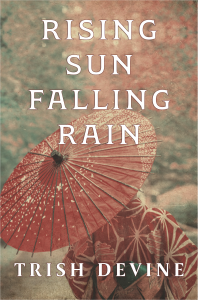
Launch: Trish Devine’s Rising Sun Falling Rain
INTERVIEW BY ELLEN IRWIN
With a bachelor’s degree in social anthropology and a teaching career in culturally diverse communities, including Hiroshima, New Zealand native Trish Devine has long explored themes of identity, resilience, and connection. Her lifelong passion for writing and her fascination with Japan’s rich culture culminate in her debut novel, Rising Sun Falling Rain, which bridges the landscapes of New Zealand and Japan with a deeply human story.
How would you briefly summarize Rising Sun Falling Rain to readers?
A sweeping saga of long-buried secrets, forbidden love and unyielding hope, set in the devastation of post-war Japan. This novel explores the clash between tradition and new ways, weaving a story spanning cultures and generations, celebrating the enduring strength of the human spirit.
 What drew you to write a story set amid the devastation of post-war Japan (as opposed to other periods in Japanese history)?
I was strongly drawn to writing a story set in Japan, but felt it would be very difficult, as a foreigner, to authentically represent the culture of a traditional society. I asked myself – when was a time of change in Japan, a time when global influences mixed with the traditional? Of course, it was post-WWII, when the world – and especially Japan – was in transition.
What inspired you to write the entwined stories of New Zealand serviceman Mick Mitchell and Japanese woman Emiko Tanazawa?
I ‘discovered’ Mick Mitchell as an extension to the thought process of the previous question/answer about Japan in change. To introduce the reader to Japan through the eyes of a novice – a curious yet ambitious – character, allowed me to represent Japan through an outsider’s view.
Emiko Tanazawa is in parallel with Mick in many ways. She’s also curious and ambitious, and looking to create changes for herself and others. Emiko brings Mick into the fascinating world of Japan and he brings her into the wider world of new possibilities. There are many other characters who carry the story. They are diverse, quirky, genuine and thought-provoking, each representing their own cultural background.
How do you think readers today might most resonate with your novel, written from the perspective of these post-war characters?
I think the themes are universal, even more so today – global tensions, star-crossed lovers, younger people looking for new ways and authorities sticking to traditions, the determination to move away from trauma and grief and mostly the enduring strength of family ties.
I imagine your background in social anthropology and teaching in diverse communities gives you a depth of understanding of what is universally human at the core of us all, despite our obvious cultural differences. How do you think your background inspires the themes that you write about in your novel?
My background that inspires the choice of setting goes way back beyond my teaching experiences and before my anthropology studies. When I was a child, I guess about eight, I felt a connection with things Japanese – even before I knew of Japan as a country. It was an emotional connection. As a teenager, when friends were collecting popstar posters, I was collecting Japanese pen friends and decorating my bedroom in Japanese style. I believe it is that connection with another culture at an early age that set the stage for me to be curious, study, teach and live in cultural richness, and therefore to write about those places.
How did living and teaching in Hiroshima specifically influence your telling of Rising Sun Falling Rain? Did you weave specific people, elements of culture, or experiences from your time there into this story?
The big take-away from my time in Hiroshima was not so much the knowledge or specifics about past events, but an admiration for the people who live there (some of those bomb-survivors), with peace, acceptance and the drive to rise above adversity. I wanted to write a story that encapsulated that forgiveness and resilience of spirit.
What was the most challenging thing you encountered while writing this novel?
The most challenging thing was definitely the depth of research required to be authentic with time and place. That was made doubly challenging by the pace of change in Japan at that time. For example, I spent hours trying to ascertain what coins were used in 1946. The yen had been the main currency up to the end of the war, then it devalued so fast that a lesser denomination was introduced – the sen. Shortly after that the US dollar became the main currency and then reverted to the yen. I couldn’t pinpoint exact dates, so just referred to the number of ‘coins’.
You are a debut author, though how long have you identified as a writer? What prompted you to begin writing stories set in the past?
I’ve been a writer all my life, but I didn’t really have a sense of direction with my work until I joined a writers’ critique group that meets weekly. Writing about other places and historic settings is much more interesting for me than the contemporary alternative and gives me the opportunity to research and extend my knowledge in a new direction.
 What future writing prospects are in your heart and mind?
I have always thought there might be a sequel to Rising Sun Falling Rain, so I have some ideas brewing. Many readers have asked ‘When is the sequel coming out? And when is the movie getting started?’ I can see both as possibilities clearly. Very exciting!
What writing advice would you like to share with aspiring authors of our genre?
Make your setting a time and place you are passionate about – anywhere, anytime, any focus, as long as you have that emotional connection. Your fascinating characters and their compelling journey will arise from that foundation.
What is the last great book you read?
Big Magic by Elizabeth Gilbert. This book has become my go-to. It explains and justifies the creative process in a way that really resonates with me.
HNS Sponsored Author Interviews are paid for by authors or their publishers. Interviews are commissioned by HNS.