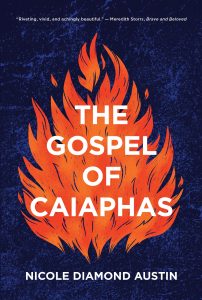
Launch: The Gospel of Caiaphas by Nicole Diamond Austin
INTERVIEWED BY LESLIE S. LOWE
Nicole Diamond Austin is a lifelong lover of books and storytelling in all forms. After graduating from Yale University, she spent six years working in the publishing industry before shifting careers, receiving an MBA from UCLA Anderson. Nicole went on to work in entertainment marketing for over a decade before leaving the corporate world to pursue writing in earnest.
 How would you describe this book and its themes in a couple of sentences?
Most people know Caiaphas either from the New Testament or from Tim Rice’s musical Jesus Christ Superstar, and he’s typically depicted as a one-dimensional villain. But what if his story is more complicated and nuanced than we’ve ever imagined? The Gospel of Caiaphas offers a bold reimagining of one of history’s most enduring stories, exploring the tensions between duty and conscience, family and fealty, love and legacy.
What inspired you to start writing historical fiction, and what has been most rewarding about it?
As writers of historical fiction, we get to resurrect personalities, events, and entire cultures, bringing them back to life. We can enter the minds and hearts of people we’ll never meet, exploring their motivations and their passions. This is especially powerful when we delve into the lives of individuals who were marginalized in their time, whether because of class, gender, or some other factor. Historical fiction allows us to tell their story as it’s never been told before.
An ornate bone box inscribed with “Joseph son of Caiaphas” was discovered in 1990, confirming his existence and family name. Was this part of your research and inspiration to write this story?
The discovery of Caiaphas’s ossuary in 1990 was one of the many mysteries of his life that made me especially keen to tell his story. Despite his nineteen-year term as high priest, the longest of any high priest in the first century, Caiaphas died in relative obscurity, buried south of Jerusalem in a modest tomb. The Gospel of Caiaphas explores the how and why of that finding along with many others.
Why the focus on this topic now?
Ecclesiastes says there is nothing new under the sun, and nowhere do we see that more than in the areas of political power and religious fervor. The Gospel of Caiaphas feels almost prescient in the way it explores how those in power navigate that power, and what happens when an individual’s most passionate beliefs clash with their desire to maintain control.
How does Joseph Caiaphas transform throughout the novel? What did that journey mean to you as you wrote it?
One of the things that drew me to Caiaphas is that we know very little about his life before or after the years he was high priest. I wanted to understand what kind of boy grows up to be a man like Caiaphas, and to explore what his life was like before, during, and after the events of the New Testament.
Over the course of the novel, while Caiaphas transforms from an eager but timid child to a leader in his community, he continues to wrestle with the insecurities and challenges of his role in the priesthood and in his father-in-law’s household. I relished the opportunity to explore his internal journey and to more deeply understand his motives.
How do you think the reader will connect with Joseph in this story?
Caiaphas is a man shaped by the circumstances of his life, doing his best to serve both his people and his God with honor. I think readers will connect with him from the beginning, and as they watch him experience love, betrayal, pride, and fear, I’d like to think they’ll be able to see a bit of themselves through his eyes.
How did you balance the research with writing the story? Did you find any interesting historical facts while researching?
One of the joys of writing historical fiction is that it begins with a puzzle to be solved. History only passes down to us some of the details of a life, and it’s up to us to put the puzzle together. Caiaphas is a particularly intriguing puzzle because each answer creates more questions.
What was Caiaphas’s childhood like? How did he end up marrying the daughter of the high priest, and what led him to become high priest himself? Most significantly, how did he maintain power for so long? And what happened to him in his later years? I love the research phase of writing historical fiction, and this book allowed me to delve deeply into both what we know and what might have been.
What are you working on now? Is it connected to this one or your other works in any way?
I’m currently working on three very different projects. First, I recently started a Substack called No Small Parts: Writing from the Margins of History and Personal Narrative, where I’m posting weekly (and loving it). Second, I’m in the research phase of my second historical novel, called The Chancellor’s Daughter, which tells the story of Margaret Roper, the bold and brilliant daughter of Sir Thomas More. Finally, I’m working on a memoir entitled Desirous of Everything, in which I explore my search for health and wholeness along three separate trajectories of my life: my precocious adolescence, my spiritual awakening, and my ongoing battle with invisible illness.
How have your life and work experiences, especially in publishing, been incorporated with or assisted you in your writing? How has it made writing more difficult?
As a former book editor and literary agent, I’ve been fortunate to participate firsthand in the acquisition and editorial process of traditional publishing. I always knew I wanted to write, but for a long time I was content to help others achieve their vision. It’s been a pleasure switching seats, although I confess that it’s a lonelier and more challenging road on this side of things.
Every author has her own publishing journey. Tell me about yours.
I knew from the beginning that The Gospel of Caiaphas might be a hard sell for traditional publishers. The protagonist is a Jewish high priest, Jesus is a minor character, and it takes place in the first century. When my agent and I originally went out on submission, we got incredibly positive rejection letters. No one knew quite what to do with the book. Eventually, I realized that I had to get creative. I launched a successful Kickstarter, which allowed me to move forward with publishing independently. It’s been both more difficult and more rewarding that I ever could have imagined.
 What advice would you give to other aspiring historical writers?
One book I always recommend to aspiring historical novelists is Once Upon a Time It Was Now: The Art and Craft of Writing Historical Fiction by James Alexander Thom. I found it incredibly helpful and encouraging as I began the process of researching and writing.
It’s very important to be organized during the research phase, because you never know when you’re going to want to go back and consult something you read at the beginning of your research. Creating a spreadsheet of my characters and mapping all important dates was also an especially helpful tool while writing.
Lastly, I’d encourage an aspiring historical novelist to pick their subject carefully; you’re going to spend a lot of time with these people and this time period, so it needs to be something that fascinates you.
What is the last great book you read?
The last great historical novel I read is probably The Queen’s Musician by Martha Jean Johnson, which I enjoyed so much I sent her The Gospel of Caiaphas, and she graciously endorsed it.

HNS Sponsored Author Interviews are paid for by authors or their publishers. Interviews are commissioned by HNS.