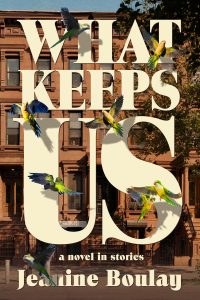
Launch: Jeanine Boulay’s What Keeps Us
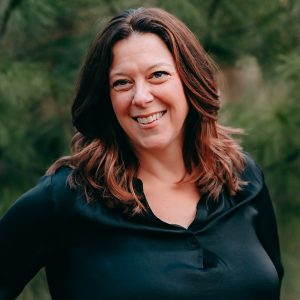
INTERVIEWED BY MALLY BECKER
Jeanine Boulay is a writer and educator interested in the connections across time and place. She is the recipient of numerous writing fellowships awarded by the New York Public Library’s Cullman Center Institute for Teachers and by the Academy for Teachers. After twenty years in New York City, she now lives in rural Massachusetts with her husband and two young boys.
 How would you describe this novel and its themes?
What Keeps Us explores what women sacrifice to survive—and what gets buried in the process. Spanning 150 years of New York City history, it’s a meditation on erasure, reinvention, and the quiet histories that outlast the people who lived them.
What inspired you to use Green-Wood Cemetery as the central setting for your interconnected stories?
During my years in Brooklyn, I lived beside Green-Wood. I loved walking the paths of its almost 500 acres, enjoying the history and nature. The concept for the book was born from those walks and the lives (real and imagined) I encountered through reading headstones and admiring monuments. Green-Wood was founded in 1838 and immediately became a place for relaxation, communing with nature, and creating a collective memory. (By the early 1860s, Green-Wood was second only to Niagara Falls as the nation’s greatest tourist attraction.) I was struck by the idea of this place as a steadfast witness to an always changing city.
What was the most surprising thing you learned in researching your beautifully written stories?
The discovery of the depression-era musical Pins and Needles was great fun. The fact that a women’s labor union wrote and produced a musical based on the times was fantastic, and then to find that the actors were the actual garment workers from the factories! I also watched several of the numbers available on YouTube.
Your stories feature women in different decades and centuries navigating work and complicated personal lives. How did you decide which people and historical moments to highlight?
I always say I’m led by the research. Through several writing fellowships at the New York Public Library, I learned about the actress Maggie Mitchell, the Blizzard of 1888, and the constraints on women looking for employment during the Great Depression. Green-Wood also offered research, with the real-life Maggie Mitchell and Sarah Garnet as “residents,” as well as victims of Brooklyn’s Park Slope plane crash. These people and events captured my imagination. And then there were stories that could not be left out when representing the diversity of Green-Wood and NYC, and some defining events for the city.
Finally, it was researching Green-Woods Freedom Lots project that provided a thematic anchor. The Freedom Lots project reclaimed and honored the unmarked graves of African Americans buried on the grounds, and when I discovered it, I understood one of the undercurrents of the collection: who gets remembered, whose stories get told, and who gets forgotten.
The parakeets at Green-Wood Cemetery appear as a recurring symbol. What do they represent to you?
For me, they represent reinvention. These displaced Argentine parakeets found themselves accidentally in New York City and created a thriving home in one of the most beautiful spaces the city has to offer. Many of the characters in the book are forced to reinvent themselves, and through that act, find beauty. And of course the flight of the parakeets is symbolic; they are untethered from the earth.
Your stories feature actual figures, including an important nineteenth-century Black educator, famous Black Civil War activist Sojourner Truth, and an actress in love with John Wilkes Booth. The historical record only provides so much information. How did you bring these characters to life?
I looked to connect with them emotionally through the everydayness of their lives. Approaching Sarah as an activist felt only intellectual. But as an educator myself, I could connect with her as a principal and begin to feel how she moved through the world every day, when her feet might hurt, and what sacrifices service to her ideals required. Similarly, Maggie is in love with John Wilkes Booth, but the story is about her, not him. She’s a young woman enthralled by charm and a bit of danger. And how many of us can relate to losing ourselves in loving the wrong person?
 How did you balance the non-chronological structure of the stories to ensure readers experience them as a “novel in stories”?
I felt strongly that the structure should be non-chronological, which was a risk. But I wanted the form to contribute to the meaning of the book as a whole. It is meant to mimic the experience of wandering through the cemetery’s paths, and thematically, seeing histories as layered and speaking to one another. The juxtaposition of similar struggles happening in the nineteenth century and the twenty-first illuminate how much we are the same despite differences, and also how frustrating progress has been. Then, determining the order was great fun and took multiple attempts. I spread out index cards with the titles of each story across the wood floor of my office and rearranged them in multiple ways until landing on the final order. Looking for the echoes that resonated between stories was deeply satisfying.
What is the best writing advice you have to share with new historical fiction writers?
The history, the time period, is a setting, only there to bring your characters to life. Always stay grounded in the experiences and emotions your characters are living. Remember that the details of the history are the medium through which your characters think, feel, want, and struggle.
What’s the last great book you read?
The Antidote by Karen Russell

HNS Sponsored Author Interviews are paid for by authors or their publishers. Interviews are commissioned by HNS.