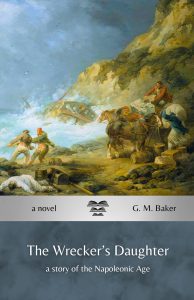
Launch: G.M. Baker’s The Wrecker’s Daughter
INTERVIEW BY ELLEN IRWIN
G. M. Baker writes stories that find the truth of the human condition in action, adventure, romance, and even magic. He is the author of the newsletter Stories All the Way Down, and has penned many historical and fantasy novels.
How would you describe The Wrecker’s Daughter to readers in a few sentences?
Welcome to St. Rose, Cornwall, where the merry villagers make their living by wrecking ships and stealing their cargoes and the parson is in the wrecker’s pay and preaches a wrecker’s gospel. Meet Hannah Pendarves, first daughter of the village, who thinks anyone from as far away as the next town is a foreigner and not to be trusted. But when a syndicate of wreckers and smugglers places Hannah as a spy in the house of a kindly and upright Falmouth shipping agent, Hannah begins to question her loyalties while, with every step, she feels the devil and the syndicate snapping at her heels.
 Your heroine, Hannah, is a woman encumbered by many moral dilemmas—homicide, spying, a choice between loyalty to her people or loyalty to love. What was your catalyst for writing a character of such moral complexity?
I had the opening scene in my head for a long time: three children finding a dead body on the beach and picking its pockets. In discussing historical figures, people often say, you have to judge them by the standards of their own time. But that is usually said condescendingly, as if we know better now, as if they behaved that way because they were not as enlightened as us, and we would have behaved better in their place. But we wouldn’t have. We behave differently today because our circumstances are different, mostly because we are so much richer. The truth is, most people will justify any behavior that puts food on the table, including slavery, murder, and robbing corpses.
I wanted to create a character who was sympathetic, but who also behaved in ways that seem terrible to us, and to show that it was not because she was a psychopath, but because it was what her people did to put food on the table. And then I wanted to put her in a situation where she is living with the kind of people who are most harmed by it, and starting to feel herself one of them, and even falling in love with one of them. But then how does she reconcile that with her people’s way of life and with her own past deeds and the blood that is on her hands?
“Poldark meets Jamaica Inn” gives us an inkling of your story’s backdrop. Might you share a bit more about the historical period and context in which your story is set? What drew you to write about this period and context?
Even the existence of 18th and 19th century wreckers who set false light and murdered crews is disputed. There are many traveler’s tales of them, but some historians doubt their authenticity. But then, they also doubted the existence of Troy until Schliemann dug it up. I prefer to believe the old wild tales. I prefer the people of the liminal places and times. When I found Bella Bathurst’s book, The Wreckers, it allowed me to connect those three children on the beach to the Cornish wreckers, and that led to The Wrecker’s Daughter.
In addition to writing this novel (as well as other works of historical fiction and fantasy), you have published many non-fictions and pursued many career interests. How has your professional life affected your interpretation of history and your approach to writing fiction?
A lot of my work was technical. It was about understanding how things work. I suppose I take that approach to history. Judging the dead is not helpful. Understanding isn’t forgiving and it isn’t condemning. It is recognizing the humanity of the other. I don’t want people to sympathize with Hannah because they think she is good. I want them to sympathize with her because they think she is human.
What is your strategy for maintaining historical accuracy while developing characters who resonate with modern readers?
I’m honestly more concerned with authenticity than accuracy. And with authenticity on particular points, because a novel is a lens, not a window. One virtue of setting a book in the past is that it helps you to separate the universally human from the particularly modern. But this isn’t about finding where people behaved the same way they do now. It is about finding where the same needs and desires caused them to behave very differently in different circumstances.
Dependence and obligation, which modern authors often portray as a burden or a form of oppression, would have been a source of comfort and security for most people in the past. How do you get across that what we see as liberty, they would see as exile? I think it is easier to create that sense of dependence in an isolated community with its own moral code and allegiances. Hannah regards anyone not from her own village as a foreigner, anyone caught in a wreck as the rightful victim of the sea, not because she is different from us, but because she is just like us, but her circumstances are different.
 How long have you identified as a writer, and what prompted you to begin writing stories set in the past?
I can’t remember when I started writing; I just always remember doing it. I think stories were more romantic when I was growing up. The walls of genre had not yet descended. Stories were set long ago and far away. There was a greater liberty then, for both readers and writers. I choose to read and to write as if that liberty existed still. It is the only way we will win it back.
What writing advice would you like to share with aspiring authors, specifically those focusing on historical fiction?
Remember that people of the past longed for belonging the way we long for independence. To belong was to live; to be exiled was to die. People did not long to break free. They longed to be welcomed in.
What is the last great book you read?
Unconditional Surrender by Evelyn Waugh.
HNS Sponsored Author Interviews are paid for by authors or their publishers. Interviews are commissioned by HNS.