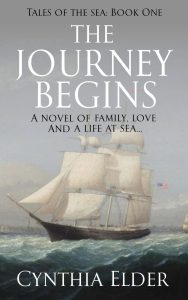
Launch: Cynthia Elder’s Tales of the Sea Series: The Journey Begins
INTERVIEW BY LESLIE S. LOWE
Cynthia Elder is a novelist, poet and nonprofit leader. Her two-book novel, Tales of the Sea, was recently featured in the Smithsonian Magazine and the New England Historical Society. Read on for a special offer!
How would you describe this book and its themes in a couple of sentences?
Tales of the Sea: The Journey Begins is a true story of a seafaring family from West Barnstable, Massachusetts, who sailed the world and put everything on the line for love during the final chapter of the Great Age of Sail, as our country marched toward the deadliest war in its history.
 As a lifelong poet, what inspired you to try your hand at historical fiction, and what has been most rewarding about it?
Poetry was my first love and remains an essential part of my identity as a writer. When I craft a poem, each word must earn its way onto the page. This philosophy infuses all my writing, whether it’s nonfiction or my new historical fiction novels.
I’m an insatiable reader of historical and literary fiction. I’d been looking for a concept that would grab me for a few years. That happened when my husband discovered hundreds of pages of original letters, ship’s logs, and personal diaries from his family in the 1800s, tucked away on the back porch of his parents’ home after they died. Their words resonated in my bones and demanded to be brought to life.
There is a promotional offer with this book, since it is the first book in the series. Can you share the promotion, where to access it, and if is it available to everyone?
I’m offering 10 free audiobooks of The Journey Begins. Email me at cynthia@cynthiaelder.com to request the code for a free download. Please review the novel when you’re finished. The book is also available in paperback and e-book.
Why the focus on this topic now? Is there a key historical event you found in researching that inspired you to write this story to portray a key message for now?
In today’s era of instant communication, technological change, and deep political divisions, this moment in history has lessons for us. These days, we get impatient if we don’t get a response to a text in a few minutes. During the 1800s, sailors were separated from their families for years, connected only by letters. Writing a letter was an act of faith. One could only hope it found its way into the hands of a loved one on the other side of the world.
In the mid-1800s, steamships seemed like a dim threat to the great wooden sailing ships which plied the oceans, connecting continents and creating a global trading system. Within the space of a couple decades, steam engines sounded the death knell to the Great Age of Sail.
Meanwhile, the issue of slavery pulled on the fabric of our new country until it tore apart at the seams. When I look at the internal conflicts in the United States today, I hope we can find common ground before we once again test the resiliency of our union.
How do the characters transform within the story over the series? What did that journey mean to you as you wrote it?
The Tales of the Sea series is told from multiple points of view and spans three generations from 1830 to 1870. In The Journey Begins, James Jenkins, Ruth Fish, and her brother Josiah are children eager to escape the confines of their small town. Each is drawn to the sea, where possibility lies just beyond the horizon. They are tested on the way to adulthood, but their trials are tempered by relationships, duty, and a sense of humor.
I fell in love with these real-life characters from the pre-Civil War days, at a time when slavery persisted and women could not vote. By the time I’d finished transcribing their words and researching the lives, I knew them as well as members of my own family. I could hear their voices in my head.
How do you think the reader will connect with James Jenkins and Ruth Fish in this book?
James and Ruth were products of their time, and they were far from perfect. Some of their ideas may feel out of step, when seen from a 21st-century perspective. I hope that readers will embrace their flaws and celebrate their courage, in context with their moment in history.
How did you balance the research with writing the story? Did you get to do any interesting interviews for your research?
I spent about two years transcribing documents, visiting libraries and museums, and reaching out to family members in search of additional information. I went on a “Dead Ancestors’ Tour” through the town where James and Ruth lived and had tea with members of the historical society, who showered me with books on local history.
My most unusual interview took place with Ken Morton, owner of the Sandy Neck Lighthouse, which figures prominently in the novels. He drove me over six miles of sand in a truck with partially deflated tires to the remote lighthouse. From the lantern room, I could see the same view keeper Joseph Nickerson would have seen nearly 200 years ago.
After writing the first draft, I discovered another large tranche of documents. Back to transcribing, researching, and writing! The entire two-book set took about four years, start to finish.
What are you working on now? Is it connected to the series in any way?
I have a couple of historical novels in the exploratory stage. I’m waiting to see which one grabs me and doesn’t let go. As always, I have a few poems in process. I’m also working on a children’s book about a young girl who goes to sea, based on a character who appears in The Drumbeats of War (Tales of the Sea, Book Two).
How have your life experiences, sailing with your family, and also working in nonprofits been incorporated with or assisted you in your writing?
My first date with my husband, Bob Elder, took place aboard a 38-foot sailing sloop in Penobscot Bay in Maine. That date lasted a week. Thirty years later, we’re still sailing. That experience gave me the courage to embark on Tales of the Sea. Bob helped out by charting the latitude and longitude recorded in ship’s logs so we could visualize trade routes.
I currently serve as executive director of a local land trust. This half-time job made it possible for me to tackle a large writing project on the side. My environmental work inspired me to infuse the books with details about the flora and fauna of each region.
Every author has their own publishing journey. Tell me about yours.
I used online sites like QueryTracker to search for an agent or independent publisher. To quell my self-doubt about the quality of my work, I submitted my unpublished manuscript to Kirkus Reviews. To my astonishment, they gave it a great review. That boosted my confidence. Armed with my Kirkus Review, I approached several independent publishers and landed on Holand Press, a new imprint in Great Britain.
 What advice would you give to other aspiring historical writers?
Search for an untold story that begs to be heard. Research it until the details come oozing out of your pores. Check and record your sources. Then let the story breathe. Let it take you away. Cry when your characters die. Rejoice when they succeed. Surprise yourself with the story you bring into the world.
What is the last great book you read? Why?
I just finished Little Great Island by Kate Woodworth. The novel is set on a fictitious island in Maine, loosely based on the island of North Haven, where I’ve sailed with my husband. Like my novels, she used multiple points of view – 12, to be exact. Little Great Island weaves a compelling story while laying bare the challenges of climate change in a small community whose livelihood is tied to the sea.
HNS Sponsored Author Interviews are paid for by authors or their publishers. Interviews are commissioned by HNS.