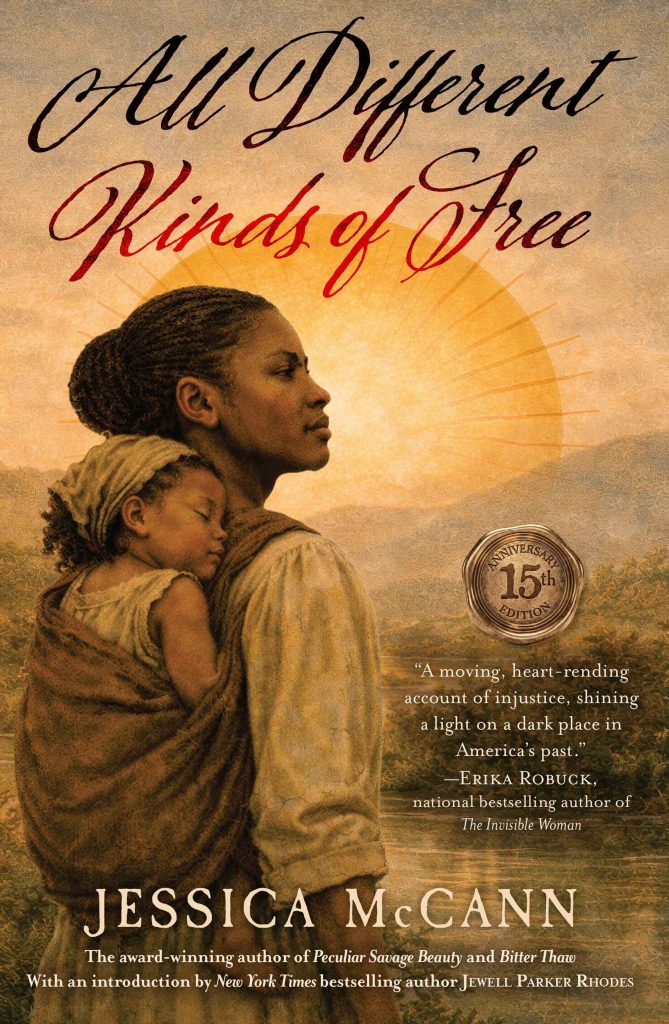
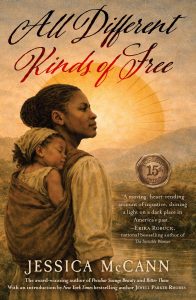
Finding a friend in an old legal document: All Different Kinds of Free by Jessica McCann
 BY HELEN JOHNSON
You’re sleeping soundly after a hard day’s work: earning money, cooking food, caring for your children. Thugs break into your house. They abduct you and the children.
The law does not help you: it deems you not a person, but ‘property’.
This shocking event lies at the heart of All Different Kinds of Free by Jessica McCann. It tells of Margaret Morgan, an American woman who grew up informed that she was ‘born a free Negro’. However, in 1837, married and with children, she was abducted and sold into slavery.
The novel was born when McCann, working as a freelance writer and editor, came across a record of the court case triggered by Margaret’s abduction. She says, “On my desk was a 500-page book manuscript to be edited. It highlighted career-defining cases for each of the U.S. Supreme Court chief justices, dating to the first in 1789. Nearly all the cases within this rather dry tome were new to me, including Prigg v. Pennsylvania.”
McCann goes on to add, “I’ve since encountered very few people who have heard of the case, the exceptions being lawyers with a strong interest in history and Constitutional law.”
However, she says, “The two-page summary of Prigg v. PA captured my attention … It centered on a kidnapping conviction, yet it included little more than a paragraph about the victims.”
Essentially, the case examined the balance of power between state and federal law. “It mentioned nothing of what became of Margaret and her children after the ruling,” says McCann. “How could their fate be so inconsequential?”
The case lingered in her mind, so McCann, intending to write a biography, set out to discover more about Margaret. “I spent several years researching newspaper archives, historical records and legal journals.”
However, she says, “My efforts yielded very little information about Margaret, though I did learn about so many other people who suffered similar nightmares under the laws of slavery.”

author Jessica McCann
But Margaret still pulled, and McCann says, “When it became clear I didn’t have enough to write a biography, I set out to write a novel. It was the best way to tell Margaret’s story.”
All Different Kinds of Free was first published in 2011. It garner attention: the Freedom in Fiction Prize from the Mackinac Center for Public Policy and Editor’s Choice in Historical Novels Review.
However, McCann has now released a new revised version. I asked why, after the debut won awards, she felt the need to change it.
“When I researched and wrote my debut novel, I was a journalist and corporate writer.” Since then. she explains, she has published two more novels, and her craft has improved. She says, “Revising the manuscript offered me an opportunity most authors never get – to see my work with fresh, more mature eyes and to leverage the literary tools I’ve sharpened over the years to make the prose richer.”
Furthermore, she adds, “The world, too, has changed. There were several places in the manuscript where a person of color was described as having skin the color of chocolate, coffee, or caramel. Such depictions are no longer acceptable. The anniversary edition enabled me to edit the manuscript with a contemporary eye.”
Had the script been older, she might have left it untouched for historical context. But at fifteen years, she says, “It felt prudent to make sure word choice was seen as respectful and accurate in the eyes of today’s readers.”
In imagining Margaret’s likely experiences, McCann doesn’t shy away from the sexual exploitation of enslaved women. I asked if she had ever been under pressure to censor such aspects. She says, “Slavery is such an ugly institution. I’m grateful my editors never asked me to censor or sugarcoat any of the brutal aspects of it in my novel.”
However, she did have concerns about her readers, worrying about the balance of a story containing so much sorrow. “I never wanted to gloss over the horrific events that Margaret and thousands of women like her endured. Yet, I also wanted to take care of my readers by not overwhelming them with endless tragedy.” Therefore, she hopes that, “The tender and quiet moments woven throughout the story help to buoy readers and bring them a smile when they need it most.”
As a reader, I felt that such moments, illuminating eternal values of friends and family, helped me to feel Margaret as a whole person.
When All Different Kinds of Free was first published, McCann faced accusations of ‘Cultural Appropriation’. She notes, “The concept of cultural appropriation in literature surfaced in 1980s academia. It refers to the adoption of cultural elements from a marginalized group by someone outside that group, particularly when done in a disrespectful, superficial, or inauthentic way.”
Since then, the concept has become more widely discussed. McCann says, “Through the years, I’ve had many people ask me whether it was appropriate for me, as a white woman, to tell Margaret’s story. I don’t consider it cultural appropriation, but rather cultural appreciation. In learning about cultures and experiences other than our own, we gain an understanding of and appreciation for the trials and triumphs of others. I write books for the same reason I read books. To learn and grow. When we explore our differences as people, we also uncover our similarities, our shared humanity.”
This has led her to feel Margaret as a friend. She says, “It took ten years to research, write and publish Margaret’s story…in the first several months after the book was complete and I had moved on to researching my next novel, I missed Margaret desperately.
But, she concludes, “Every time I get to revisit her story, during an interview or when chatting with readers, it feels like I’m reconnecting with an old friend.”
Her publisher, Colin Mustful, writes that McCann, ‘Brings readers into a life and a struggle that history all too often reduced to a footnote.’
Through the pages of McCann’s work, Margaret lives on – as a person.
About the contributor: Helen Johnson lives and works in Yorkshire, UK, a region known by its residents as ‘God’s Own Country’. After a quarter of a century roving Yorkshire to write about its people, places, history and heritage, Helen was inspired to bring its past back to life through historical fiction. Helen has a special interest in Yorkshire’s Viking heritage, and the 11th century Harrying of the North, William the Conqueror’s genocide. She has published many hundreds of articles, reviews and short stories, and now seeks a publisher for her novels. She is a member of many organisations, including the Society of Authors. She is a reviewer for the Historical Novel Society, a beta reader for The History Quill, and leads online writers’ workshops for Promoting Yorkshire Authors. Discover more at her website.