Launch: Camille Booker’s Code Name Funnel Web
INTERVIEW BY M.N. STROH
Camille Booker is a multi-award-winning author with numerous accolades in writing competitions across Australia, the UK and the US. She is also an editor, teacher, PhD candidate, and literary judge for the Hawkeye Publishing Manuscript Development Prize. She writes gothic historical fiction with morally grey female protagonists and unique Australian settings.
 How would you describe your book’s premise in two sentences?
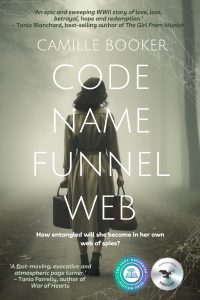
Code Name Funnel Web is a cinematic story of love and loss stretching from WWII’s wartime Australia to war-torn Europe, where Frankie is forced to grow up fast as she’s pulled into a shadow world of secrets, betrayal and reckless courage. The novel pulses with danger and dark beauty—from leafy Australian towns to the cobblestone lanes of the Latin Quarter in Paris and the winding alleyways of Peking, with coded messages, perilous missions, and the emotional weight of a girl discovering what she’s truly made of, all through a distinctly Australian lens.
What drew you to write Gothic Historical Fiction?
To me, gothic historical fiction is about striking imagery, lyrical prose and haunting metaphors, while imparting a feeling of dread or suspense. I’ve always loved gothic settings; atmospheric, moody scenes are so much fun to write because, as writers, we’re constantly forced to think: how do we want the reader to feel while they’re reading this? Horrified? Terrified? A sense of unease? Or will I allow them a little relief?
Gothic historical fiction allows us to explore the murkier, hidden side of history, as was the case with Code Name Funnel Web, a time of internment camps and the deep-seated fear of the ‘other’, as well as the choices women were forced to make during wartime.
I understand that Code Name Funnel Web is a re-release of your debut novel What If You Fly? What’s the story behind that transition?
Yes, this book was first released as What If You Fly? in 2021, right in the middle of the pandemic. Then, at the beginning of 2024, my publisher asked if I would consider removing ten thousand words from the manuscript ahead of its third print run in order to create a second edition. I replied ‘Sure!’ on autopilot. But I didn’t know if I was going to be able to do it, let alone how.
Do I just cut the 10,000 words and hope it makes sense?
Do I have the mental capacity or the time?
Would readers be upset if I released a second edition?
After my initial panic subsided, I reached out to a trusted writer friend who not only read the original version but gave in-depth feedback. She helped me realise that I had two choices: I could either skim words from each page, hoping to find a spare ten thousand to remove; or I could cut it down to its core plot beats and rewrite the book, scene by scene, to ultimately create a richer, deeper version. With her encouragement, I decided to simplify the plot (and my protagonist’s motivation), delete superfluous POV chapters, and develop a deeper sense of place and emotional connection.
Then, in a burst of manic energy, an all-consuming period of creative desperation as though I wanted the new draft completed yesterday, of writing any free moment, of ignoring family members, of bowls of cereal for dinner, of waking at 3AM to scribble down ideas, I completed the first draft in nearly two months. The story is darker, more immersive, and the third act and ending have completely changed. But I hope I have infused the book with a deeper layer of emotion and given readers a more memorable experience.
Sydney, Australia, is a unique setting for a World War II era novel. What was the draw to writing a story in that place?
I was inspired by the anecdotes and stories of my husbands’ grandparents, about what life was like during the war in our little suburb south of Sydney. A time when the ‘war in Europe’ felt far away, a time of unity, of resilience, of women stepping into the roles that their fathers, brothers, and husbands left behind.
This book opens in Como, a tiny but gorgeous suburb nestled on the banks of the Georges River. I’d heard the advice ‘write what you know’, so I decided to give my WWII novel a local setting. I’ve lived in Como my whole life and grew up hearing about the fascinating history of the area. Then I read a biography on Nancy Wake (the Australian war heroine) and felt inspired about her life, courage, and the incredible things she did for the Resistance. I knew I wanted to write a story about the women who played essential roles during WWII. The ingenuity, courage and resilience that these women demonstrated during the war paved the way for generations of Australian women that followed.
Is there a character in your story that you found challenging to create?
Because this novel is focalized through the main character, Frankie, some of the secondary characters were quite challenging. Like Frankie’s brother, Thomas, who we meet at the beginning but then is shipped off to fight in Singapore and goes MIA. Or the Nazi officer Frankie must seduce in Paris. I wanted to ensure they were three dimensional and memorable, with realistic flaws and motivations. This proved challenging, since they don’t get much airtime.
What was your favorite discovery while researching this book?
Just how brave women were during this time. How much they contributed to the war effort. Not only those who joined the SOE and the Resistance, but also the women on the home front who did industrial and agricultural work, who drove ambulances, or who were involved in code breaking. Their unmatched courage, resilience, intelligence, and determination are so often overlooked or overshadowed by men.
 What is the best writing advice you have to share?
When one of my writer friends first introduced me to a ‘draft zero’ (a very rough initial draft written before the first draft) it felt like a lightbulb illuminated above my head. When we give ourselves permission to write terribly, to unload and dump huge sections of bad prose into a document, suddenly the idea of writing a first draft doesn’t feel so terrifying, because we already have an outline, or at least, some rough ideas, of where the story should go.
What is the last great book you read?
Wild Dark Shore by Charlotte McConaghy.

HNS Sponsored Author Interviews are paid for by authors or their publishers. Interviews are commissioned by HNS.