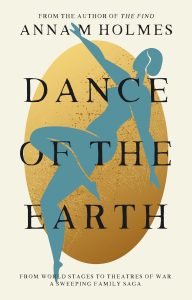
Launch: Anna M. Holmes’s Dance of the Earth
INTERVIEW BY REBECCA ROSENBERG
Stories with big themes written as page-turners are Anna M. Holmes‘s speciality. With an extensive background in dance and theatre, Dance of the Earth is a story she has longed to write. Her novels—The Find, Wayward Voyage, and Blind Eye—are all typified by deep research. Anna worked as a radio journalist before embarking on a career in arts management. She has recently begun reviewing dance performances for German-based Dance for You magazine. Originally from New Zealand, she now lives in southwest London.
How would you describe this book and its themes in a couple of sentences?
With themes of birth, sacrifice, and renewal, Dance of the Earth is a sweeping family saga taking readers from backstage to centre stage and theatres of war.
Dance of the Earth is such a rich, immersive historical novel, spanning decades and touching on major historical events. What sparked the idea for this particular story?
I want to share my love for dance and theatre, a subject I know a lot about. Dance critic, Clement Crisp, fired my interest in the Ballets Russes while I was studying 20th-century history for my Dance MA at London’s Laban Centre in the mid-1980s. Dance has always been a part of my life—as a practitioner, enabler, and educator. Early on I knew The Rite of Spring, 1913, would figure in the story (the title, Dance of the Earth is from Stravinsky’s score), so I started there.
 Your novels are known for their deep research, and Dance of the Earth is no exception. The historical detail, especially the theatre world and World War I, is incredible. What was your research process?
Books, of course! I have accumulated dance history books, and the Royal Academy of Dance library was a place for notes and photos. The Lost Theatres of London, by Raymond Mander and Joe Mitchenson, was a rich source for information. I also read up on social and military history.
At my work desk I have two monitors, one with my writing page, the other ready to explore digital worlds: Wikipedia, theatre playbills, photos of dancers, sets and costumes, articles. And YouTube. At the end of Dance of the Earth, Rose watches The Sleeping Princess at the Alhambra Theatre. While writing that scene I had the Royal Ballet’s, Marianela Nuñez, performing the Rose Adagio on my other screen. The goosebumps of joy I felt became Rose’s own.
The British Newspaper Archive is wonderful. By inputting key words, selecting dates and publications, I could magic-up what I wanted. Diaries of specific regiments were useful military history internet resources, so I knew day by day, where they were while serving at The Front.
Specialist advice is crucial. Jane Pritchard, Theatre and Dance curator at the Victoria and Albert Museum (V&A), provided behind-the-scenes articles on ballets from periodicals of the time. Dr Toby Haggith, Senior Curator at the Imperial War Museum provided information on the music that accompanied The Battle of the Somme 1916 film. Librarians at St John’s School, Leatherhead, and the Royal Academy of Music, provided syllabuses relevant to my character, Walter.
Physically being somewhere can put you in a character’s shoes. When visiting the Coliseum, the splendour of the interior is impactful, and I could imagine Rose on stage. Exhibits at the V&A included a costume from The Rite of Spring and I could imagine Nina sweating as she danced in that heavy woollen fabric. While visiting St John’s School, I took photos and chatted with ‘old boys’. And in Northern France I visited battlefield sites so I knew where the East Surrey Regiment were.
You mention in your author’s note that Dance of the Earth is your most personal novel to date. How did your personal connection to dance influence the development of Rose’s character and her journey?
I recalled the delight I took in the smell of warm greasepaint and the entire back-stage experience. My own home-town theatre in New Zealand contributed to the sensory experiences Rose had at her beloved Alhambra.
The novel spans from 1875 to 1921. How did you approach structuring such a vast timeline, and how did you keep the narrative cohesive?
I consulted the massive tome, The Timetables of History: A Horizonal Linkage of People and Events to create a year-by-year spreadsheet listing key events—dance, arts, literature, society, history, politics, etc., so I knew what world my characters were born into.
Structurally Dance of the Earth is book-ended by christenings and Aurora/dawn themes at the Alhambra Theatre. In 1875 with The Flower Queen playing on stage, a newborn (Rose) is deposited at the stage door. At the end of the story, in 1921, it is Diaghilev’s production of The Sleeping Princess on stage with a middle-aged Rose watching. The middle of the story is when The Rite of Spring premieres in Paris, 1913, a date that is significant for her children. I am grateful for the assistance of editors suggesting where I could tighten scenes or allow scenes to breathe and add more.
The characters in your novel face immense personal and societal challenges. What message do you hope readers take away from their journeys?
The final part of my backcover blurb says, ‘fact and fiction interweave in this tapestry of birth, sacrifice, and renewal. Art—both serious and comic—is at the story’s beating heart’. Dance of the Earth is about the power of art to uplift and heal. Rose insists that pretend worlds matter just as much as the real world. I agree!
 You mentioned your background as a radio journalist and in arts management. How have these experiences influenced your writing?
Perhaps those experiences help me write succinctly and to ask, who is my audience? I’m not someone who enjoys overblown language or too much sentiment. When I started writing, 20 years ago, I wrote speculative screenplays and have been told I have a visual style.
For aspiring historical fiction writers, what’s one piece of advice you’d offer regarding research and integrating it seamlessly into the narrative?
Know your subject front to back, then you can play with it. Some scenes are stronger if you blur facts, but scenes must feel authentic. Writing is about rewriting. Get a first draft down, put it aside, then look at it again with an analytical eye. Repeat. Write. Rewrite.
HNS Sponsored Author Interviews are paid for by authors or their publishers. Interviews are commissioned by HNS.