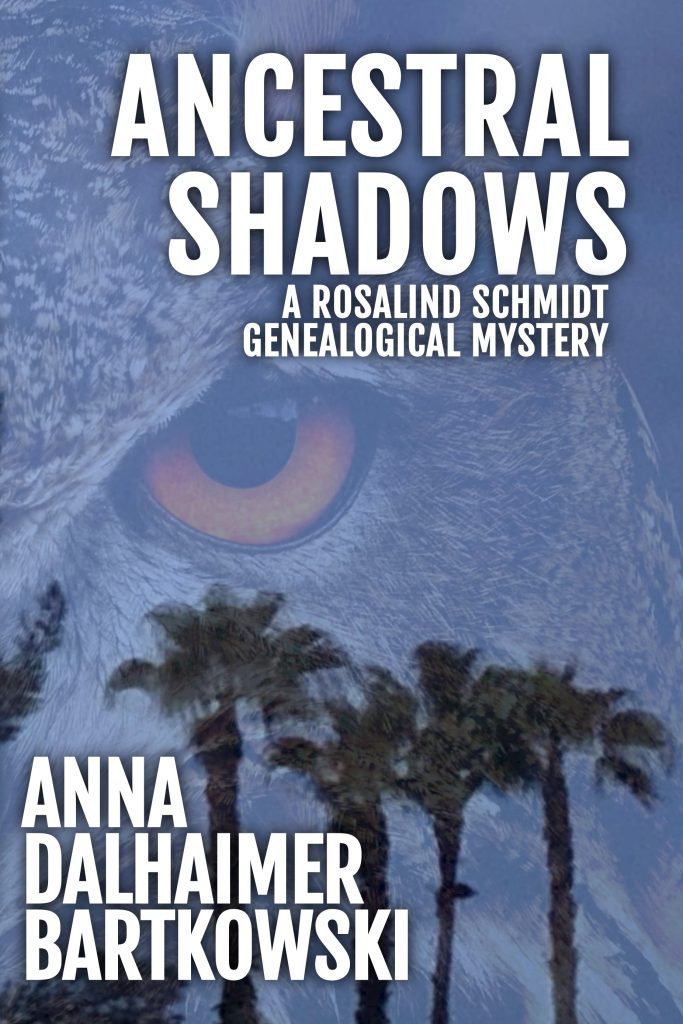
Launch: Anna Dalhaimer Bartkowski’s Ancestral Shadows
INTERVIEWED BY MALLY BECKER
Anna Dalhaimer Bartkowski has chased stories since childhood—first as a wide-eyed kid and later as a passionate genealogist determined to uncover the voices of those who came before her. Her lifelong adventure pieces together family mysteries, connects past to the present, and shares the magic of historical fiction.
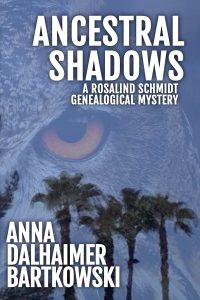 How would you describe this book and its themes in a couple of sentences?
Ancestral Shadows is a mysterious family saga that weaves genealogist Rosalind Schmidt’s present-day investigation to find her aunt’s biological parents with the eighteenth-century lives of her ancestors, German settlers in Russia. At its heart, the novel explores how family stories and secrets, loss, resilience, and memory continue to shape generations later.
Before reading your book, I knew nothing about German immigrants in Russia nor about the Kirghiz attacks in the eighteenth century. What about that specific event sparked your interest in making it the centerpiece of this novel?
My grandmother shared stories about her life growing up in Mariental. She told me that my grandfather, Johannes, wrote the Kirghiz story in 1906 as told to him by his father, Nickolaus Dahlheimer. The story, entitled The History of Mariental, told how the attacks dramatically altered the lives of ordinary German families and was preserved in the Russian archives. Years later, after the Russian archives opened to the west, I secured a copy, and the whole event suddenly felt much closer to home.
So I had to make it the centerpiece of this book to honor my ancestors and great-grandfather. I wanted readers to experience what it felt like to face such uncertainty and hardship. The attack became the perfect backdrop for exploring survival, family loyalty, and how historical trauma can be inherited across generations.
Your protagonist, genealogist Rosalind Schmidt, dreams of ancestors and places she couldn’t know. Do you think genetic memory is real?
To me, genetic memory is real—it’s built into our DNA. Yet I intentionally leave it open in the book for readers to ponder. I’m fascinated by the idea that memory and experience may echo through generations in ways we don’t fully understand.
You write that “Rosalind’s ancestors are fictional characters based on the ancestry of my family.” Is there one of your actual ancestors who inspired you the most as you wrote Ancestral Shadows?
Several ancestors influenced the story, but I was especially inspired by the courage of the German colonists who left their homes in Europe and traveled thousands of miles into an uncertain future in Russia. Their willingness to embrace risk, endure hardship, and build new lives for their families continues to amaze me.
My fourth great-grandfather, Christoph Dalhaimer, was the inspiration for Christoph Schmidt. Telling his story from the Germanic states required a strong central character—someone who had endured the hardships of the Seven Years’ War, lost his family, and lost his fortune, making the move to Russia the best decision he could make. Christoph was that character, so I gave him my real ancestor’s first name.
Other ancestors—the Herrmans, the Reimers, the Herzogs, the Wächters—all inspired stories throughout the Rosalind Schmidt books.
Do you ever let yourself change history for the sake of your story?
I strive to remain faithful to the historical record because our readers deserve an authentic experience.
That said, fiction allows us to create imagined characters who move through real events. I may compress timelines, combine minor historical details, or invent personal experiences that could reasonably have occurred. My goal is always to preserve the truth of history while telling a compelling story.
Russia used the Julian calendar until February 1918, while most other countries switched to the Gregorian calendar in 1582 under Pope Gregory XIII. As a result, the dates of the Kirghiz attacks vary across the histories. My great-grandfather wrote that the attack occurred on Assumption Day in 1774, so I chose that date, though multiple sources suggest other years in the 1770s.
Any storylines or dates that don’t precisely match the recorded history are noted in my acknowledgments, where I explain my reasoning.
For writers interested in incorporating genealogy into historical fiction or historical mystery, what common mistakes should they avoid, and what one or two solid sources might they be overlooking?
One common mistake is treating genealogy as names, dates, and charts. Readers care about people, not pedigrees. The challenge is transforming records into living, breathing characters with desires, fears, and conflicts.
Rosalind encounters details about her family that aren’t quite what they seem—and that’s a lesson for writers, too. Some assume that if a record suggests something, it must be true. It’s essential to find a corroborating source for every assumption.
Another mistake is overlooking local records and community histories. Some of the richest details come from church records, county histories, newspapers, probate files, land records, and historical maps.
For German-Russian research, colony histories and church registers are invaluable. Writers should also spend time learning about the social and cultural context surrounding their ancestors, rather than focusing solely on individual facts.
 What is the best writing advice you have to share with new historical fiction writers?
Fall in love with the questions, not just the answers.
Historical fiction begins with curiosity. Follow the mysteries, contradictions, and gaps you encounter in your research. Ask what happened, why it happened, and how it felt to the people who lived through it. Trust your instincts and meditate on the questions that are hardest to answer.
I’m also a strong advocate for paying attention to your dreams—both figuratively and literally. I’ve tracked my dreams for decades and gain incredible insight by paying close attention to them. Use those nocturnal hours to tap into creativity we can’t always access during the day. That’s why I developed Dreams Remembered: A Guided Journal for Seekers, Writers, and Genealogists. Setting an intention each evening and recording your dreams can help you craft better stories—and understand your own journey more deeply.
Research thoroughly but remember that your ultimate responsibility is to tell a compelling story. Facts provide the foundation; empathy and imagination bring history to life.
What’s the last great book you read?
The Last Green Valley by Mark Sullivan

HNS Sponsored Author Interviews are paid for by authors or their publishers. Interviews are commissioned by HNS.