India in Children’s Historical Fiction
WRITTEN BY ANN LAZIM
 There has been an increase in UK children’s publishing in books that are set in India and also some that feature characters of Indian/South Asian heritage in a UK historical setting. This includes a recent mini trend in historical fantasy novels that are set in a 19th century “alternate colonial India”. I set out to explore the possible reasons for its emergence within the context of current children’s literature that links India and Britain.
Only a few years ago, there were few UK-published children’s books by South Asian heritage authors. Exceptions included novels by Jamila Gavin, particularly her Surya trilogy, set at the time of partition, available in new editions to mark the 30th anniversary of The Wheel of Surya (Methuen, 1992; Farshore, 2022). The pain of partition has also been addressed more recently in a short novel, Torn Apart by Swapna Haddow (Scholastic, 2021), that focuses on two boys, one Hindu and one Muslim, who meet briefly at the height of the chaos caused by the manner of the British withdrawal from India, dividing the country in two and using an arbitrarily drawn line to do so. Following a dearth of children’s fiction about this significant subject, Hiba Noor Khan’s The Line They Drew Through Us (Andersen Press, 2025) is soon to be published. Speaking of her forthcoming book in a recent interview, Hiba says of the theme of partition: “It is something that if I had understood in a deeper sense when I was young would have been very empowering and important for me to learn about me, as well as everyone around me learning about it.”1 Her previous novel Safiyyah’s War (Andersen Press, 2023), relating how Muslims in Paris helped their neighbours escape Nazi persecution during World War Two, received many plaudits.
Bali Rai’s early novels were mostly set in modern multicultural Britain, although his City of Ghosts (Doubleday, 2009) focuses on the Amritsar massacre in 1919. At SAILFest2, a recent conference of South Asian heritage children’s authors, Bali said that he thought the lack of interest in City of Ghosts when it was first published meant that it had been the “wrong” time for a brown person to write this book in terms of what mainstream publishing expected and revealed that he is now writing a sequel. Bali Rai’s writing has also played a role in highlighting previously lesser-known people of colour in history and their experiences with books about Indian soldiers in both World Wars and The Royal Rebel about the suffragette Princess Sophia Duleep Singh (Barrington Stoke, 2021).
Sufiya Ahmed has also written about the latter, and the producers of the 2023 Reflecting Realities report3 had this to say about her work within the wider context of their research on the “production of historical fiction that reimagines, reframes and counteracts the traditional erasure or marginalisation of the presence and perspective of racially minoritised figures and communities”: “The review team gained important insights from Sufiya Ahmed’s invaluable contribution to this genre through Rosie Raja: Churchill’s Spy (Bloomsbury, 2022). Ahmed has been steadfast in her commitment to shining a light on South Asian female figures, both imagined as in the case of Rosie and real life as featured in her title My Story: Princess Sophia Duleep Singh (Scholastic, 2022).”
The findings of the Reflecting Realities research have influenced an increase in ethnic minority characters in children’s books, although the representation of Asian characters is still low in comparison with their percentage in the population. The reimagining and reframing mentioned above is also linked to the re-examination of history, especially colonialism, going on more widely in society. The publication of books that address colonialism goes wider than India, but there is a strong link due to the connections with the British Empire. Notable attempts to explain the colonial past to children in accessible ways have been made by Sathnam Sanghera’s Stolen History: The Truth About the British Empire and How It Shaped Us (Puffin, 2013), published in the wake of his bestselling book for adults, Empireland (Viking, 2021), and Shelina Janmohamed’s Story of Now: Let’s Talk about the British Empire (Welbeck, 2023).
The Asian diaspora that followed the end of the British Empire has gradually resulted in more authors of South Asian heritage – some of whom were born in the UK or came when they were young children, some of whom are second or third generation. A number of them had previous professional careers in medicine, the law or engineering before becoming children’s authors.
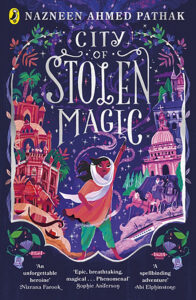
Against this background, I became aware of the role of historical fantasy when two books came to my notice almost simultaneously – The Destiny of Minou Moonshine by Gita Ralleigh (Zephyr, 2023) and City of Stolen Magic by Nazneen Ahmed Pathak (Puffin, 2023). In The Destiny of Minou Moonshine Minou is a foundling who lives with her adopted grandmother in Moonlally, formerly a queendom, but now ruled by an autocratic general. The place names are invented, although the map of “Indica” at the beginning of the book clearly suggests the shape of southern India, and connections with India are evoked in several ways. The division and power imbalance between Blacktowners and Whitetowners is highly suggestive of the colonial connections between Europe and India. There is an airship named Napoleon, and while the date is never mentioned, the inclusion of this invention suggests a time frame of the 1850s onwards, and there are details that enable readers to draw parallels with historical events if they wish. Gita has gone on to publish The Voyage of Sam Singh (Zephyr, 2024) which takes place in the same alternate world (see review by Louise Tree in HNR August 2024). In a conversation I had with Gita about her work, we talked about how attitudes towards colonialism in children’s literature have changed and the importance of children knowing about this as a part of British history.
She started writing The Destiny of Minou Moonshine in 2016 but, disheartened by increased racism in Britain associated with Brexit, she abandoned it until encouraged by her agent to go back to it. Her own reading of fiction featuring India and the British Empire included Rudyard Kipling’s Kim and Wilkie Collins’ The Moonstone and, of more recent vintage, Philip Pullman’s The Ruby in the Smoke (1987) gave her a double perspective of reading about India through British eyes. In writing an “alternate” history, using snippets from real history mixed with fantasy, she drew inspiration from the work of Joan Aiken. Gita believes that crossing boundaries in this way is more allowed in children’s fiction.
Like a number of authors of colour who started writing because their childhood selves and their own children could not find themselves in a book, this was part of Gita’s motivation. She wanted to write a colonial adventure centring a child of colour. This was also behind the creation of Nazneen Ahmed Pathak’s City of Stolen Magic which is explicitly set in 1855 (reviewed by Marion Rose, HNR February 2024).4 Speaking at the inaugural SAILFest, Nazneen said that she wrote the book so that her own child could see themselves in a story. As a child she rewrote classics like The Secret Garden and The Little Princess in her head with South Asian girls as the main characters. But until she was in her thirties, she “had no idea how colonialism had been responsible for establishing the migrant community I am part of”. Both Gita and Nazneen believe that the fantasy element gives their characters agency, and Nazneen says that writing about history through the eyes of fantasy allows for the realm of the possible, such as magical children bringing down the British Empire. She plans further stories about the characters in City of Stolen Magic.
The creation of stories connecting India and Britain in an alternative 19th-century world continues. Jasbinder Bilan’s first novels had contemporary settings with an element of magic. However, her latest novel Nush and the Stolen Emerald (Chicken House, 2024) has a 19th-century colonial India setting (also reviewed in HNR, August). Piu DasGupta’s Secrets of the Snakestone (Nosy Crow, 2024) features a central character Zélie Dutta, who is from Calcutta working as a maid in Paris during the Belle Époque in 1895.
The increase in children’s fiction that challenges earlier narratives about the colonial relationship between India and Britain and gives voice to writers of South Asian heritage is to be welcomed. It is important that it continues and is not seen only as a temporary trend. The way in which writers are working collectively to support and promote each other’s work is a very positive development and many of them believe that their stories have parallels with what is happening in the world today, that historical novels are often about now rather than then.
References:
- Rob Green, “Seeking truth in the hidden depths of life”, Pen & inc. Autumn/Winter 2024, pp. 9-11
- SAILFest is a new group bringing together UK-based South Asian heritage creatives of children’s literature. They held their inaugural conference on 6 September 2024. https://www.sailfest.org.uk
- Reflecting Realities is a research project based at the Centre for Literacy in Primary Education in London which has produced annual reports about diversity in UK children’s literature since 2018: https://clpe.org.uk/research/reflecting-realities
- This interview about Nazneen’s book and how she came to write it is very informative: https://easterneye.biz/nazneen-ahmed-pathak-telling-stories-of-a-history-we-need-to-know-and-talk-about/
About the contributor: Ann Lazim is UK Children’s & YA Reviews Editor for HNR. A retired children’s and education librarian, she is involved in IBBY (International Board of Books for Young People) and a jury member for NEEV Children’s Book Award, India.
Published in Historical Novels Review | Issue 110 (November 2024)