Despite Our Differences: When We Were Divided by Liz Flanagan
 BY CLARE RHODEN
Liz Flanagan, a British novelist from Hebden Bridge, West Yorkshire, is best known for her fast-paced teenage fiction and highly successful fantasy adventures for young children. Flanagan’s writing is inspired by the beautiful landscape of her hometown and a lifetime of voracious reading. She has won several awards, including a UKLA Award in 2024.
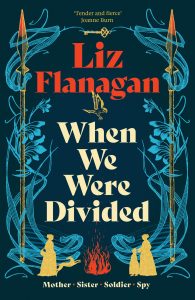
When We Were Divided (Fox & Ink Books, February 2026) is Flanagan’s first adult novel and first historical fiction, and shows how civil war affects the lives of three ordinary people. Set in 1643 England, when massive societal disruption causes family division and grief, the novel charts the long road to forgiveness and reconciliation between two divided sisters. ‘I began by immersing myself in research – to the point that I almost gave up before I started writing!’ comments Flanagan. ‘I could spend the rest of my life researching this complex era and still not know “everything”.’
The idea for the novel developed during the COVID-19 pandemic, and was also instigated by the surrounding countryside of Flanagan’s home. The book is ‘a hymn to the Yorkshire landscape I love, which has held me all my life, including through my most difficult days when walking these hills kept me whole … I trudged up the Buttress almost every day in 2020, heading out to walk my dogs through the lockdowns of that year and the next, and I recalled the battle that had happened there.’
The fabric of the novel, she explains, was woven from that fixed starting point, the Battle of Heptonstall. Although most of the story is set in 1643, just after the start of the Civil War, the prologue reflects back to 1631 when Heptonstall endured an outbreak of the plague. Flanagan remarks: ‘Can you tell I started writing in 2021 when the world was enduring a terrible pandemic?’
Our own recent real-time experience with an infectious world finds echoes in these pages, making the scene very relatable. ‘It’s my way of processing the pandemic years,’ explains Flanagan. ‘I can see now how the terrible anxieties of that time have seeped into the story.’
However, When We Were Divided is a historical novel, not a book of history, so the next element of writing was to create characters to interact with the important events of the time. ‘There’s no story without character,’ says Flanagan. ‘I usually begin with a main character and the question that is preoccupying them. In this case, the whole story was defined by difference and division.’
The action takes place in Yorkshire and Lancashire, with three narrators: sisters on opposing sides, Jane and Isabel, who have been torn apart by loss, and Kit, a soldier who enlists in order to survive the dangerous times, having no surviving family. Each of these perspectives unfolds through a different mode (past-tense, present-tense, and first-person narratives), a superb writing strategy which helps to clarify and cement the characters’ different experiences and responses.

author photo by Sarah Mason
Flanagan’s characterisation process was ‘to write out a long table of contrast points between (sisters) Jane and Isabel which covered their personalities, their place within family relationships, their attitudes to religion and domestic work and many other different preferences which never even made it into the story.’ As for the third main character: ‘Kit’s gender is a question throughout the story so I needed those sections to be in the first person, to avoid attributing a gendered pronoun. Later, Kit is gendered by others, because of the clothes or assumptions used, but it was a particular challenge to write around … And Kit is the one who encounters the most action and violence in the story, so the present tense seemed to work well to convey the confusion of battle, for example.’
Flanagan was particularly interested in how women faced the limitations placed upon them, and how education and class impacted the available choices. ‘It was only after finishing drafting that I appreciated quite how many similarities there are between the 1600s and the present day,’ she says. Then as now there were ‘crises over new technology spreading “fake news”; urgent political questions about democracy and rule of law; outbreaks of disease, and devastating quarantines.’
While the situational specifics of the 17th century and the 21st century are very different, Flanagan wanted to focus on resilience and recovery: ‘How do we recover from this terrible grief? How do we forgive each other, even after these awful wrongs? How do we live together, despite our differences? Those questions don’t feel very different from today at all.’
Flanagan believes historical fiction is essential to helping us understand the women of the past. Novels can bring to life a moment in history and help us to appreciate how people in the past faced dilemmas just as we do. ‘Of course, our research might be imperfect,’ she admits. ‘Of course, we will be projecting our own beliefs onto the past. But still, the best historical fiction walks a line between what we know and what might have been, and it simply has to be persuasive. For me, trust is built when I am convinced the creator knows enough about the time period for me to believe in their leaps of imagination.’
Flanagan found herself enthralled by the world of the novel. ‘Imagining the women who lived in this landscape and left it long ago, I found great comfort in thinking that their experiences might mirror ours. That we are not the only ones who have felt we are living through unprecedented times. That we are not the only ones who consume national news hungrily, fearing a slide towards conflict, who think “how can they believe that?” of friends, family or neighbours. By writing a story that ends with the sisters each making a deep effort to understand the other and to reconcile, love and forgive, in spite of everything, I see perhaps I was writing this message to myself.
‘Yes, even when it’s hard, even now, even when you think you’re right, you must make that effort of hearing the other person, so that you may no longer be divided,’ she adds.
About the contributor: Clare Rhoden is a writer, editor and reviewer from Melbourne Australia. Her PhD investigated Australian literature of the Great War. Her WWI novel The Stars in the Night was published in 2019. Her latest novel is a mystery for younger readers, and she is currently working on a fantasy trilogy.